how to follow up no response email: Get replies fast
·
It’s a feeling we all know: you craft the perfect email, hit send, and then… crickets. Your first thought might be that they’re just not interested, but the real reason is usually a lot less personal. The truth is, the modern inbox is a war zone for attention.
Why Your Emails Get Lost in the Shuffle
Most professionals are just plain swamped. Think about it—the average office worker gets hit with over 121 emails every single day, according to a Radicati Group report. Your message isn’t just one email; it’s one of a hundred others all fighting for a few seconds of their time. It’s not about being ignored; it’s about getting buried.
When you don’t get a reply, it’s rarely a hard “no.” It’s usually a “not right now.” Understanding this is the first step to mastering the follow-up.
The Usual Suspects for Radio Silence
So, why did your first email get lost in the noise? It typically boils down to a few common culprits:
- Inbox Overload: Your email landed during a crazy-busy part of their day and was quickly pushed down the screen by a flood of other messages. Data from Superhuman shows that the average person only responds to 30% of the emails they receive.
- A Fuzzy Call to Action: The person on the other end wasn’t totally sure what you needed from them. Vague requests like “Let me know your thoughts” are easy to put off and even easier to forget because they require more mental effort.
- Bad Timing: Sending an email late on a Friday or first thing Monday morning is like throwing it into a black hole. Studies from Boomerang suggest the best time to send an email for a high open rate is between 6 AM and 7 AM on a weekday.
- The dreaded Spam Folder: Sometimes, it’s a technical glitch. Your email never even made it to their inbox. That’s why it’s so important to understand how to improve email deliverability to make sure you’re not getting filtered out.
The trick is to stop thinking of your follow-up as a pushy demand. Instead, see it as a helpful, professional reminder. You’re simply bringing your message back to the top of their pile and making it easy for them to respond.
This isn’t just a hunch; the numbers back it up. A study by Iko System found that campaigns with just a few follow-ups can boost reply rates by over 65%. Yet, a Hubspot report indicates that an incredible 48% of salespeople give up after just one email, leaving a massive opportunity on the table. A smart follow-up isn’t just polite—it’s a powerful strategy that gets results.
Finding the Perfect Follow-Up Cadence
Timing your follow-up is an art. Go in too hot, and you come across as desperate or just plain annoying. But if you wait too long, your original message is ancient history, buried under a mountain of other emails. There’s no magic formula here; the right approach really depends on the situation.
Think about it: after a job interview, you’d send a quick thank-you note within 24 hours, but a real follow-up should probably wait a week. On the other hand, if you’ve sent a time-sensitive sales proposal, checking in after 2-3 business days makes perfect sense. Showing a little patience proves you respect their time and aren’t just adding to the inbox chaos we all face.
Mapping Your Follow-Up Sequence
Instead of firing off random reminders, it pays to have a plan. A structured follow-up sequence helps you stay persistent without becoming a pest. The general idea is to gradually space out your messages over time.
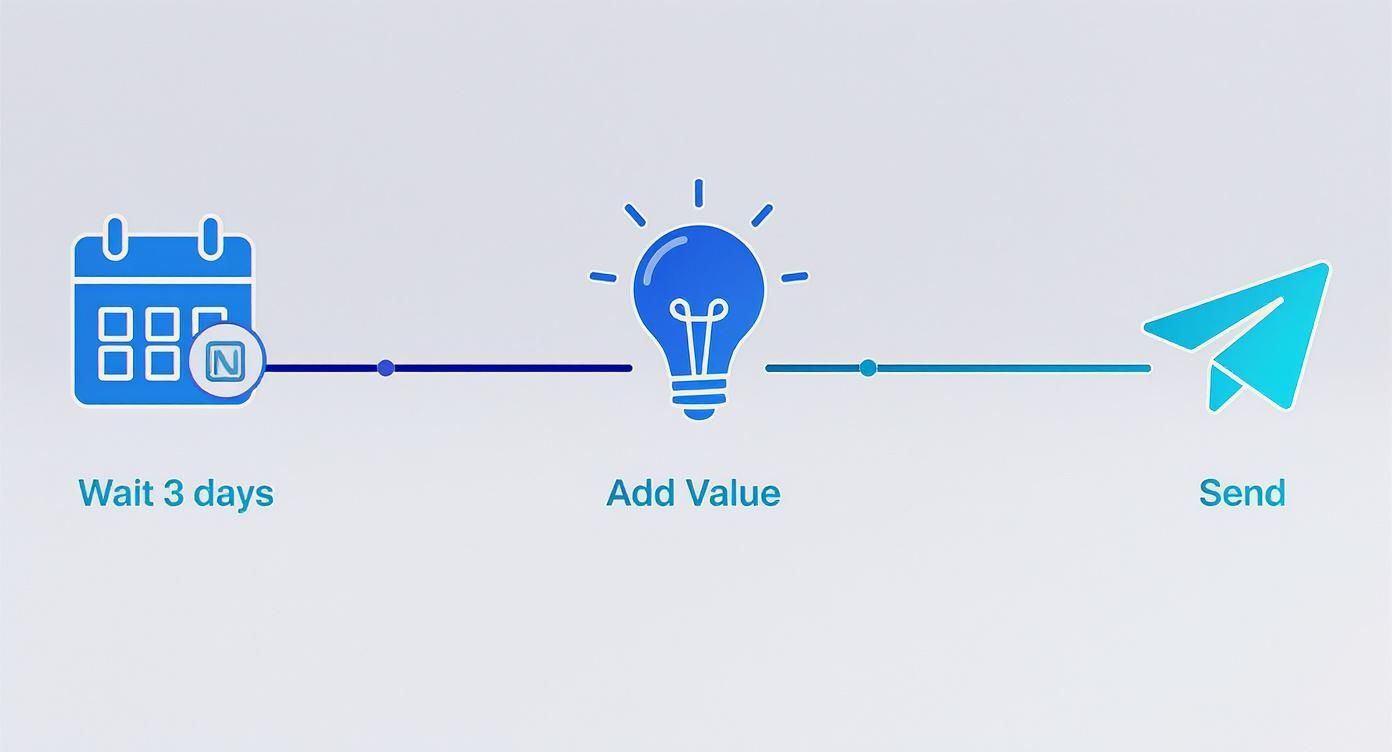
This infographic lays out a simple but really effective timeline for that first follow-up.
As you can see, the core principle is to give them a few days to breathe before you send a message that offers something new, not just a “did you see my last email?” nudge.
A tried-and-true cadence often looks something like this:
- Email 1: The initial outreach.
- Email 2: A gentle follow-up after 3-4 days.
- Email 3: Another check-in after 5-7 days.
- Email 4: The final, “breakup” email after another 7-10 days.
This kind of schedule keeps your name in front of them without making them want to hit the spam button.
The Data Behind Persistence
So, when is the best time to follow up? The numbers tell a pretty clear story. Persistence definitely pays off, but there’s a point where you get diminishing returns.
A well-known sales study by Yesware found that a single follow-up email can boost replies by 30%, and a second one can add another 21%. However, success plummets after the third or fourth attempt, and spam complaints can increase significantly after the fourth message.
The takeaway is clear: A sequence of two to three well-timed follow-ups is the sweet spot for maximizing your chances of a reply without damaging your professional reputation.
This strategic patience shows you’re serious about getting noticed but professional enough to know when to back off. If you want to get this just right, you might consider a tool like Fin AI for automated email follow-ups to handle the scheduling. Automating the process ensures you never miss a touchpoint and frees you up to focus on writing messages that actually add value.
Crafting a Subject Line That Actually Gets Your Email Opened
If your subject line is weak, your follow-up is dead in the water. It’s that simple. Think about it: in a sea of unread messages, your subject line is the one thing that can earn you a click. In fact, data from Invesp shows that 47% of people decide whether to open an email based on the subject line alone. Get it wrong, and your message might as well be invisible.
The first choice you have to make is a big one: do you reply to the original email or start a completely new thread?
For the first couple of nudges, I almost always recommend replying in the same thread. It’s a clean, efficient way to keep the conversation history bundled together. This gives your contact instant context, saving them the hassle of digging through their inbox to remember who you are and what you talked about.
When to Reply vs. When to Start a New Thread
Sticking with “Re: [Original Subject]” is your safest and most effective bet most of the time. It’s a subtle but powerful reminder of your previous chat and keeps everything neatly organized. This works best when the context of that first email is still fresh and relevant.
But what if you’ve already sent a follow-up or two with no luck? That’s when a fresh start can make all the difference. A brand-new subject line signals a different approach and can cut through the “inbox fatigue” they might feel seeing the old thread pop up again. A new, punchy subject line can grab their attention in a way the old one no longer can. If you want to really get into the weeds on this, there are some great email subject line best practices that can give you an edge.
Real-World Subject Line Examples That Work
The perfect subject line is all about the context. A sales follow-up needs a completely different vibe than a friendly check-in after a networking event. Let’s break down some examples I’ve seen work time and time again.
For Sales and Outreach
- “Quick question about our chat on [Topic]”: This works well because it feels personal, direct, and implies the email is short and easy to handle. Subject lines phrased as a question often have higher open rates.
- “Following up on the [Company Name] proposal”: This is all business. It’s professional, provides instant context, and gets straight to the point for a busy executive.
For Networking Follow-Ups
- “Great connecting at [Event Name]”: This immediately places you in their memory. They’ll know exactly who you are and where you met. It’s a warm, personal touch.
- “Following up from our conversation”: Simple and polite. This works great if you had a particularly good chat that you’re confident they’ll remember.
For Job Seekers
- “Following up on my [Job Title] application”: No fluff here. It’s direct, professional, and makes it incredibly easy for a recruiter to file and find your message.
- “Re: Interview on [Date]”: This is the gold standard for post-interview follow-ups. Keeping the conversation in one thread is just good etiquette and helps the hiring manager stay organized.
The secret to a killer follow-up subject line isn’t about being clever or mysterious. It’s about being clear, relevant, and brief. Your goal is to give them just enough context and spark just enough curiosity to earn that click. Think of it as a helpful nudge, not an annoying knock at their digital door.
Crafting Follow-Up Emails That Get Replies
So, your killer subject line worked and they opened the email. Great. Now comes the hard part: writing a message that actually gets a response. The body of your follow-up is where you have to prove you’re worth their time. The secret isn’t just to “check in”—it’s to be brief, clear, and genuinely helpful.
The best follow-ups I’ve ever seen—the ones that actually work—get straight to the point without being pushy. A quick, polite opening that reminds them of your last email is all you need to set the scene.
The Anatomy of a High-Impact Follow-Up
An email that gets a reply really only needs three things: a gentle reminder, a piece of new value, and a super clear call to action. Forget about rehashing your entire original pitch in long, winding paragraphs. Your goal here is to be a helpful nudge, not a broken record.
Here’s a simple breakdown of how to structure your message:
- Start with Context: Kick things off by briefly mentioning your last interaction. Something as simple as, “Just circling back on my email from last week about…” works perfectly. It instantly jogs their memory.
- Add New Value: This is where most people drop the ball. Instead of just asking, “Did you see my last email?” give them something new. It could be a link to a relevant case study, a surprising industry statistic, or a useful tip you thought of that relates to their business.
- End with a Clear, Low-Friction Ask: Make it dead simple for them to respond. Ditch vague questions like “What are your thoughts?” and ask something direct that requires a simple “yes” or “no” or pointing you to the right person.
A great follow-up should feel less like a demand for a response and more like a helpful contribution to their day. By adding value, you shift the dynamic from asking for their time to earning it.
Personalization Beyond the First Name
This is the real game-changer. I’ve seen firsthand how a little personalization can make a massive difference. While general marketing emails have an average open rate of around 21%, highly personalized campaigns can see open rates jump to 40% or higher. That’s the power of making your recipient feel like you’re talking directly to them.
Instead of just using {First.Name}, try referencing something specific:
- A recent company announcement or funding round. (Example: “Congrats on the recent Series B funding!”)
- A post they shared on LinkedIn. (Example: “I really enjoyed your recent post about the future of AI.”)
- A cool project mentioned on their website. (Example: “I was impressed by the case study you published with Acme Corp.”)
This small bit of effort shows you’ve done your homework and aren’t just blasting out a generic template to hundreds of people. For more detailed advice, we have a whole guide on how to follow up politely in an email.
Follow-Up Template Comparison for Different Scenarios
Not all follow-ups are created equal. The tone, goal, and call to action need to change depending on whether you’re chasing a sales lead, connecting with a new contact, or checking on a job application. This table breaks down how to approach each situation.
| Scenario | Key Objective | Sample Opening Line | Call to Action |
|---|---|---|---|
| Sales | Re-engage a lead and demonstrate value. | ”Hi [Name], I was just reading an article on [Topic] and thought of our conversation about your team’s goals…" | "Are you free for a quick 15-minute call next Tuesday to discuss how this might apply?” |
| Networking | Build the relationship and stay top-of-mind. | ”Hi [Name], it was great meeting you at [Event]. I really enjoyed our chat about [Topic]…" | "I’d love to continue the conversation sometime. How does your calendar look for a coffee next week?” |
| Job Application | Express continued interest and professionalism. | ”Hi [Name], I hope you’re having a great week. I’m writing to follow up on my application for the [Job Title] role…" | "I’m still very interested in this opportunity. Is there any additional information I can provide to help with the decision?” |
As you can see, the core components are the same—context, value, and a clear ask—but they’re adapted to fit the specific goal. A sales email is direct and value-driven, while a networking email is more about building rapport.
Practical Examples That Get Replies
Let’s look at a quick “before and after” to see this in action.
The Nagging Follow-Up (Don’t do this):
Subject: Re: Following Up
Hi Jane,
Just wanted to check in and see if you had a chance to look at my previous email.
Let me know if you have any questions.
Best,
John
This email is a one-way ticket to the trash folder. It offers zero value and puts all the work on Jane to remember who you are and what you wanted.
The Value-Driven Follow-Up (Do this instead):
Subject: Re: Quick question about [Company Name]‘s content strategy
Hi Jane,
Hope you’re having a productive week.
I was just reading a Gartner report about [Relevant Topic] and thought of your team. It mentioned that companies using [Specific Strategy] saw a 25% increase in engagement, which reminded me of our conversation.
Would you be the right person to chat briefly about this, or should I reach out to someone else on the marketing team?
Best,
John
See the difference? This version is helpful, offers a new insight, and ends with a simple question that’s easy to answer. Of course, this is just one piece of the puzzle. For a broader look, these strategies for crafting the perfect email to get a response are a fantastic resource. Once you master these techniques, you’ll know exactly how to follow up on a no-response email in a way that feels professional, respectful, and incredibly effective.
The Art of the Final Follow-Up Email
Persistence is a superpower in sales and networking, but there’s a fine line between being persistent and becoming a pest. Knowing when to send that final email is just as crucial as knowing when to send the first one.
A fascinating study from Yesware revealed that while a staggering 70% of email chains stop after just one email, sending more than five follow-ups often has a negative impact on reply rates. Your last email isn’t a final, desperate plea. It’s a strategic move to close the loop with professionalism and grace.
This last message is what many people call the “breakup email.” The goal is simple: politely acknowledge that you haven’t heard back, let them know you’re closing the file on your end, and leave the door open for them to re-engage later. You’re not trying to make them feel guilty; you’re showing that you respect their time and their silence.
Why the Professional Close Works
Here’s the interesting part: this no-pressure approach is often the one that finally gets a response. According to data, breakup emails can have reply rates as high as 33%. When you remove the “ask” and just signal that you’re moving on, it can create a subtle fear of missing out (FOMO). People who were genuinely interested but got swamped with other priorities are often prompted to finally reply before the opportunity disappears.
This email does a few important things for you:
- Protects your professional image: It shows you’re organized, respectful, and not desperate.
- Cleans up your pipeline: You can officially mark the lead as cold and redirect your valuable energy to more promising prospects.
- Leaves a great final impression: By being polite and professional, you ensure that if their situation changes down the road, they’ll remember you in a positive light.
The goal of the final email isn’t just to get a reply—it’s to end the conversation on your terms, preserving the relationship for any future opportunities. Never burn a bridge.
How to Write Your “Graceful Goodbye”
Your last email should be short, friendly, and to the point. You’re just letting them know you get the message (or lack thereof) and won’t be bothering them anymore, but you’re still available if they need you.
Here’s a simple, field-tested template you can adapt.
Subject: Re: Checking in
Hi [Name],
I’ve reached out a few times about [Topic] but haven’t heard back, so I’ll assume your priorities have shifted.
I won’t follow up again, but please feel free to get in touch if this becomes relevant for you in the future.
All the best to you and the team at [Company Name].
Best,
[Your Name]
This works because it’s not accusatory or passive-aggressive. It’s a polite, professional way to put the ball in their court for good, concluding your follow-up efforts on a high note.
Answering Your Top Follow-Up Email Questions
Even with a solid plan, you’ll run into situations that make you pause. What’s the right move? Knowing how to follow up after getting radio silence often comes down to handling a few common scenarios with a bit of finesse.
Let’s walk through the questions I get asked most often. Think of this as your field guide for those tricky moments when you’re staring at your screen, wondering what to do next.
How Long Should I Wait Before the First Follow-Up?
The honest answer? It depends entirely on why you emailed them in the first place. There’s no single magic number, but a good rule of thumb is to let a few business days pass.
For most sales outreach or business inquiries, I’ve found that waiting 2-3 business days is the sweet spot. It gives your contact enough time to see and process your email, but not so long that it gets completely buried. Bumping it up in their inbox within 24 hours can feel a bit desperate.
But if it’s something less urgent, like a networking connection or a casual check-in, stretching that to 5-7 days is perfectly fine and shows you respect their time.
The goal is to be a helpful reminder, not a source of pressure. Give your contact enough breathing room—it shows you understand they’re busy, just like you.
Should I Reply in the Same Thread or Start a New One?
This one’s easy. For your first couple of follow-ups, almost always reply within the same email thread. It’s a simple move, but it makes a huge difference.
Why? Because it keeps the entire conversation in one neat package. You’re saving them the hassle of digging through their inbox to remember who you are and what you wanted. It makes their life easier, which makes it easier for them to respond.
A new thread can easily look like another cold, unsolicited email—the kind that gets deleted on sight. The only time I’d start a fresh one is if the topic has totally changed or if you’ve sent a few follow-ups with no luck and want to try a completely different subject line as a last-ditch effort.
What’s the Best Call to Action for a Follow-Up?
The most effective call to action (CTA) is simple, crystal clear, and asks for as little effort as possible. I see so many people fumble here with vague, open-ended questions like, “Let me know your thoughts.” That feels like you’re assigning them homework.
Instead, you need to propose a specific, low-friction next step. Here are a few examples that actually get replies:
- To book a meeting: “Does a quick 15-minute call on Tuesday or Thursday work for you?” This is an example of a “closed question” that makes scheduling simple.
- To find the right person: “If this isn’t in your wheelhouse, could you point me to the right person to discuss this with?” This gives them an easy way to help you even if they can’t say “yes.”
- To gauge their interest: “Is this still a priority for you right now?” A simple yes/no question is easy to answer and gives you a clear signal.
The easier you make it for them to give you a straight answer, the more likely you are to actually get one.
How Do I Mention I Haven’t Heard Back Politely?
Your choice of words here is everything. You have to avoid any language that sounds even slightly accusatory or tries to make the recipient feel guilty for being busy.
Stay far away from phrases like “Since I haven’t heard from you…” or “You didn’t reply to my last email.” They just come across as passive-aggressive, even if you don’t mean them to.
Instead, go for something gentler and more professional. Assume good intent—that they’re just swamped.
Here are a few phrases I use all the time:
- “Just wanted to follow up on my previous email.”
- “Circling back on this when you have a moment.”
- “Gently bumping this to the top of your inbox.”
This approach keeps the tone positive and respectful. It positions you as a helpful professional, not an impatient pest.
Navigating the world of outreach requires more than just good email etiquette; it demands timely and relevant prospects. FundedIQ delivers hand-curated lists of recently funded startups, giving your team direct access to companies with clear buying signals. Stop guessing and start engaging high-intent leads at the perfect moment. Find your next customer on FundedIQ.