What Is Growth Hacking a Complete Guide
·

Growth hacking is all about one thing: rapid, measurable business growth. It’s a highly focused, data-driven process that involves constant experimentation across marketing, product development, and sales to find the most effective and efficient ways to scale. You can think of it less like traditional marketing and more like applying the scientific method to growing a company.
What Is Growth Hacking Exactly
At its heart, growth hacking is a mindset obsessed with a single goal: growth. While a traditional marketer might be juggling brand awareness, PR, and other broad objectives, a growth hacker is laser-focused. They wake up and ask one simple question: “How do I get more customers for this product today?”
This relentless focus changes everything. Instead of pouring money into big-budget ad campaigns, growth hackers rely on creativity, analytics, and social metrics to find scalable tactics. The “hacking” part isn’t about breaking into computer systems; it’s about finding clever shortcuts and unconventional solutions to achieve growth fast. For example, a growth hacker might use web scraping to build a list of potential leads from a public directory, bypassing the costly process of buying lead lists.
The Origins of a New Discipline
The term “growth hacking” was born in Silicon Valley, where startups live or die by their ability to scale quickly with very little cash. Back in July 2010, an entrepreneur named Sean Ellis wrote an essay titled “Find a Growth Hacker for Your Startup,” and the name stuck.
Ellis noticed a pattern: early-stage companies were hiring traditional marketers whose skills just weren’t a good fit for the breakneck pace of a startup. He defined a growth hacker as someone whose “true north is growth,” a person who blends marketing instincts with product knowledge and data analysis.
This data-first mentality is the engine that drives all growth hacking. Every decision, every experiment, is backed by user data, A/B testing, and hard metrics—not gut feelings. To get a better handle on this, you can learn more about what is data-driven decision making and see how it powers modern business.
Growth hacking isn’t a magic trick; it’s a process of methodical, intelligent, and rapid experimentation that prioritizes growth above all else. It’s about finding the most efficient path to a scalable and sustainable business model.
How It Differs from Traditional Marketing
The biggest difference between growth hacking and traditional marketing comes down to scope and methods. A traditional marketer often lives at the top of the sales funnel, working to grab attention and generate leads. A growth hacker, on the other hand, is involved in the entire customer journey.
Let’s break down the key distinctions:
- Full-Funnel Focus: Growth hackers don’t just acquire customers. They work on ensuring users have a great first experience (Activation), keeping them coming back (Retention), and turning them into brand advocates (Referral).
- Product Integration: They often collaborate directly with engineers to build growth mechanics right into the product. Think of Dropbox’s famous referral program, which gave users more free storage for inviting friends—a brilliant example of product-led growth that increased signups by 60%.
- Rapid Experimentation: Instead of launching one big campaign, a growth hacker runs dozens of small, quick tests. They keep what works, ditch what doesn’t, and learn incredibly fast. This high-tempo testing is what allows for such rapid optimization.
Growth Hacking vs Traditional Marketing a Quick Comparison
To really see the difference, it helps to put them side-by-side. This table breaks down the core philosophies that separate these two disciplines.
| Attribute | Growth Hacking | Traditional Marketing |
|---|---|---|
| Primary Goal | Rapid, scalable growth | Brand awareness, market share |
| Focus | The entire customer funnel | Top of the funnel (awareness) |
| Methods | A/B testing, data analysis, product iteration | Advertising, PR, content creation |
| Budget | Lean and experimental | Often requires significant investment |
| Metrics | CAC, LTV, conversion rates, virality | Reach, impressions, brand sentiment |
| Mindset | ”What works now?" | "What builds the brand long-term?” |
While both aim to help a business succeed, their paths are fundamentally different. Growth hacking is designed for the agility and speed required in today’s fast-moving digital environment. If you want to dive even deeper, this guide on What Is Growth Hacking offers another great perspective.
Adopting the Growth Hacking Mindset
To really get what growth hacking is all about, you have to look past the flashy tactics and tools. At its heart, growth hacking is a way of thinking—a mindset built on curiosity, creativity, and an unstoppable drive for results. It’s not about finding one secret trick; it’s about developing a completely different way of tackling problems.
Think of a detective at a crime scene, carefully collecting every single clue. Each piece of evidence, no matter how small, helps solve the puzzle. That’s a growth hacker in a nutshell. They treat business growth like a case to be cracked, using hard evidence instead of just making assumptions.
This mindset really stands on three key pillars: a deep-seated reliance on data, a knack for creative solutions, and an intense focus on the entire customer journey.
The Pillar of Data-Driven Decisions
Gut feelings are great, but in growth hacking, data is king. Every single strategy starts with a hypothesis—an educated guess backed by real numbers. For example, a growth hacker might dig into user analytics and notice people are bailing at a specific step in the signup process.
This observation leads to a hypothesis: “If we slash our signup form from five fields down to two, we can boost our activation rate by 15%.” This isn’t just a shot in the dark; it’s a specific, measurable idea that can be tested. So, they run an A/B test. Half of the new visitors see the old form, and the other half gets the new, shorter version. The data from the experiment points to a clear winner and tells them exactly what to do next.
This cycle of hypothesizing, testing, and tweaking is what fuels growth. Growth hacking lives and breathes this process, running experiments on everything from social media ads to landing page copy to find the absolute best ways to bring in new customers. Every element is tested to understand how people behave and fine-tune the strategy for the biggest possible impact. You can find more insights about growth hacking strategies on Indeed.com.
Creative Problem-Solving and Multidisciplinary Skills
Data tells you what’s happening, but creativity is what helps you figure out why and what to do about it. A growth hacker doesn’t just stare at charts all day. They pull together insights from marketing, product engineering, and even psychology to find clever growth opportunities that their competitors are probably missing.
This blend of skills is what makes the approach so powerful. A traditional marketer might see that signup drop-off and think it’s a messaging problem. An engineer might assume it’s a technical bug. A growth hacker, on the other hand, considers both possibilities and then asks more questions:
- Is there a psychological hurdle? Maybe asking for a phone number right away feels too invasive. This is a common issue; studies have shown that asking for a phone number can decrease conversion rates by over 5%.
- Can we build a fix into the product itself? What if we gamified the onboarding to make it more fun?
- What channels are we completely ignoring? Could we partner with a complementary app to drive better signups?
By wearing multiple hats, growth hackers discover creative solutions that don’t fit neatly into any single department’s playbook.
A Relentless Focus on the Full Customer Journey
Old-school marketing often punches the clock as soon as a lead comes in the door. The growth hacking mindset, however, stretches across the entire customer lifecycle. A growth hacker is just as obsessed with keeping a customer as they are with finding one in the first place. They know that a happy, loyal user who tells their friends about you is worth far more than a one-and-done buyer.
This means optimizing every single interaction, from the very first ad a person sees to the follow-up email they get a year later. It’s about getting to know who your best customers are and what makes them stick around. Building a clear picture of your target audience is a non-negotiable first step. Take a look at our guide on what is an ideal customer profile to learn how to pinpoint your most valuable users. This complete, 360-degree view is what turns a temporary spike in numbers into real, sustainable growth.
Using the AARRR Pirate Funnel to Drive Growth
To make growth hacking work in the real world, you need more than just a mindset—you need a map. For most growth teams, that map is the AARRR framework. It got its famous nickname, the “Pirate Funnel,” because if you say the letters out loud, well, you sound like a pirate.
But it’s more than just a clever name. The funnel breaks the entire customer journey down into five clear, measurable stages. It’s a diagnostic tool that helps you see exactly where you’re losing people so you can focus your experiments where they’ll have the biggest impact.
The process below shows how growth experiments are really driven—it all starts with data, gets a boost from creative ideas, and is guided by a laser focus on goals. This is the engine that powers optimization at every stage of the funnel.
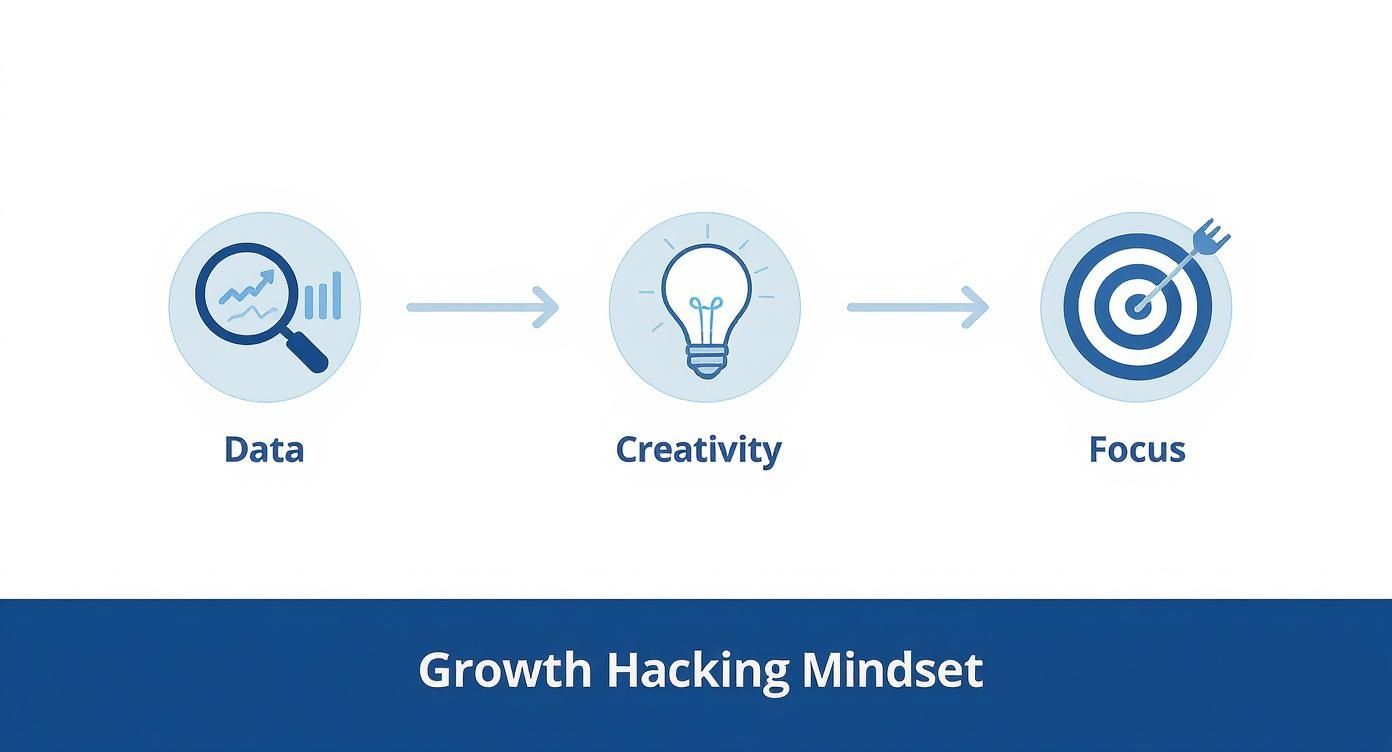
This loop of data, ideas, and goals is exactly what you apply to each piece of the Pirate Funnel. Let’s break it down.
Acquisition: How Users Find You
This is the top of your funnel, where strangers first encounter your brand. Acquisition covers all the ways you get people to your digital doorstep, from a Google search to a social media ad. The goal isn’t just to get traffic; it’s to get the right traffic.
Growth hackers are constantly testing different channels to find the most efficient and scalable ways to bring in new users. Some go-to tactics include:
- Content Marketing & SEO: Writing helpful blog posts or building free tools that show up in search results. For example, HubSpot generated millions of leads by creating free tools like their “Website Grader” and “Email Signature Generator.”
- Viral Loops: Designing product features that naturally encourage users to invite their friends, creating a growth engine that runs on its own.
- Paid Social Ads: Pinpointing specific audiences on platforms like Facebook or LinkedIn with targeted ads and obsessively tracking the cost per acquisition (CAC).
Activation: Getting Users to Experience Value
So, you got them to your site. Now what? Activation is that critical first experience. It’s the “aha!” moment when a new user truly understands what your product does for them and why they should care.
If tons of people sign up but never come back, you likely have an activation problem. Your onboarding might be confusing, or the initial value just isn’t clear. A practical example is how Twitter discovered that new users who followed at least 30 people were far more likely to become active. They immediately redesigned their onboarding to encourage this behavior, significantly boosting their activation rate.
Retention: Keeping Users Coming Back
It’s a well-known fact that acquiring a new customer can cost five times more than keeping an existing one. Retention is all about plugging the leaks in your bucket. If you’re losing customers as fast as you get them, you’ll never see sustainable growth.
The key here is to build habits and deliver ongoing value that keeps people engaged. Growth teams work hard on:
- Automated Email Sequences: Sending timely, relevant emails based on user actions—like a nudge to finish setting up their profile or an announcement for a new feature.
- Community Engagement: Creating a space like a Slack channel or a dedicated forum where customers can connect with your team and each other.
- In-App Notifications: Using push notifications to gently pull inactive users back into the product. Research shows this can boost app engagement by up to 88%.
Referral: Turning Customers into Advocates
The best marketing has always been word-of-mouth. The Referral stage is where you stop hoping for it and start engineering it. This is about turning your happiest, most loyal customers into a volunteer sales force.
Dropbox’s early referral program is the textbook example. They gave free storage to both the person referring and the person who signed up. It was a simple, powerful incentive that turned users into evangelists. A great referral program feels like a no-brainer for the user and is incredibly easy to share. To effectively apply growth hacking principles like these, it’s crucial to have a solid plan in place; understanding a modern growth strategy framework can guide your efforts.
Revenue: Monetizing Your User Base
Finally, it all comes down to revenue. This is where active users become paying customers. For a growth hacker, pricing isn’t something you just set and forget. It’s another variable to test and optimize.
A growth hacker views pricing not as a fixed number but as a variable to be tested. They might experiment with different subscription tiers, freemium models, or promotional offers to maximize customer lifetime value (LTV).
This last step ties the whole funnel together. When you do a good job at each of the previous stages, you build a large base of engaged, happy users who are far more likely to open their wallets. The AARRR framework provides a clear path to follow, which is similar in concept to other structured processes. For a deeper dive into another type of funnel, check out our guide on how to build sales funnels.
How Famous Companies Hacked Their Way to the Top
It’s one thing to talk about growth hacking in theory, but it’s another to see it in the wild. The truth is, some of the biggest tech companies you know today didn’t get there by simply outspending their competitors on traditional ads. They got scrappy. They were clever. They built growth right into their DNA.
These stories are more than just fun tech trivia; they’re a masterclass in the growth hacking mindset. By breaking down how these startups became household names, we can see the core principles of creativity, data-informed decisions, and product-led growth in action.
Let’s look at the brilliant moves Dropbox, Airbnb, and Hotmail made to completely dominate their markets.
Dropbox: The Viral Loop That Changed Everything
When Dropbox first appeared, it had a serious problem. The cloud storage market was already getting crowded, and buying customers through paid ads was a money pit. The cost to acquire a single user was way higher than the product’s $99 price tag. A traditional marketing playbook would have been a death sentence.
So, instead of trying to win a game they were destined to lose, they built a growth engine directly into the product. This became one of the most legendary referral programs of all time.
The idea was almost deceptively simple:
- Give and Get: When you invited a friend to join Dropbox, you both got extra storage space for free. This wasn’t a one-sided reward; it gave the new person an immediate benefit for signing up.
- Frictionless Sharing: The invitation was baked right into the user experience, making it incredibly easy to send to friends and colleagues.
- The Reward Was the Product: They didn’t offer gift cards or discounts. The prize was more of the product itself, which not only reinforced its value but also got people to use Dropbox even more.
This created a powerful viral loop. Every person who signed up became a salesperson, turning their entire user base into a massive, self-sustaining marketing machine. The results were mind-blowing. In just 15 months, Dropbox exploded from 100,000 users to 4 million—a 3900% increase fueled almost entirely by their own customers.
Airbnb: The Unconventional Craigslist Play
In the early days, Airbnb was stuck in the classic “chicken-and-egg” dilemma. They needed travelers to attract hosts, but they needed hosts with listings to attract travelers. With practically no budget, they had to find a huge, ready-made audience of people looking for exactly what they offered.
They found that audience on Craigslist.
The founders realized their target market was already on Craigslist searching for short-term rentals. So, they built a clever (and technically unofficial) integration that let hosts cross-post their Airbnb listings to Craigslist with a single click.
It was a stroke of growth hacking genius. This one move put their listings in front of a massive, highly relevant audience without spending a penny on ads. Because Airbnb listings generally had better photos and more compelling descriptions, they naturally stood out from the typical Craigslist clutter. This drove a steady stream of traffic back to Airbnb’s much slicker platform, helping them solve their user acquisition problem and gain critical early traction.
Hotmail: The Simple Signature That Sparked a Revolution
Way before “going viral” was even a phrase, Hotmail pulled off one of the first and most effective growth hacks the internet had ever seen. Back in 1996, free web-based email was a novel idea, and they needed a fast, cheap way to let the world know about it.
Their solution? A single, simple line of text added to the footer of every single email sent from a Hotmail account:
“P.S. I love you. Get your free email at Hotmail.”
This little signature turned every user into a brand ambassador. Every email sent was a micro-endorsement, a personal recommendation delivered directly to a friend or colleague. It was contextual, non-intrusive, and scaled perfectly. The more users they got, the faster the message spread, creating a snowball of exponential growth. It worked. Hotmail signed up its first million users in just six months and hit 12 million within a year and a half.
By the mid-2010s, this kind of thinking had become an established practice. One compelling example comes from the consulting firm Simon-Kucher: a retail client they worked with increased monthly revenue by a staggering 450% and their direct-to-consumer run-rate by 2700% through growth hacking methods. You can discover more about how they scaled growth on Simon-Kucher.com.
Building Your Growth Hacking Toolkit
Clever ideas alone won’t get you very far in growth hacking. To execute a high-tempo strategy, you need the right set of tools. Think of your tech stack as the growth hacker’s laboratory—it’s where you run experiments, measure outcomes with precision, and connect with users at every step. Trying to do this without the right software is like flying blind.
Each tool in your arsenal should serve a specific purpose, whether it’s understanding how people behave on your site or automating a marketing campaign. Building a smart mix of free and paid tools is a non-negotiable for any team, no matter the size or budget, that wants to put growth hacking into practice.
Tools for Analytics and User Behavior
Every good growth experiment starts with data. Before you can even dream up a hypothesis, you have to understand what your users are actually doing. Analytics tools are what turn a flood of raw clicks and pageviews into genuine insights you can act on.
- Google Analytics: This is the bedrock of web analytics. It’s free, powerful, and answers the most fundamental question: “Where are our users coming from and what are they doing?”
- Mixpanel: If Google Analytics tells you what happened, Mixpanel tells you how users interact with your product. It’s built around event-based tracking, helping you answer questions like, “What specific actions do our best customers take?”
- Hotjar: This tool adds a crucial visual layer to your numbers. Hotjar gives you heatmaps, session recordings, and on-site polls to see exactly where people are clicking, scrolling, and getting stuck. It’s the closest you can get to looking over their shoulder.
Platforms for A/B Testing and Optimization
Once you have a data-backed idea, you need a reliable way to test it. A/B testing platforms are the engine of this process. They let you serve up different versions of a page, a headline, or a call-to-action to different groups of users to see which one comes out on top. This is where rapid experimentation truly comes to life.
A/B testing is how you kill the “I think” culture. Instead of debating which headline sounds better, you let your users vote with their clicks. Decisions are driven by performance, not opinions.
Leading tools like Optimizely and VWO (Visual Website Optimizer) are brilliant for this. They make it surprisingly easy to set up and manage experiments without needing a developer, empowering marketers to test everything from a button color to a complete page redesign.
Software for Marketing Automation and User Feedback
Reaching the right user at just the right moment is key to keeping them around. Marketing automation platforms help you send personalized messages triggered by user behavior, while feedback tools let you collect invaluable qualitative insights straight from the source.
Having a balanced toolkit across these areas is crucial. Here’s a quick look at some of the best tools for the job, broken down by what they do best.
Top Growth Hacking Tools by Category
| Category | Example Tools | Primary Use Case |
|---|---|---|
| Marketing Automation | Mailchimp, Customer.io | Sending targeted email sequences, onboarding campaigns, and behavior-triggered messages. |
| User Feedback | SurveyMonkey, Typeform | Creating and distributing surveys to gather customer insights on satisfaction and new features. |
| SEO | Ahrefs, SEMrush | Analyzing keyword rankings, researching competitors, and identifying content opportunities. |
By weaving these tools together, you create a powerful system for understanding your users, testing new ideas, and automating personalized outreach. This stack isn’t just a collection of software—it’s the engine that powers your entire growth process, helping you learn and iterate faster than your competition.
How to Build a Growth Process in Your Company
https://www.youtube.com/embed/uHtfppoJhwY
It’s one thing to talk about growth hacking, but actually doing it is a whole different ballgame. The real secret isn’t finding some magic tactic that unlocks a flood of new users overnight. Instead, it’s about building a repeatable system for running smart experiments—a true growth engine.
This is how you get away from random acts of marketing and move toward a disciplined, scientific approach. It’s about embedding a culture of testing and learning right into the heart of your company, transforming growth from a gamble into a predictable process.
Step 1: Brainstorm and Ideate
Everything starts with ideas. Your first job is to build a backlog of potential growth experiments, and this is absolutely a team sport. Get your marketers, product managers, engineers, and designers in the same room.
You’d be surprised where the best ideas come from. An engineer might spot a way to build virality directly into the product, while a marketer is still thinking about ad campaigns. Create a “no bad ideas” zone where the focus is on quantity and creativity.
Look at every part of your customer journey (the AARRR funnel) and start asking questions:
- Acquisition: How could we get our best customers to bring in their friends? (e.g., a two-sided referral program)
- Activation: What’s the one thing a new user must do to see our product’s value? Can we make that ridiculously easy? (e.g., simplify the onboarding flow to one click)
- Retention: Could a targeted email nudge bring back users who haven’t logged in for 30 days? (e.g., a “we miss you” campaign with a small incentive)
Step 2: Prioritize with a Framework
That brainstorming session will leave you with a mountain of ideas. Now what? You can’t do everything at once, and you shouldn’t just chase the shiniest object. This is where a prioritization framework like ICE becomes your best friend.
ICE scoring is a simple but powerful way to filter your backlog. You rate each idea on a scale of 1-10 for three factors:
- Impact: If this works, how big of a deal will it be for our main growth goal?
- Confidence: Based on what we know, how likely is this to actually work?
- Ease: How much time, money, and effort will this take to launch?
Just multiply the scores (I x C x E) to get a final number. The ideas with the highest scores float to the top of your to-do list. This simple math helps you focus on the quick wins and high-leverage projects first, which is critical for building momentum.
The real power of a framework like ICE is that it takes ego and gut feelings out of the equation. It stops the “whoever shouts loudest wins” dynamic and focuses everyone on what the data suggests will actually drive growth.
Step 3: Design, Launch, and Analyze
Once you have your top-priority idea, it’s time to turn it into a real experiment. Start with a clear hypothesis. For example: “By changing the checkout button color to green, we believe we can increase conversions by 5%.” Be specific about what you’re measuring, who will be in the test group, and how long you’ll run it.
After launching, resist the urge to peek at the results every five minutes. Let the experiment run its course until you have enough data to make a confident call.
Then comes the analysis. Was your hypothesis right? Why or why not? The most important question is always: What did we learn? A failed experiment that teaches you something valuable isn’t a failure at all—it’s a lesson that just saved you from making a much bigger, more expensive mistake down the road. Those learnings are the fuel for your entire growth engine.
Got Questions About Growth Hacking? We’ve Got Answers.
It’s a hot topic, so it’s natural to have questions. Even with a solid grasp of the basics, people often wonder how growth hacking plays out in the real world. Let’s clear up some of the most common points of confusion.
Isn’t This Just a Fancy Name for Marketing?
Not quite. While they both share the goal of growing a business, their approaches are fundamentally different. Traditional marketing usually concentrates on building brand awareness and attracting people at the top of the funnel.
Growth hacking, on the other hand, is a full-funnel discipline. It weaves together marketing, product development, and data analysis to drive growth across the entire customer journey. A marketer might launch a great ad campaign; a growth hacker might work with developers to bake a viral referral loop directly into the product itself. It’s less about running campaigns and more about building sustainable growth systems.
So, Do I Need to Go Hire a “Growth Hacker”?
You can, but it’s not a silver bullet. The magic isn’t in a job title; it’s in the mindset. The real win comes from creating a culture of experimentation across your entire company.
The most powerful growth engine is a cross-functional team—marketers, engineers, designers, and product managers—all obsessed with the same growth goals. That collaborative spirit is far more valuable than a lone wolf “hacker” trying to do it all.
Is This Just a Thing for Tech Startups?
Growth hacking definitely has its roots in Silicon Valley, where startups needed to scale rapidly with limited resources. But the principles themselves are universal.
Massive companies like Amazon and Netflix are constantly running experiments and optimizing every touchpoint—that’s growth hacking. Any business, no matter its size or industry, can benefit from a data-driven, systematic approach to growth. After all, with reports showing that 92% of startups fail within three years, these principles are less of a “nice-to-have” and more of a survival guide.
What’s the Biggest Mistake People Make When They Start?
Getting tunnel vision on Acquisition. It’s easy to get caught up in the excitement of bringing in new users, but that’s only one piece of the puzzle. If you don’t have a solid plan for keeping those users around (Retention), you’re just pouring water into a leaky bucket.
True, sustainable growth comes from creating an experience so valuable that users stick around, stay engaged, and eventually become your best advocates. Ignoring the rest of the customer lifecycle is a fast track to high churn rates and a lot of wasted effort.
Ready to stop guessing and start growing? FundedIQ delivers curated lists of recently funded startups, giving your agency direct access to high-intent leads at the perfect moment. Pinpoint your next big client with actionable data. Find your next lead today at FundedIQ.