How to Cold Contact: A Guide to Getting Replies with Confidence
·

If you want to master cold outreach, you have to make one critical shift in your thinking. It’s time to stop playing the numbers game and start focusing on a value-first, personalized approach. Your goal isn’t just to get noticed; it’s to start a genuine conversation by proving you understand their world before you even hit send.
Rethinking Cold Outreach in a Crowded World
Let’s be real—most cold outreach lands straight in the trash folder or gets flagged as spam. According to research, the average professional is drowning in over 120 emails per day, which creates a ridiculous amount of noise. You aren’t just competing with other salespeople; you’re up against internal updates, urgent client requests, and personal messages, all for a few seconds of someone’s attention.
This is exactly why the old-school “spray and pray” method of blasting a generic template to a massive list is completely broken. In fact, campaigns with low personalization see reply rates of less than 1%.
To break through today, your mindset has to change from interruption to invitation. A truly effective cold email doesn’t feel like a sales pitch. It feels like a helpful, well-timed introduction from someone who actually did their homework.
The Mindset Shift from Spam to Strategy
The secret to modern outreach is simple: deliver genuine value with respect. This goes way beyond plugging a {FirstName} tag into a template. It’s about showing you’ve invested the time to understand who you’re talking to and why your message is relevant to them, right now. For example, referencing a recent company achievement or a challenge they mentioned on a podcast proves you’ve done more than scrape their name from a list.
This shift is the single most important factor in turning strangers into meaningful professional connections. It’s what separates an email that gets instantly archived from one that earns a thoughtful reply.
Modern outreach is about earning the right to someone’s attention. You achieve this by proving your relevance and demonstrating value from the very first sentence.
By taking a strategic approach, you acknowledge you’re reaching out to a real person, not just an entry in a CRM. This thinking applies even to more direct channels like phone calls. Cold calling, believe it or not, remains a potent tool, with research showing that 69% of buyers have accepted a call from a new provider in the last year. However, success here requires grit, as it takes an average of eight dials just to get someone on the line. You can dig into more cold calling statistics to see the full picture.
Old School Spam vs Modern Strategic Outreach
So, what actually separates a deleted email from a conversation starter? It’s crucial to understand the difference between the spammy tactics of the past and the strategic approach that works today.
This table breaks it down.
| Element | Old School Spam | Modern Strategic Outreach |
|---|---|---|
| Focus | Volume & Speed | Quality & Relevance |
| Personalization | Generic, uses only name/company. Ex: “Hi {FirstName},“ | Deep, references specific projects, news, or posts. Ex: “Saw your post on scaling dev teams…” |
| Goal | Get a quick sale or demo | Start a meaningful conversation |
| Value Prop | ”Here’s what I sell" | "Here’s how I can help you solve X” |
| Tone | Pushy and self-serving | Respectful, helpful, and genuinely curious |
Ultimately, one is a transaction, while the other is the beginning of a relationship. The modern approach respects the prospect’s time and intelligence, which is the only way to build the trust needed for a long-term partnership.
Crafting a Laser-Focused Prospect List

Let’s be honest: your outreach campaign lives or dies by the quality of your prospect list. This is the bedrock of everything that follows, yet it’s the one step most people cut corners on. The goal isn’t to buy some massive, stale list that gets your emails sent straight to spam. Instead, you need to put on your digital detective hat and find the right people at the right companies.
It all begins with defining your Ideal Customer Profile (ICP) with almost surgical precision. An ICP is essentially a blueprint of the perfect company for your product—one that gets huge value from what you offer and, in turn, provides great value back to you. We’re not just talking about industry and company size; we’re digging for the specific triggers that make a startup a perfect fit at this very moment.
Zeroing In on Your Ideal Customer Profile
To build a truly effective ICP, you have to look past the obvious. Think about the common threads connecting your best customers or the types of companies you know you can knock it out of the park for.
- Firmographics: The basics. What’s their industry, where are they located, and what’s their annual revenue? How many employees do they have? For example, your ideal customer might be a B2B SaaS company in the FinTech space with 50-200 employees.
- Technographics: What’s in their tech stack? Knowing a company uses Salesforce, Marketo, and Outreach lets you tailor your pitch to their existing workflows, making your solution feel less like a replacement and more like an enhancement.
- Buying Signals: This is where the magic happens. Did they just announce a Series B funding round? Hire a new VP of Marketing? Are they posting jobs for a new data science department? These events are clear signs they have new budget and new problems you can solve right now. A funding announcement, for instance, often precedes major technology investments by 3-6 months.
A strong ICP acts like a GPS for your prospecting. It stops you from just finding leads and ensures you’re finding the right ones—companies primed to listen because your solution hits a nerve they’re feeling today.
Once you have this profile locked in, the hunt begins. A tool like LinkedIn Sales Navigator is a fantastic starting point for filtering companies based on these criteria. But don’t stop there. Get creative. I’ve found some of my best prospects by monitoring industry awards lists, following relevant venture capital firms to see their new investments, and tracking speakers at industry conferences.
To keep the pipeline full, you might eventually want to set up an automated lead generation system, which can help you consistently build out this high-intent list.
Finding the Right Person to Talk To
Okay, you’ve found the perfect company. That’s only half the battle. Now, you need to find the right person inside that company. Generic titles can be incredibly deceiving—a “Head of Sales” at a 50-person startup is likely a hands-on manager, while at a 5,000-person company, they are a high-level strategist far removed from day-to-day tooling decisions.
Look for clues in their recent activity on platforms like LinkedIn. Did they just post about the challenges of scaling their team? Did they share an article about a pain point their department is grappling with? Those are your conversation starters. It’s less about their title and more about their immediate priorities. Our guide on finding the best https://fundediq.co/cold-calling-lists/ dives even deeper into these specific strategies.
But here’s a reality check: data goes bad. Fast. B2B contact info decays at a rate of about 2.1% per month, which adds up to over 25% in a single year. This makes constant list verification an absolute necessity. Building your prospect list isn’t a one-and-done task; it’s a continuous cycle of discovery, refinement, and validation.
Crafting an Email That Actually Gets a Response
Alright, you’ve got your curated list of prospects. Now comes the moment of truth: turning all that research into an email that doesn’t just get deleted on sight. This is where the magic happens. Your goal is to write something that feels less like a cold pitch and more like a helpful, timely introduction from someone who actually gets what they’re doing.
The secret? It’s all about relevance. Your email needs to immediately answer the silent question in your prospect’s mind: “Why should I care about this right now?” This isn’t about you or your amazing product. It’s about them, their company, their challenges. Many of the core ideas behind writing inquiry letters that get a reply apply perfectly here—it’s about being concise, respectful, and providing value from the get-go.
The Anatomy of a High-Performing Email
Think of your email as a series of small wins. Each part has a specific job, and they all need to work together to guide your prospect from curiosity to genuine interest. If one part fails, the whole thing falls apart. A study by Boomerang found that emails written at a 3rd-grade reading level get a 36% higher response rate than those written at a college level, proving simplicity is key.
Let’s look at the key elements that make or break a cold email.
Key Elements of a High-Converting Cold Email
A well-structured email respects the reader’s time and intelligence. The table below breaks down the essential components and shows you how to nail each one.
| Email Component | Purpose | Best Practice Example |
|---|---|---|
| Subject Line | Earn the open without being misleading. | ”Question about Acme’s recent launch” or “Idea re your LinkedIn post on scaling teams” |
| Opening Line | Create an instant, personal connection. | ”Saw your recent post on scaling your engineering team—loved your point about agile pods.” |
| Value Proposition | Clearly state how you can help them. | ”We help Series A tech companies like yours cut their cloud spend by 15% without re-architecting.” |
| Call-to-Action (CTA) | Make the next step easy and low-friction. | ”Would you be open to a 15-minute call next week to see if this is a fit?” |
This structure turns a generic blast into a thoughtful message that shows you’ve done your homework.
Subject Lines That Cut Through the Noise
Your subject line is the gatekeeper. It’s fighting for attention in an inbox that’s probably overflowing. Get it wrong, and you’re toast. Vague, salesy, or clickbait-y subject lines are a one-way ticket to the trash folder. In fact, 69% of recipients report emails as spam based on the subject line alone.
The best ones are specific, personal, and intriguing. They act as a “pattern interrupt”—something that stops the mindless scroll and makes them think, “Huh, this looks like it was written for me.”
Try one of these angles:
- Reference a Trigger Event: “Congrats on the new funding round” (Shows you’re timely).
- Ask a Relevant Question: “Quick question about your hiring goals” (Sparks curiosity).
- Offer a Specific Idea: “Idea for improving [a specific metric]” (Promises immediate value).
The single biggest mistake I see in cold email is a generic subject line. Your open rate can swing by 50% or more based on this one tiny piece of text. Personalization here isn’t a bonus; it’s the cost of entry.
If you really want to get this right, it’s worth checking out some data-backed email subject line best practices. You’d be surprised how small tweaks can lead to huge results.
Writing an Opener That Connects Instantly
Okay, they opened it. Now you have about three seconds to convince them to keep reading. This is where you prove the subject line wasn’t just a gimmick. You have to immediately show that you understand their world.
This is your chance to demonstrate your research.
Weak Opening:
“My name is John, and I work for a company that helps businesses like yours.” (Generic and self-centered).
Strong Opening:
“Saw the article in TechCrunch about your recent expansion into the APAC market—congratulations on the incredible growth.” (Specific, timely, and complimentary).
The second one works because it creates an immediate, genuine connection. It signals that you’re not just spamming a list of names; you’re reaching out for a specific, contextual reason. This is how you earn the right to their attention for the next few sentences.
Structuring Your Pitch with a Proven Framework
Once you have their attention, you need a logical flow. One of the most effective frameworks I’ve used over the years is Problem-Agitate-Solve (PAS). It’s simple, powerful, and it just plain works.
- Problem: Start by stating a problem you know they’re likely facing. Your research should make this easy. For example, “Scaling a sales team after a new funding round often creates challenges with onboarding and ramp time.”
- Agitate: Gently twist the knife by highlighting the negative consequences. “This can lead to missed quotas and a delay in capitalizing on the new investment.”
- Solve: Finally, position your solution as the clear path forward. “We help recently funded startups implement a sales enablement platform that cuts ramp time by 40%, getting new hires to full productivity in under 60 days.”
The PAS framework is so effective because it frames your offer as a solution to a real pain point, not just another product to evaluate. You’re not selling features; you’re selling a better outcome. Remember, the goal of this first email isn’t to close a deal—it’s simply to start a conversation.
Mastering the Art of the Follow-Up
Your first email is just the opening move. The real work—and where you’ll actually win or lose the deal—is in the follow-up. Think about this: 80% of sales require at least five follow-ups, yet a staggering 44% of salespeople throw in the towel after just one attempt. That gap is your opportunity. It’s where you can pull ahead of everyone else.
Persistence is key, but there’s a fine line between being persistent and just being annoying. The secret is to make every single follow-up a valuable touchpoint, not just another lazy “bumping this to the top of your inbox” message. You have to earn their attention with each interaction.
This infographic really nails the core components that make any email, including your follow-ups, land effectively.
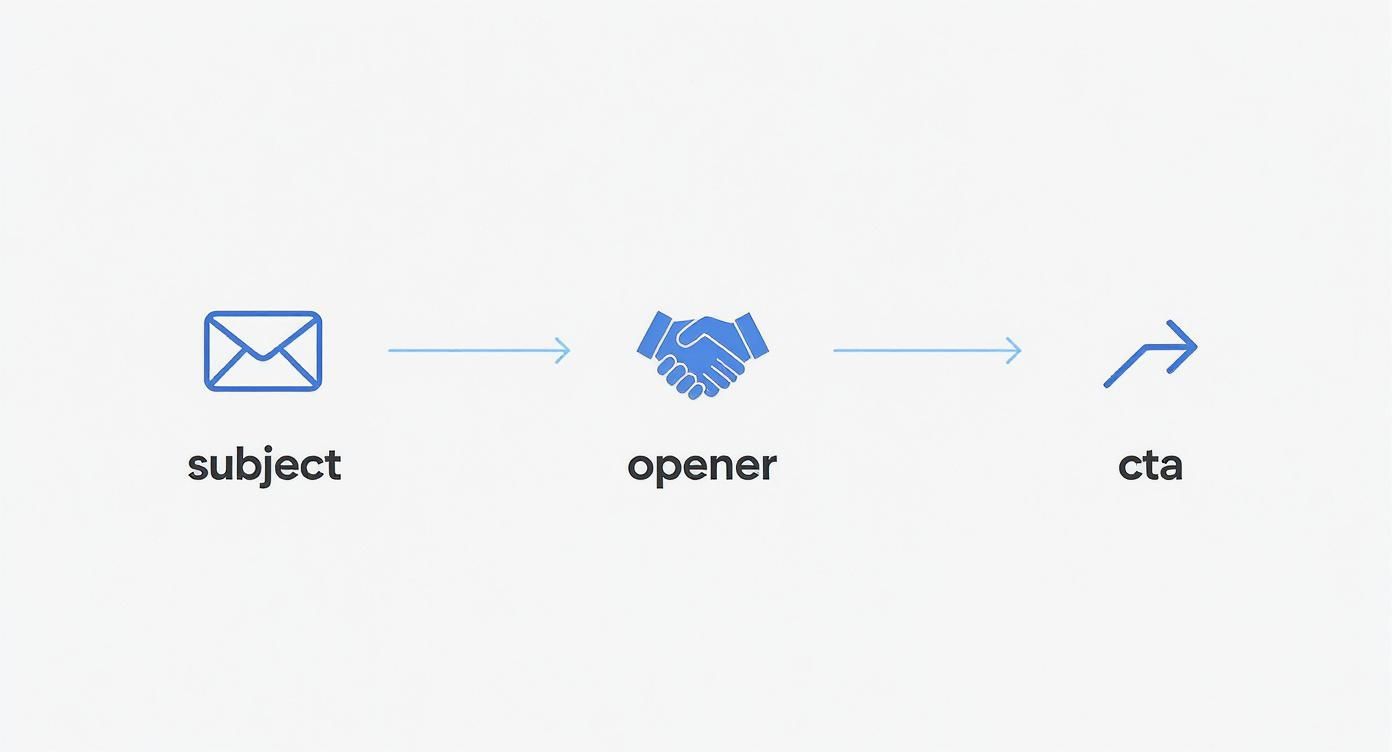
It shows how a killer subject line leads into an engaging opener, which then sets up a crystal-clear call-to-action. That flow is just as vital in your second or third email as it is in the very first one you send.
Designing a Value-Driven Follow-Up Sequence
A truly effective follow-up strategy isn’t about sending random pokes; it’s a planned sequence. It should feel helpful, not like you’re harassing them. The goal is to stay top-of-mind by mixing up your communication channels and offering something new with each touch.
Here’s a sample multi-touch sequence you can tweak for your own campaigns:
- Day 1: Send that initial, highly personalized email.
- Day 3: Hop over to LinkedIn and send a connection request. Add a short note referencing your email, like, “Hi [Name], I sent you a quick email about [topic]. Looking forward to connecting.” This simple step increases the chance they’ll recognize your name later.
- Day 5: Time for the first follow-up email. This is where you bring new value to the table. Maybe it’s a link to a relevant case study or a quick insight you had about a competitor’s recent announcement. For example: “Thought this case study on how [Similar Company] tackled [Problem] might be relevant.”
- Day 8: Engage with their content on LinkedIn. Don’t just “like” their post; leave a thoughtful comment on something they shared or an article their company published. A good comment asks a question or adds a new perspective.
- Day 12: Send one last, concise follow-up. This is often called the “breakup” email, where you politely close the loop and leave the door open for the future. Something like, “Assuming this isn’t a priority right now, I’ll stop reaching out. Feel free to connect if that changes.”
By using a multi-channel approach like this, you increase your visibility without clogging up their inbox. The magic is that each step offers something fresh or reinforces your relevance in a low-pressure way.
What to Actually Say in Your Follow-Up Emails
The biggest mistake I see people make is sending follow-ups that offer absolutely zero new information. You can’t just ask if they saw your last email. Instead, treat every message as a chance to add another piece to the puzzle, showing off your expertise and genuine helpfulness.
Your follow-up is not a reminder; it’s a new opportunity to be relevant. Share an insight, a resource, or a new idea that connects to their world. This shifts your role from seller to valuable resource.
Instead of a generic “just checking in,” try one of these angles:
- Share a Relevant Resource: “Hi [Name], following up on my last email. I came across this industry report on [topic] and thought you might find the section on [specific insight] interesting, especially given your work in [their area].”
- Provide a Quick Insight: “Hi [Name], I noticed your competitor [Competitor] just launched [new feature]. It made me think about our conversation regarding [their challenge]. A similar strategy helped another client of ours achieve [specific result].”
- Reference Their Activity: “Hi [Name], I saw your post on LinkedIn about the challenges of remote onboarding. It’s something we’ve been helping companies with. Have you considered [brief, helpful tip]?”
These approaches prove you’re still thinking about their specific situation, which makes your outreach feel more like a professional consultation than a tired sales pitch. For more ideas, looking through a good follow-up email after no response template can give you a solid foundation to build from.
Ultimately, getting good at cold outreach is about mastering persistence with a purpose. When you create a thoughtful, value-packed follow-up sequence, you dramatically increase your odds of starting a real conversation and truly standing out from the noise.
Knowing When and How to Pick Up the Phone
Let’s be honest, most inboxes are a war zone. A well-timed phone call can be the secret weapon that cuts right through the digital chaos. This isn’t about dialing for dollars like some old-school boiler room. Think of the phone as an accelerator—a way to turn your one-way email broadcast into a real, human conversation.
The trick is to position the call as a natural next step, not a cold ambush. A call feels way less intrusive when you can open with, “I’m just calling about the email I sent regarding…” That context immediately lowers their guard. It makes your call feel less like a random interruption and more like an expected follow-up.
Strategically Timing Your Call
Picking up the phone at the wrong moment is a fast track to a brusque “not interested” or, worse, the black hole of voicemail. While there’s no single magic hour that works for everyone, the data does show some clear patterns.
Research from Gong consistently points to mid-week—specifically Wednesday and Thursday—as the best days to connect. By then, the Monday morning fires are out, but the Friday pre-weekend rush hasn’t kicked in yet.
As for the time of day, you’re generally looking at two sweet spots:
- Between 10 AM and 11 AM
- And again from 3 PM to 5 PM
This helps you avoid the post-lunch productivity dip and the end-of-day scramble to wrap things up. You’re playing the odds here, using data to give yourself the best shot at catching someone with a moment to spare.
A phone call isn’t an interruption if it’s a relevant continuation of a conversation you’ve already started. Use it to add a human touch to your digital outreach, not to start from scratch.
A Simple Script for Getting Past Gatekeepers
More often than not, the first person you speak to won’t be your target. You’ll probably get an executive assistant or receptionist—the gatekeeper. How you handle this interaction is everything. You need to be respectful, but confident.
Don’t sound like every other salesperson they’ve screened that day. Project a little warmth and assume you’re going to be put through.
- What most people say: “Hi, is Mr. Smith available?” (This practically screams “sales call.”)
- What you should say: “Hi, I’m calling for John Smith. This is [Your Name] from [Your Company].”
The second approach is direct and presumes a connection. If they push back and ask what it’s regarding, be ready with a straight answer. “I’m following up on an email I sent him about [topic]. Is he free for a moment?” It’s simple, respects their role, and clearly states your purpose without being pushy.
The First 15 Seconds of the Call
Once you get your prospect on the line, the clock starts ticking. Fast. You have maybe 15 seconds to disarm their skepticism and prove you’re not wasting their time. The goal isn’t to launch into your life story; it’s just to secure enough interest for a brief chat.
Try an opener that’s both direct and respectful:
“Hi [Prospect’s Name], my name is [Your Name]. I know I’m catching you out of the blue, but I sent you an email last week about how we help startups like yours solve [specific problem]. Do you have 30 seconds for me to explain why I’m calling?”
This little script works wonders because it accomplishes three things instantly:
- It acknowledges the interruption, showing you respect their time.
- It gives immediate context by tying back to your email.
- It asks for permission for a tiny slice of time—“30 seconds”—which is an easy, low-commitment “yes.”
Leaving a Voicemail That Gets a Response
If you hit voicemail, don’t just hang up. A well-crafted voicemail is another touchpoint, and it can be surprisingly effective. The key is to keep it incredibly short—under 20 seconds. Data shows the optimal voicemail length is between 8 and 14 seconds.
State your name and company clearly, reference the email again, and leave your number.
Example Voicemail:
“Hi [Name], this is [Your Name] with [Your Company]. I’m following up on the email I sent regarding [briefly state value prop]. You can reach me back at [Your Number]. Thanks.”
It’s professional, continues to build familiarity, and doesn’t sound desperate. Remember, the phone isn’t about closing the deal on the spot. It’s about being professionally persistent, adding that human element, and nudging the conversation forward.
Keep Score: Tracking and Tuning Your Outreach
So, you’ve sent your emails. Now what? Just letting them fly into the void without tracking what happens next is a massive mistake. It’s like shooting arrows in the dark and hoping one hits the bullseye. You have to know what’s working and what’s not.
Turning your outreach from a shot in the dark into a reliable way to generate leads comes down to one thing: data. You need to treat every campaign like a small experiment. Test your ideas, measure the results, and then pour your effort into what actually gets a response. It all starts with tracking the right numbers.
What Numbers Actually Matter?
It’s easy to get bogged down in metrics that don’t really tell you much. Open rates, for example, used to be helpful, but with privacy updates like Apple’s Mail Privacy Protection, they’ve become unreliable vanity metrics. Instead, you want to focus on the metrics that show someone is truly engaged.
Here’s what I keep my eye on:
- Reply Rate: This is your north star. Are people actually hitting “reply”? For a solid, personalized cold outreach campaign, you should be aiming for a reply rate somewhere between 5-10%. If you’re below 2%, it’s a strong signal that either your list, your messaging, or both are off.
- Positive Reply Rate: Let’s be real, not every reply is a good one. This metric cuts through the noise of “unsubscribe” or “not interested” messages and shows you how many people are genuinely curious or want to learn more. It’s a much truer measure of interest.
- Meeting Booked Rate: This is the big one. At the end of the day, the goal is to start conversations and get meetings on the calendar. This number tells you how well your entire process—from the initial email to your call-to-action—is working to achieve that goal. A 1-2% meeting booked rate from a cold list is a very healthy benchmark.
You absolutely have to track these three metrics. Without them, you’re just guessing. You won’t know if your prospect list is off, if your subject line is falling flat, or if your core offer just isn’t compelling enough.
A/B Testing: Your Secret Weapon for Improvement
Once you know your baseline numbers, it’s time to start improving them. The best way to do this is with A/B testing, which is just a fancy way of saying you’re testing one version of something against another.
The golden rule here is simple: test only one thing at a time. If you change the subject line and the call-to-action at the same time, you’ll have no idea which change actually made a difference.
Here’s how it works in practice. Let’s say you want to test two subject lines. Grab a small segment of your list, maybe 200 prospects. Send Version A to the first 100 and Version B to the second 100. Whichever one gets the better reply rate is your winner. That’s your new champion. Now, you can take that winning subject line and start a new test on your call-to-action. It’s this constant cycle of testing, learning, and refining that will dramatically improve your results over time.
Your Top Cold Outreach Questions, Answered
Even the most seasoned pros run into questions when building out a cold outreach plan. Let’s tackle a few of the most common ones I hear from people just getting started.
How Many Follow-Ups Is Too Many?
There’s no single magic number, but data suggests the sweet spot is a sequence of 4-6 touches spread over two to three weeks. One study found that sequences with 4-7 emails get 3x more replies than sequences with only 1-3 emails.
The real key here isn’t the number, but the content. Each follow-up has to add new value. Don’t just send a lazy “just checking in” email. If you’ve gone through a full sequence with zero response, it’s time to shift gears. Move that prospect to a long-term nurture list and focus your energy on fresh leads. This keeps the door open without wasting your time.
What Are the Must-Have Tools When Starting Out?
You can get surprisingly far without a massive, expensive tech stack. Honestly, you only need three core tools to build a powerful outreach system:
- A reliable email finder: This is non-negotiable for getting accurate contact info. Tools like Hunter or Snov.io are popular choices.
- An email sending and tracking tool: You need this to automate your sequences and see who’s actually clicking and replying. Mailshake or Lemlist are great starting points.
- LinkedIn Sales Navigator: For finding the right people at the right companies, this is still the gold standard. Its advanced filtering is crucial for building a quality prospect list.
Start with these, master them, and then you can think about adding more complex tools later on.
Should I Contact More Than One Person at the Same Company?
Yes, you absolutely should. This is a classic account-based strategy, and it works wonders, especially in B2B sales where the average buying committee now involves 6-10 decision-makers.
By reaching out to 2-3 relevant decision-makers at the same time, you dramatically increase your odds of getting a response. Your message to the Head of Sales should be different from your message to the COO, tailored to what each of them cares about (e.g., revenue growth vs. operational efficiency). This turns a single point of failure into multiple shots on goal and can spark an internal conversation about your solution.
Ready to stop guessing and start connecting with high-intent leads? FundedIQ delivers hand-curated lists of recently funded startups with verified decision-maker contacts, giving you the perfect reason to reach out. Get your first prospect list today at https://funded.iq.