Follow Up Email After No Response Template: Get Replies
·
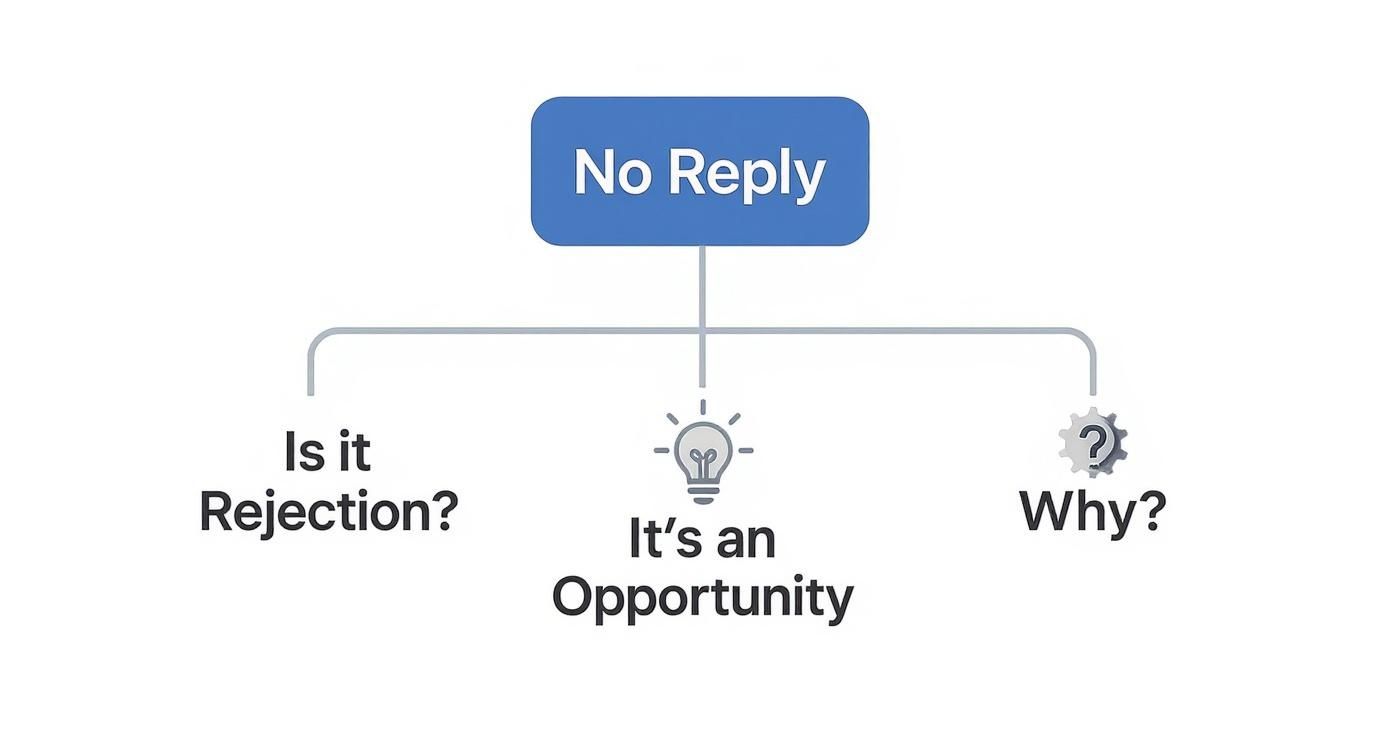
Hitting ‘send’ only to be met with silence is a feeling we all know. It’s easy to get discouraged, but a solid follow up email after no response template can be your secret weapon. Think of it less as a desperate plea and more as a polite, strategic nudge to bring your original message back to the top of a very busy person’s inbox.
Why Your First Email Probably Went Unanswered
Let’s get one thing straight: a lack of response rarely means a hard ‘no.’ It’s far more likely that you’ve reached a professional who is absolutely buried under a daily avalanche of messages. The average professional receives over 120 emails per day, so it’s easy to take the silence personally, but the real key to successful outreach is to see it as an opportunity, not a rejection.
The reality is your email probably landed at the worst possible time—right when they were running into a meeting, dealing with a crisis, or just trying to clear out a hundred other “urgent” tasks. Sometimes, it’s simple human error. They might have even read it, flagged it to reply to later, and then completely forgot. This is precisely why a well-timed follow-up isn’t an annoyance; it’s a critical part of professional communication.
The Power of Professional Persistence
Changing your mindset is half the battle. If you think of your follow-up as a strategic nudge instead of a desperate ask, you’ll approach it with more confidence. It’s a standard business practice that shows you respect their packed schedule while gently reminding them of the value you’re offering.
Effective, professional persistence is your greatest asset here.
The data doesn’t lie: persistence pays off. Sending just one or two follow-up emails can dramatically increase your chances of getting a reply, turning radio silence into a real conversation.
The numbers back this up in a big way. Sending just a first and second follow-up can boost your reply chances by 21% and 25%, respectively. Some studies have even found that a sequence of 2–3 follow-ups can increase overall response rates by as much as 65.8%. This isn’t about being pushy; it’s about being thorough and professional.
Of course, what you say in that follow-up matters just as much as the fact that you sent it. Your subject line and opening sentence have to do the heavy lifting to get your email opened in the first place. For a deeper dive on that, check out our guide on how to increase email open rates.
At the end of the day, a great follow-up email respects the recipient’s time while making it incredibly easy for them to say “yes” (or at least reply).
The Anatomy of a Follow-Up That Actually Gets Replies
Crafting a follow-up email that works is part art, part science. It’s less about just sending a reminder and more about understanding the psychology of a busy inbox. Let’s break down what turns a ghosted email into a genuine conversation. The first step is a mental one: change how you view their silence.
This isn’t about pestering someone. It’s about finding a way to reconnect thoughtfully. Think of a non-response not as a hard ‘no’, but as a puzzle. Why didn’t they reply? Were they busy? Did it get buried? Your follow-up is the key to solving that puzzle.
When you approach it this way, your entire tone shifts from demanding to helpful, and that’s what makes all the difference.
First Things First: The Subject Line
Your subject line’s only job is to provide instant context. Honestly, the best and simplest trick in the book is to just reply directly to your original email. This keeps the whole history in one thread, so they can immediately remember who you are and what you were talking about. No guesswork required.
If starting a new thread is unavoidable, don’t get clever. Clarity beats creativity every single time. Vague or clickbaity subject lines are just annoying and get deleted.
Stick to something straightforward:
- “Following up on my email about [Original Topic]”
- “Quick question about our last chat”
- “Circling back on the proposal”
The goal is recognition, not mystery. A subject line that jogs their memory is far more powerful than one that tries to be a headline. Mastering how to follow up email no response starts with getting them to simply open the message.
The Opening: A Polite Nudge, Not a Shove
Start your email with the assumption that they are a busy, well-intentioned professional—because they probably are. People rarely ignore emails out of spite; they just get overwhelmed.
A simple, warm opening like, “Hi [Name], hope your week is going well,” sets a friendly tone.
Right after that, you need to connect the dots back to your original message without making them feel bad. This is the moment where a follow-up can either succeed or crash and burn.
Avoid anything that sounds passive-aggressive, like, “Just checking to see if you got my last email.” It immediately puts people on the defensive. Instead, frame it as a helpful reminder: “Just wanted to bring my note about the project proposal back to the top of your inbox.”
See the difference? One implies they dropped the ball; the other acknowledges their busy schedule. This small tweak in language keeps the conversation positive and professional, making them far more likely to engage.
The tone you choose can completely change the outcome of your email. Here’s a quick comparison to illustrate how different approaches land with a recipient.
Follow-Up Email Tone and Approach Comparison
| Tone/Approach | Key Language | Best For | Example Snippet |
|---|---|---|---|
| The Gentle Nudge | ”Circling back,” “bumping this up,” “wanted to quickly follow up” | Most situations; when you want to be polite and respectful of their time. | ”Just wanted to circle back on the invoice I sent over last week.” |
| The Value Add | ”Thought you might find this useful,” “I saw this and thought of you” | When you have new, helpful information to share that relates to your original email. | ”I saw this article on Q3 marketing trends and thought it might be helpful for your team.” |
| The Direct Ask | ”Do you have a moment to connect this week?” “What are the next steps here?” | When a decision is time-sensitive and you have an established relationship. | ”Hi Jen, do you have 15 minutes to sync on the launch plan tomorrow?” |
| The “Last Chance" | "I’ll assume you’re not interested if I don’t hear back,” “closing the loop” | After multiple follow-ups with no response; provides a clean break. | ”If this isn’t a priority right now, I’ll go ahead and close the file.” |
Choosing the right tone is crucial. For most situations, the Gentle Nudge is your safest and most effective bet. It’s professional, respectful, and gets the job done without creating friction.
Field-Tested Follow-Up Email Templates
Theory is great, but having a battle-tested follow-up email after no response template in your back pocket is what actually saves time and drives results. The real secret is knowing which template to pull out for which situation—because a one-size-fits-all approach just doesn’t work.
I’ve broken down four templates I’ve seen work time and again, each crafted for a specific professional scenario. For a deeper dive into structure and strategy, this guide on the perfect follow-up email after initial consultation template and best practices is an excellent resource.
The Gentle Nudge
This is your go-to for most situations. It’s polite, professional, and operates on the assumption that the other person is just swamped. The goal here isn’t to apply pressure; it’s simply to pop your original message back to the top of their inbox with a friendly reminder.
It works because it’s incredibly low-effort for them to read and reply to.
Subject: Re: [Original Email Subject]
Hi [Name],
Hope you’re having a productive week.
I just wanted to circle back on my previous email regarding [Original Goal]. I know how busy things can get and wanted to make sure it didn’t get buried.
Let me know if you have any questions.
Best,
[Your Name]
The Value-Add
This one is a game-changer. It completely flips the script from asking for something to giving something. Instead of just “checking in,” you provide a new, genuinely useful piece of information—a relevant article, an interesting case study, or a helpful tip.
This move immediately positions you as a valuable resource, not just another person with an ask. It’s a powerful way to keep the conversation warm while demonstrating your expertise.
Subject: A few thoughts on [Original Goal]
Hi [Name],
I was thinking about our conversation on [Original Goal] and came across this article on [Relevant Topic]. Thought you might find it interesting.
[Link to Resource]
No need to reply, but let me know if you have a moment to connect next week.
Cheers,
[Your Name]
The Direct Question
Sometimes you just need a straight answer to move forward. This template cuts through the noise and makes it dead simple for the recipient to give you a quick yes or no. You’re respecting their time by being concise.
I’d recommend using this only after one or two gentler follow-ups have gone unanswered. It works by removing the friction of needing to craft a long, detailed response. For more tactical examples like this, check out this list of the 12 best sales follow-up email templates that cover a range of scenarios.
The “Breakup” Email
Okay, so you’ve sent multiple follow-ups and all you’re hearing is crickets. It’s time to professionally close the loop. This “breakup” email is a final, polite attempt that often creates a surprising sense of urgency.
It’s effective because it gives the other person a clear out, which ironically prompts many to finally reply. By stating that you’ll stop contacting them, you signal that this is their last chance to engage.
Subject: Closing the loop
Hi [Name],
I’ve reached out a few times regarding [Original Goal] but haven’t heard back. I’ll assume your priorities have shifted or this just isn’t the right time for you.
I’m closing the file on my end for now, but please don’t hesitate to reach out if things change down the road.
Wishing you all the best.
Regards,
[Your Name]
Not All Follow-Ups Are Created Equal: Tailoring for Industry and Company Size
Think you can send the same follow-up email after no response template to a tech startup founder and a logistics manager? Think again. That’s a surefire way to get your message ignored.
The culture and pace of communication can be wildly different from one sector to another. A direct, persistent style might be exactly what a busy manufacturing director expects, but it could completely turn off a relationship-focused healthcare executive. Your approach has to show you get their world.
Before you even think about hitting ‘send,’ you need to get a feel for the industry’s vibe. For instance, data shows that people in manufacturing, solar, and logistics often appreciate more direct and repeated follow-ups. On the flip side, industries like crypto, cloud technology, and healthcare tend to require a lighter touch. You can dive deeper into these sales follow-up statistics on belkins.io to see just how much it varies.
It all boils down to creating a strategy that fits the person you’re trying to reach.
Big Company vs. Small Business: A Different Ballgame
Industry is one piece of the puzzle, but company size is just as critical. The way you approach a small local business should look nothing like how you try to connect with a VP at a Fortune 500 company.
- Small & Mid-Size Businesses (SMBs): These folks are often more about building relationships. You can usually get away with—and even benefit from—multiple touchpoints, as long as each one offers something useful. Their teams are smaller, so a friendly, direct conversation often works best.
- Enterprise-Level Companies: Picture an executive at a massive corporation. Their inbox is a battlefield. Your message has to be incredibly concise and immediately relevant to a problem they are actively trying to solve. If you don’t grab their attention in the first sentence, you’ve lost them.
Your outreach should feel like it was written specifically for their world. A logistics manager cares about supply chain efficiency, not agile development methodologies. Speak their language to earn their attention.
Ultimately, this is all about demonstrating that you’ve done your homework. A generic, one-size-fits-all email screams “mass blast.” But a message that’s clearly tailored to their specific industry and role shows respect for their time—and that’s what gets replies.
Common Follow-Up Mistakes to Avoid
Even the best follow-up email after no response template can fall flat if you’re making a few common, easily avoidable mistakes. Honestly, sometimes the biggest improvements come from simply knowing what not to do. Getting a response is as much about sidestepping the classic blunders as it is about writing the perfect message.
So many well-intentioned emails end up in the bin because they feel lazy or, even worse, a little passive-aggressive. These small missteps can immediately shut down any hope of building a real professional connection.
The “Just Checking In” Disaster
This has to be the most overused—and least effective—follow-up phrase ever. It adds zero new value to the conversation. All it really does is put the pressure on the other person, subtly making them feel like they’ve dropped the ball. It’s the polite-but-not-really-polite way of asking, “So, why haven’t you replied yet?”
A better approach: Always lead with something valuable or a clear purpose. Instead of the dreaded “just checking in,” try something like, “I was thinking about our conversation and found this article on [Relevant Topic] that I thought you’d find useful.” This simple pivot changes the entire tone from demanding a reply to being genuinely helpful.
Vague Subject Lines
A confusing or generic subject line is a one-way ticket to the trash folder. If someone can’t immediately grasp the context from their crowded inbox, they have no reason to open your email. Steer clear of things like “Following Up” or “Quick Question” unless you add more specific details.
- The Mistake: Subject: “Checking in”
- The Fix: Subject: “Re: Our discussion about the Q3 proposal”
That small change makes all the difference. It provides instant recognition and makes your email feel like a continuation of a conversation, not just another interruption. Getting this right is a huge part of learning how to follow up politely in an email.
Sending Too Many Emails Too Quickly
In the follow-up game, patience truly is a virtue. Bombarding someone’s inbox every 24 hours is the fastest way to annoy them and get your emails flagged as spam. You need to give people room to breathe.
Wait at least 2-3 business days before sending your first follow-up. From there, gradually increase the time between any other messages you send. A rushed follow-up doesn’t show you’re keen; it signals desperation, which is never a good look.
Unpacking the Nuances of the Follow-Up
Even with the best template, you probably still have a few questions. Let’s tackle the most common ones I hear about sending a follow-up email when you’ve heard nothing back.
How Long Should I Wait Before Nudging Them?
This is a classic question, and the answer is all about timing. I’ve found the sweet spot is waiting 2-3 business days after your initial email. This feels just right—it gives your contact enough time to catch up on their inbox without letting your original message get buried and forgotten.
After that first nudge, you can stretch the timing out a bit. For any other follow-ups, give it about 4-7 days between each send.
What’s the Best Subject Line to Use?
Honestly, the simplest move is usually the most effective one. Just reply directly to the original email you sent.
Doing this keeps the entire conversation in one thread. When they see your new message, they’ll instantly have all the context from your first email right there. No need to overthink it.
How Many Follow-Ups is Too Many?
You want to be persistent, not a pest. In my experience, a sequence of 3-4 emails (that’s your original plus 2-3 follow-ups) tends to hit the mark and get the best results.
Pushing past five emails often starts to yield diminishing returns, and you risk annoying your prospect. It’s better to move on and focus your energy elsewhere.
Ready to stop guessing and start connecting with high-intent leads? FundedIQ delivers curated lists of recently funded startups with verified decision-maker contacts, giving you the perfect reason to reach out. Stop chasing cold leads and start engaging prospects at the perfect moment. Find your next client today.