What Is Demand Generation Marketing
·
Let’s be honest, the term “demand generation” gets thrown around a lot. But what does it actually mean for your business?
Simply put, demand generation marketing is all about creating awareness and genuine interest in what you do. It’s the long game—building a relationship with your audience by providing real value, way before you ever ask for their credit card.
So, What Is Demand Generation, Really?
Think of it less as a marketing tactic and more as the art of making your ideal customers want what you have to offer. It’s not about a hard sell or aggressively capturing a lead right out of the gate. Instead, it’s a full-picture approach that guides people from “I’ve never heard of you” to “I can’t imagine working with anyone else.”
Imagine your favorite local coffee shop. They don’t just hang a sign that says, “Buy Coffee Here.” They create a vibe. They host open mic nights, post latte art on Instagram, and maybe even offer a free brewing class. People are drawn to the experience and the community. When it’s time for their morning caffeine fix, that shop is top of mind. That’s demand generation in a nutshell.
Moving Beyond a Textbook Definition
At its heart, a solid demand generation strategy is designed to do a few key things:
- Build Brand Awareness: Make sure the right people know who you are and what you’re all about.
- Establish Credibility: Position your brand as the go-to expert in your field.
- Generate Interest: Create a real buzz around the problems you solve, not just the product you sell.
- Nurture Relationships: Build a loyal community by consistently offering helpful, educational, or entertaining content.
This isn’t just theory; it’s a fundamental shift in how modern marketing works. The old playbook was all about collecting as many contacts as possible and hoping for the best. Today, that’s completely changed. A whopping 78% of marketing leaders now prioritize lead quality over quantity, and for good reason. They know that a small group of genuinely interested people is worth far more than a massive list of cold leads.
This focus is critical, especially when you consider that only about 25% of leads gathered through traditional methods ever become actual sales opportunities. If you’re curious, you can dig into more lead generation statistics to see how marketers are adapting to this new reality.
The goal isn’t just to be found; it’s to be sought out. When done right, demand generation makes the sales process feel like a natural next step for the customer, not an aggressive pitch from your team.
The Pillars of Demand Gen
So, what is demand generation marketing when you boil it all down? It’s about playing the long game. It uses tools like content marketing, SEO, social media, and webinars to build an entire ecosystem of value around your brand. For instance, a B2B SaaS company might create an ungated library of video tutorials, host a podcast with industry experts, and publish original research reports. None of these directly sell the software, but they establish the company as an indispensable resource.
By focusing on educating and engaging your audience first, you lay a foundation of trust. That trust is what makes them want to do business with you when the time is right, creating a steady flow of high-quality prospects who are already sold on your brand.
Demand Generation vs Lead Generation
One of the biggest hang-ups in marketing is getting demand generation and lead generation straight. They sound alike and definitely work together, but they’re two totally different beasts. Getting them mixed up is like confusing fishing with a giant net for fishing with a spear. Sure, both can land you a fish, but the entire approach—and the results—are worlds apart.
Think of demand generation as playing the long game. It’s all about creating genuine buzz and an appetite for what you offer. This is a top-of-funnel play, focused on educating your audience and positioning your brand as the go-to expert. The immediate goal isn’t to snag an email address; it’s to be the first name that pops into someone’s head when they have a problem you can solve. For example, a cybersecurity firm might produce a podcast about emerging data privacy threats. They aren’t capturing leads, but they are building an audience of concerned IT managers who will remember their name when it’s time to upgrade security.
Lead generation, on the other hand, is much more direct. It’s the tactical side of things, where you capture the contact information of people who are already showing interest. This is where you convert the awareness you’ve built into actual, actionable leads for your sales team. It’s a conversion-focused push, like offering a gated eBook titled “The IT Manager’s Guide to Securing Corporate Data.”
The Chef Analogy Explained
Let’s make this crystal clear with an analogy. Picture yourself as a top chef trying to build a name for your restaurant.
- Demand Generation is your cooking show. You’re not trying to sell seats at your restaurant during the show. Instead, you’re sharing your passion, teaching incredible techniques, and giving away recipes. You’re building a loyal following of people who trust your expertise and are now craving your style of cooking. You’ve created demand.
- Lead Generation is when you ask viewers to sign up for your exclusive recipe newsletter. After earning their trust, you offer them something valuable in exchange for their email. Now you’re capturing the details of your most engaged fans.
The cooking show builds the crowd and the craving (demand), while the newsletter sign-up identifies the most interested folks within that crowd (leads). One creates the audience; the other pinpoints the prospects.
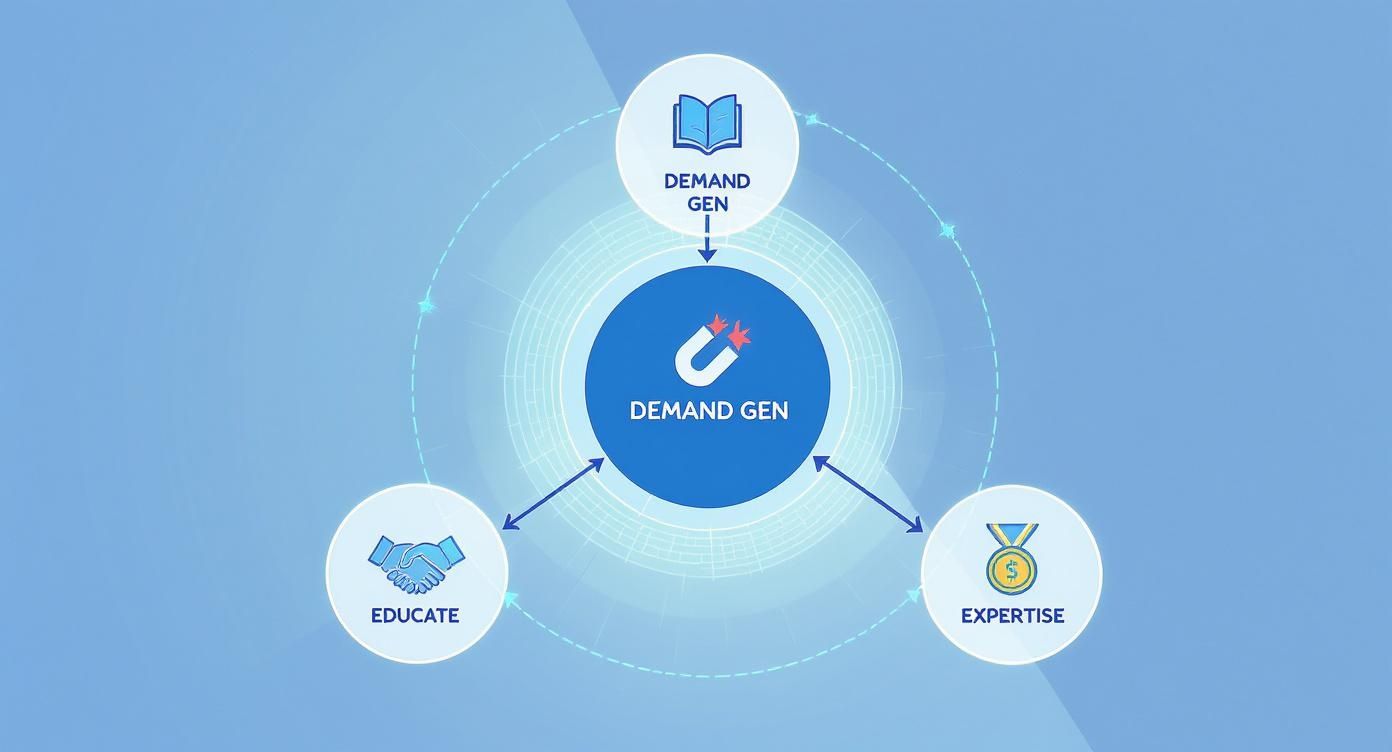
This infographic does a great job of visualizing how demand generation is all about building those foundational pillars of trust, education, and expertise.
The real takeaway here is that authentic demand is built on delivering value, not a sales pitch. It’s about creating a magnetic pull that draws people to your brand naturally. In fact, research shows that B2B buyers consume an average of 13 pieces of content before making a decision, highlighting the importance of this value-first approach.
Demand Generation vs Lead Generation At a Glance
To really get a feel for how these two functions operate, it helps to see them side-by-side. The table below breaks down their core differences. If you’d like to dig even deeper, it’s worth it to further explore the differences between demand generation and lead generation to see how they fit into a bigger strategy.
| Aspect | Demand Generation | Lead Generation |
|---|---|---|
| Primary Goal | Create awareness and educate the market. Build brand affinity and establish trust. | Capture contact information from interested prospects. Convert audience into leads. |
| Audience Focus | Broad and top-of-funnel. Aims to attract and engage a wide segment of your ideal customer profile. | Narrow and mid-to-bottom-funnel. Targets individuals who have shown buying intent. |
| Key Tactics | Ungated blog posts, podcasts, social media content, webinars, organic SEO, video series, free tools. | Gated content (eBooks, whitepapers), demo requests, free trial sign-ups, contact forms, webinars with registration. |
| Success Metrics | Website traffic, social engagement, brand mentions, keyword rankings, video views, content downloads. | Conversion rate, cost per lead (CPL), number of Marketing Qualified Leads (MQLs), form submissions. |
Ultimately, demand gen and lead gen aren’t competitors—they’re partners. A truly effective marketing engine uses demand generation to fill the top of the funnel with an educated, engaged audience. This makes the job of lead generation, and eventually sales, so much easier and more efficient.
It’s a powerful synergy that drives sustainable growth. In fact, for highly targeted B2B companies, understanding what is account-based marketing can add another potent layer, allowing you to focus your resources on high-value accounts you’ve warmed up through your broader demand efforts.
Proven Strategies for Your Demand Generation Engine

Knowing the theory is one thing, but actually building a demand generation engine is where the magic happens. A great demand gen program isn’t just a random checklist of marketing tactics. It’s a finely tuned, integrated machine where every part works together to get your name out there and build a rock-solid reputation.
Let’s dig into the core strategies that actually power this machine. These aren’t just abstract ideas; they’re about meeting your audience right where they are and offering real value at every turn. The whole point is to build an ecosystem that naturally pulls in and captivates your ideal customers, making you the obvious choice when they’re ready to buy.
Create Genuinely Valuable Content
Content is the fuel for your entire demand generation engine. But let’s be clear: we’re not talking about thinly veiled sales pitches. Your content needs to be truly valuable and educational, laser-focused on solving your audience’s problems, not just pushing your product. In fact, 71% of B2B buyers say they consume blog content during their purchasing journey.
Think of your content as a free consultation. You’re giving away your best advice, building goodwill, and proving you know your stuff long before asking for anything in return. This simple shift in mindset makes potential customers see you as an indispensable resource.
To pull this off, you need to go deep with formats that really let you flex your expertise.
- Insightful Blog Posts: Forget surface-level listicles. Write the kind of comprehensive guides and data-packed analyses that become the go-to resource on a topic. Answer the tough questions your ideal customers are typing into Google.
- In-depth eBooks and Whitepapers: Offer these up without a form field in sight to build maximum trust. Use them to tackle complex subjects, share your own research, or lay out a detailed framework for solving a huge industry headache.
- Expert-Led Webinars: Get your team’s experts (and other industry pros) in front of a live audience to talk about trends, challenges, and solutions. It’s a fantastic way to engage directly with people and cement your authority.
The best demand generation strategies deliver value without a single sales pitch involved. By consistently providing no-strings-attached content, you build a foundation of trust that makes future sales conversations feel natural and welcome.
Leverage Search Engine Optimization
Creating phenomenal content is half the battle. The other half is making sure people can actually find it. That’s where Search Engine Optimization (SEO) comes in. SEO is all about making sure that when your ideal customer has a problem, your content shows up with the solution. On average, B2B researchers conduct 12 searches before engaging on a specific brand’s site.
Good SEO isn’t about gaming the system. It’s about deeply understanding what people are searching for and creating the single best answer on the internet for their query. This lines up perfectly with the whole point of demand generation: to educate and help.
When you nail your SEO, you create a sustainable pipeline of high-intent traffic. These aren’t just random visitors; they are people actively looking for the expertise you offer. A smart SEO strategy ensures your best content works for you 24/7, attracting potential customers while you sleep.
Build a Thriving Social Media Community
Using social media for demand generation has nothing toto do with follower counts. It’s about building a real, living community around your brand and your mission. The goal is to carve out a space where your audience can connect, learn, and talk—both with you and with each other.
Of course, share your valuable content, but don’t stop there. Spark conversations. Ask questions, run polls, and show the human side of your brand with behind-the-scenes glimpses. This turns your social media from a megaphone into a roundtable discussion, building loyalty that lasts.
For instance, a B2B software company could start a LinkedIn group for professionals in its niche. Inside, they can guide discussions, share exclusive advice, and build a network of advocates who see the brand as a key part of their professional world. A practical example is Adobe’s Creative Cloud community, which provides a forum for users to share tips and get help, fostering immense brand loyalty.
Target Dream Clients with Account-Based Marketing
For companies chasing bigger fish, Account-Based Marketing (ABM) is a game-changer. Instead of casting a wide net and hoping for the best, ABM treats each high-value target account as its own market. This means crafting highly personalized campaigns that speak directly to the specific challenges and goals of the key players in that organization.
It flips the old-school marketing funnel upside down. You pick your dream clients first, then build custom content and outreach just for them. This requires your sales and marketing teams to be in lockstep, creating a seamless and impressive experience for the target account.
This hyper-personalized focus is why ABM works so well. In fact, 68% of marketing leaders now call ABM and content marketing their top priorities. Modern ABM has evolved far beyond static spreadsheets, using dynamic, data-driven systems that have led to a 3x improvement in targeting precision. If you want to dive deeper, you can discover more insights about demand generation trends.
When you start weaving these strategies together, you create a powerful flywheel. SEO brings new people in, great content educates them, social media nurtures a community, and ABM hones in on your most valuable prospects. Over time, you can put parts of this on autopilot by exploring some proven marketing automation best practices to manage and scale your efforts as your audience grows.
Measuring Demand Generation Success
If you can’t measure it, you can’t improve it. That old saying is especially true for demand generation. While its impact might feel less direct than a simple form fill, it is absolutely measurable.
The trick is to look beyond flashy “vanity metrics” and zero in on the Key Performance Indicators (KPIs) that actually connect to your business’s bottom line. This means digging into data that tells a story about brand health, audience engagement, and—most importantly—revenue influence.
Top-of-Funnel Brand Awareness Metrics
Before you can ever dream of seeing a sales spike, you have to know if people are even finding you. These early metrics are your canaries in the coal mine, telling you whether your strategy is gaining any traction at all. They show that your content is actually reaching people and making an impression.
Here’s what to keep an eye on:
- Website Traffic Growth: Are more people visiting your site from organic search, social media, and referrals? A steady climb is a great sign that your content and SEO work are drawing people in. Look for a 10-20% month-over-month growth in organic traffic as a healthy benchmark.
- Keyword Rankings: Keep tabs on where you rank for important, non-branded keywords. When you start climbing the search results for the terms your ideal customers are actually using, you know you’re building real authority.
- Brand Mentions and Share of Voice: Notice how often your brand gets mentioned on social media, in forums, or on other websites. A great way to gauge your market presence is to understand how to calculate share of voice and leverage it for insights. This metric tells you how much of the conversation in your industry you actually own.
Measuring Audience Engagement and Trust
Okay, so you’ve grabbed their attention. Now what? The next step is to see if they’re actually engaging with what you’ve created. This is where you find out if your audience thinks your content is genuinely valuable or if they’re just bouncing off your site.
High engagement is one of the strongest indicators of trust, which is the cornerstone of demand generation.
Look for signs that your content isn’t just being seen, but truly consumed and appreciated:
- Time on Page and Bounce Rate: Are people sticking around to read your articles, or are they hitting the back button immediately? High time-on-page (e.g., over 3 minutes for a long-form article) and low bounce rates are clear signals that your content is hitting the mark.
- Social Shares and Comments: When someone shares your content, they’re putting their own reputation on the line to vouch for its quality. That’s powerful social proof and a key sign that you’re building a real community.
- Newsletter and Subscriber Growth: An expanding email list is a direct signal that people want to hear more from you. A healthy monthly growth rate of 5-10% indicates your top-of-funnel content is resonating.
The goal isn’t just to attract clicks; it’s to earn trust. Engagement metrics are your best proxy for measuring how well you are building a relationship with your audience before they are even considering a purchase.
Connecting Demand to Business Outcomes
At the end of the day, the C-suite wants to see how all this effort impacts the bottom line. This is where you connect the dots between your brand-building activities and tangible business results. It’s about proving that your work doesn’t just create buzz—it builds the sales pipeline.
Here are the metrics that prove the real value of what you’re doing:
- Sales Pipeline Velocity: This is all about how fast leads move through your sales funnel. A solid demand gen program warms up prospects, so they often move much quicker from that first touchpoint to a closed deal. Companies with strong demand gen programs can often see a 15-20% reduction in their sales cycle length.
- Customer Acquisition Cost (CAC): Done right, demand generation will lower your CAC over time. By creating a strong inbound flow of educated prospects, you become less reliant on expensive ads and outbound sales tactics.
- Lead Quality: A tell-tale sign of success is when your sales team is genuinely excited to talk to the leads you send them. Track the percentage of Marketing Qualified Leads (MQLs) that convert into Sales Qualified Leads (SQLs) to see if you’re sending over informed, high-quality prospects. A high MQL-to-SQL conversion rate (above 15% is a strong benchmark) is an excellent indicator.
By tracking these KPIs, you can weave a clear narrative showing how investing in your brand pays real dividends. Learning how to measure marketing ROI is the key to proving this connection and securing the budget to keep the engine running.
Building Your Demand Generation Funnel

Think of a great demand generation funnel less like a rigid sales script and more like a helpful, self-guided journey. You’re not pushing people through stages; you’re creating a path that lets them move from initial curiosity to a confident purchase, all on their own terms. Let’s walk through how to build this experience, one stage at a time.
The whole thing runs on trust. When you consistently offer real value without asking for anything right away, you stop being just another vendor and become a go-to expert. This shifts the entire dynamic from a one-off transaction to a genuine relationship, which is the heart and soul of demand gen.
Top of the Funnel (ToFu): Attracting Your Audience
The top of the funnel is all about making a great first impression. Your only goal here is to attract a broad audience by answering their questions and solving their surface-level problems. No strings attached. You’re casting a wide net, focusing entirely on being helpful and getting your name out there, not on capturing leads.
This means your content must be completely ungated. Anyone should be able to access it without forking over an email address. This simple act removes all the friction and builds instant goodwill. It’s a powerful way to say, “We’re here to help. That’s it.”
Here are some classic ToFu content plays that work:
- Valuable Blog Posts and Articles: Go deep on a specific problem your ideal customer is wrestling with.
- Engaging Podcasts: Bring on industry experts for conversations or share insights people can listen to on their commute.
- Informative Videos: Use platforms like YouTube to publish tutorials, break down complex ideas, or offer quick, actionable tips.
- Free Tools and Templates: Build simple checklists, calculators, or templates that offer immediate, tangible value. A practical example is HubSpot’s “Website Grader” tool, which provides instant value without asking for anything but a URL.
The name of the game is discovery. You want people to stumble upon your brand through a Google search or a social media share and leave thinking, “Wow, that was actually useful.”
Middle of the Funnel (MoFu): Nurturing Genuine Interest
Okay, so you’ve grabbed their attention. Now what? The middle of the funnel is where you start nurturing that initial spark of interest into something more serious. People at this stage know they have a problem and are actively looking for solutions. Your job is to provide deeper, more specific content that helps them weigh their options—and subtly positions you as the best choice.
This is the point where you can start introducing gated content. The key is making sure the trade is fair. If you’re asking for their contact information, what you offer in return has to be substantial. This is how you start turning a passive audience into a list of potential customers.
This stage is the critical bridge between awareness and decision. Your content needs to get more detailed and solution-focused, guiding people from thinking “what is my problem?” to “what’s the best way to solve it?”
Effective MoFu content often looks like this:
- Expert-Led Webinars: Host a deep dive on a specific topic, offering advanced insights and a live Q&A session.
- Detailed Case Studies: Show, don’t just tell. Walk them through how you’ve helped businesses just like theirs solve the exact same problems. For example, a project management software company could feature a case study on how a creative agency cut project timelines by 30%.
- In-Depth Whitepapers and eBooks: Offer up original research or comprehensive guides that go way beyond a standard blog post.
- Strategic Email Newsletters: Land in their inbox with curated, high-value content that keeps your brand top of mind without being annoying.
Bottom of the Funnel (BoFu): Guiding the Conversion
Welcome to the finish line. At the bottom of the funnel, your prospects are ready to make a call. They’ve done the homework, they see you as a credible source, and now they’re comparing you to the competition. The conversation here can be more direct and product-focused, but it still shouldn’t feel pushy.
The handoff to a sales conversation should feel like the next logical step, not a sudden ambush. Because you’ve spent the entire funnel building trust and providing value, the “ask” feels earned. This is where all your earlier work pays off.
Content at this stage is all about sealing the deal and removing any last-minute hesitation:
- Free Trials and Demos: The ultimate “try before you buy.” Let them see the value for themselves.
- Personalized Consultations: Offer a one-on-one call to map out how your solution fits their unique situation.
- Clear Pricing Pages: Be upfront about costs and what’s included. No one likes surprises.
- Customer Testimonials and Reviews: Let your happy customers do the selling for you. Social proof is incredibly powerful. A study by G2 and Heinz Marketing found that 92.4% of B2B buyers are more likely to purchase after reading a trusted review.
By carefully designing each stage, you create a seamless experience that respects your buyer’s pace, builds real trust, and ultimately drives the kind of growth that lasts.
Common Questions About Demand Generation
Diving into demand generation can feel like a big shift, and it’s totally normal to have questions. This approach is more of a marathon than a sprint, so it helps to understand the practical side of things right from the start. Let’s tackle some of the most common questions marketers have when they’re gearing up to build their own demand generation engine.
How Long Does It Take to See Results?
This is the big one, isn’t it? Unlike a pay-per-click campaign that gives you instant gratification with clicks and form fills, demand generation is a long-term play. The whole point is to build trust and establish yourself as an authority, and that just doesn’t happen overnight.
You’ll probably start seeing some early signs of life within the first 3-6 months. Think of these as little green shoots popping up—a noticeable lift in organic website traffic, more people interacting with your social posts, or a steadily growing email list. But for the really meaningful stuff, like a real impact on revenue and a faster-moving sales pipeline, you’re typically looking at 6-12 months or even longer. It takes time for your brand’s reputation to really take root.
Can Small Businesses Use Demand Generation Marketing?
Absolutely. You don’t need a massive corporate budget to make demand generation work. The core principles scale down beautifully. A small business can make a huge impact by being smart, focused, and incredibly consistent. It’s all about prioritizing value over sheer volume.
Instead of trying to boil the ocean, a smaller company can win by:
- Creating genuinely helpful blog content that’s laser-focused on a specific niche audience.
- Going deep on one or two social platforms where you know your ideal customers hang out.
- Hosting small, practical webinars that solve a very real, very specific problem for people in your industry.
For a small business, consistency beats a big ad spend every time. A steady drumbeat of valuable content is what builds a loyal, engaged audience. For instance, a local accounting firm could create a series of short YouTube videos explaining tax deductions for freelancers. This costs very little but builds immense trust within a specific target market.
What Is the Role of Technology in Demand Generation?
Technology is the engine that makes all of this work at scale. While the strategy itself is all about people, the right tools are what let you automate the grunt work and give you the data you need to make smart moves. Honestly, trying to run a multi-channel demand gen program without tech would be a nightmare.
Technology doesn’t replace great strategy or creative content—it supercharges it. It handles the repetitive, manual tasks so marketers can focus on what humans do best: understanding their audience and creating real value.
A few pieces of tech are pretty much non-negotiable for a modern demand gen stack:
- Marketing Automation Platforms: Think tools like HubSpot or Marketo. They’re essential for nurturing your audience with email campaigns and understanding how people behave on your site.
- SEO Tools: You can’t fly blind. Platforms like Ahrefs or Semrush are critical for planning content, finding the right keywords, and keeping an eye on your organic search performance.
- Analytics Platforms: The classic, Google Analytics, is the foundation for measuring website traffic, seeing what content resonates, and tracking overall effectiveness.
As your program gets more sophisticated, you might bring in specialized tools for Account-Based Marketing (ABM) or predictive analytics to help you pinpoint and engage your highest-value accounts with surgical precision.
Ready to find the most valuable accounts for your agency? FundedIQ delivers a curated list of recently funded startups directly to your inbox every month. Stop guessing and start engaging with high-intent prospects at the perfect moment. Discover your next big client at FundedIQ.