


Content Marketing for Startups: The Ultimate Guide to Growth

For a startup, content marketing isn't just about creating stuff—it's about strategically creating and sharing valuable information to pull in the right audience, keep them hooked, and eventually turn them into loyal customers. It’s the polar opposite of interruptive advertising. Instead of shouting "buy my product," you're offering genuine solutions and building real trust. Your expertise becomes your best growth tool, and the best part? It's not about who has the biggest budget, but who's the smartest and most helpful. A practical example is how Groove, a customer service software startup, famously documented their entire growth journey on their blog, sharing revenue numbers and lessons learned. This transparency built a massive, loyal following that propelled them to millions in annual revenue.
Why Content Is Your Startup's Unfair Advantage
In a world where everyone is bombarded with ads, how can a new company possibly stand out? The secret is to stop selling and start helping. For a startup, content marketing is more than just a box to check on your marketing plan; it's a core strategy that lets you punch way above your weight and compete with established players.
Instead of renting an audience with ads that vanish the moment you stop paying, content builds a permanent asset for your business. A single, high-quality blog post can pull in organic traffic, generate leads, and establish your authority for years to come. For a new business running on a tight budget, this approach is just plain smarter and more sustainable.

Building Trust Before the Sale
Just think about how you buy things. You probably do some digging online, read reviews, and seek out expert opinions before you pull out your credit card. Your customers do the exact same thing. In fact, 47% of B2B buyers consume three to five pieces of content before engaging with a salesperson. By consistently publishing helpful, insightful content, you position yourself as the go-to expert they turn to.
This isn't something you can buy with an expensive ad campaign. It’s genuine trust. When someone sees you as a credible, helpful authority, the sales conversation is a million times easier because you've already proven your value.
The market data backs this up. The global content marketing industry is expected to be worth around $600 billion by the end of 2024, which shows a massive shift in how businesses are choosing to connect with people. You can dig into more content marketing statistics to see just how big this trend is.
A Cost-Effective Engine for Growth
Every dollar matters when you're a startup. Sure, PPC ads can get you eyeballs quickly, but they're a money pit—the traffic stops when the cash runs out. Content marketing works differently. The time and effort you put in upfront starts to compound, delivering returns that grow over time. On average, content marketing costs 62% less than traditional marketing and generates about three times as many leads.
Imagine you write an in-depth guide that solves a major pain point for your ideal customer. That guide can start ranking on Google for all sorts of relevant searches, bringing in a steady flow of high-quality leads month after month, long after you hit "publish."
"Content doesn’t just attract an audience; it builds a community. For a startup, that community is your first line of defense, your most passionate focus group, and your most effective sales team."
This flywheel effect is incredibly powerful. As your content brings in more traffic and earns backlinks, your website’s authority grows, making it even easier for your next piece of content to rank. This is how a small startup can systematically build a massive presence and go toe-to-toe with the big guys, using nothing more than their expertise.
Laying the Foundation for Content That Actually Grows Your Business
In all my years working with startups, I've seen one mistake sink more content marketing efforts than any other: jumping straight into writing. Great content doesn't just happen. It's built on a solid, deliberate foundation. Before you even think about blog topics or social media posts, you have to get clear on who you're talking to and what you're trying to accomplish.
Think of it this way: you wouldn't build a house without a blueprint. Doing so in content marketing leads to a lot of wasted time, money, and effort on articles and videos that simply don't resonate. A little strategic groundwork upfront makes all the difference, ensuring every piece of content you create has a purpose and moves the needle.
Get Obsessed With Your Customer
The first, non-negotiable step is to figure out exactly who you're creating content for. A vague description like "tech managers" or "small business owners" is far too broad to be useful. You need to dive deeper and build out an Ideal Customer Profile (ICP)—a richly detailed portrait of the person you're trying to reach.
Forget just demographics. What you really need to understand are their biggest headaches, their career ambitions, and the specific problems they're desperately trying to solve.
Here’s how you get that information:
- Become a Fly on the Wall: Where do your ideal customers hang out online? Spend time lurking in relevant subreddits (like r/sysadmin for an IT tool), LinkedIn groups, or niche industry forums. Pay close attention to the questions they ask and the exact words they use to describe their frustrations. This is pure content gold.
- Spy on the Competition (Ethically): Take a good look at your competitors. See what topics are getting them the most shares, comments, and engagement. Just as important, look for what they aren't talking about. Those gaps are your opportunity to swoop in and offer something better.
- Just Talk to People: This is the one most startups skip, and it's a huge mistake. Hop on a 15-minute call with a few of your best customers. Ask them what was going on in their world that made them start looking for a solution like yours. You'll uncover insights you could never guess.
This deep dive is what separates content that gets ignored from content that feels like it’s reading the customer’s mind.
Give Your Content a Job to Do
Your content can't just exist; it needs a purpose. Goals like "get more brand awareness" are fluffy, impossible to measure, and ultimately, don't help you make decisions. You have to connect your content efforts directly to real business outcomes.
I see it all the time: startups create content just to have content. Remember, the goal isn't just to publish blog posts. The real goal is to generate qualified leads, make the sales process easier, or keep your current customers happy and engaged.
This means every single article, video, or guide should be a tool designed for a specific job.
To make this practical, it's helpful to map your high-level business goals to specific content marketing objectives and the KPIs you'll use to measure them.
Matching Startup Goals to Content KPIs
Here’s a simple table I use with clients to connect their broader business ambitions to the metrics their content team should actually be tracking.
| Business Goal | Content Marketing Objective | Primary KPIs to Track |
|---|---|---|
| Increase monthly recurring revenue (MRR) | Generate qualified leads for the sales team | MQLs from content, demo requests, trial sign-ups |
| Establish industry authority | Become the go-to resource for a specific topic | Organic keyword rankings, backlinks earned, brand mentions |
| Improve customer retention | Educate users and drive product adoption | Product guide views, webinar attendance, support ticket reduction |
This framework brings clarity. Instead of a vague objective, you get a tangible goal like: "Generate 50 marketing-qualified leads (MQLs) per month from our blog within six months."
Now you know exactly what to do. You'll need to create more bottom-of-funnel content, optimize your calls-to-action, and keep a close eye on your MQL numbers. It gives your entire strategy a clear direction.
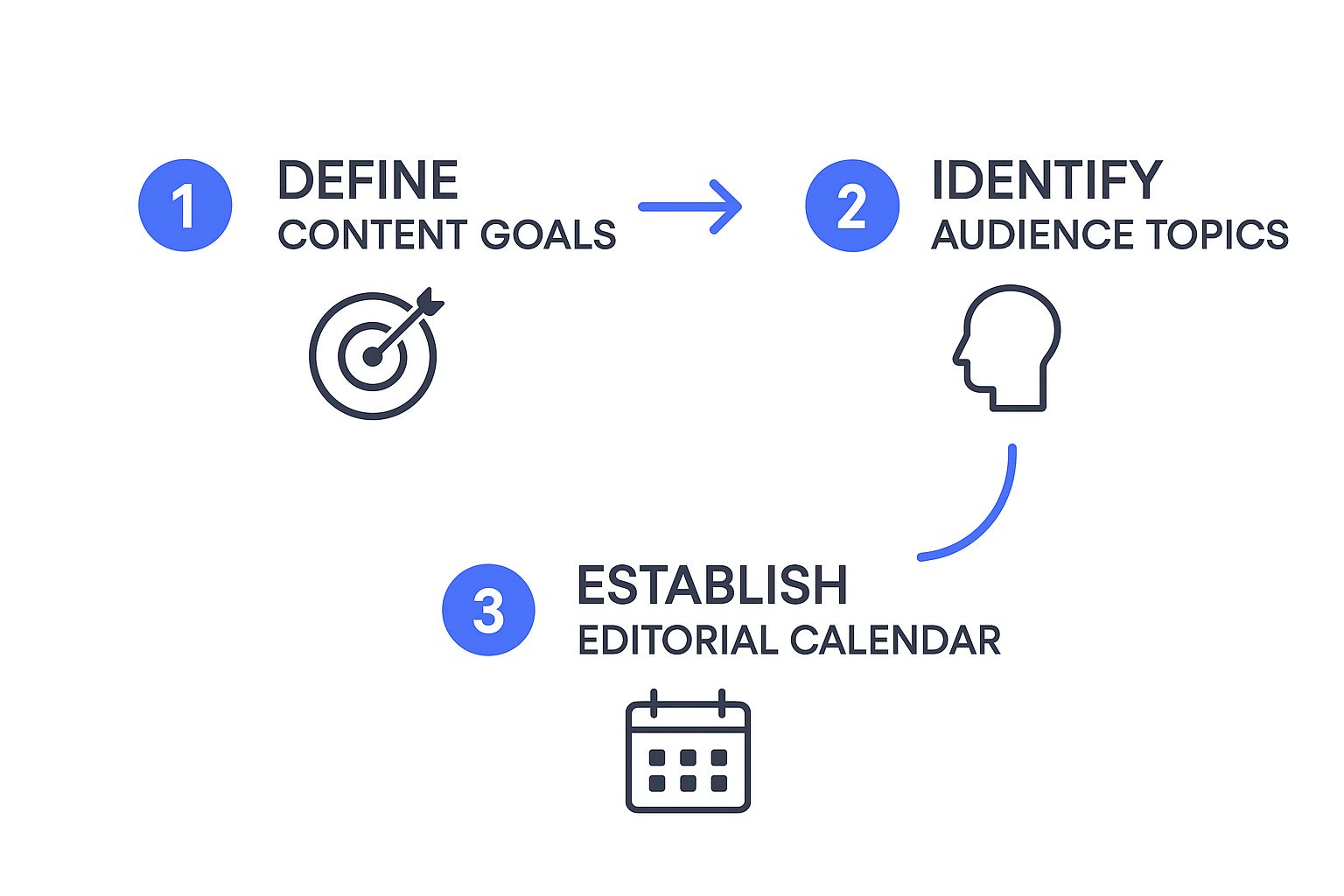
Following this process ensures that your content strategy is directly tied to business growth, turning your blog from a cost center into a revenue driver.
Creating Content That Actually Connects
Alright, you've done the strategic heavy lifting. Now for the fun part: turning all that customer insight into content that actually gets read, shared, and acted upon. This is where the rubber meets the road. For a startup running lean, your content creation process has to be smart, repeatable, and completely focused on delivering real value.
Forget pumping out content just to have something to post. Every single piece—whether it's a blog post grabbing new eyeballs or a case study sealing the deal—needs to have a job to do. Your mission is to gently guide your ideal customer from "Who are you?" to "Where do I sign up?" by answering their questions and solving their problems at every turn.

Brainstorming Ideas Mapped to the Customer Journey
Great content ideas don’t just appear out of thin air. They come directly from understanding your customer's journey. Mapping your ideas to their path ensures you're giving them the right information exactly when they need it most.
Let's break it down into three basic phases:
- Awareness: At this stage, people know they have a problem, but they don't know about you or your solution yet. Your content here should be purely educational. Think "how-to" guides, simple checklists, and articles answering their top-level questions like "how to improve team productivity." You're the helpful expert, not a salesperson.
- Consideration: Okay, now they're aware solutions like yours exist, and they're starting to shop around. This is where you can introduce your product. Case studies, honest competitor comparisons (e.g., "Slack vs. Microsoft Teams"), and deep-dive feature guides work wonders here.
- Decision: They're on the verge of making a purchase. Your content needs to give them that final nudge of confidence. This means crystal-clear pricing pages, implementation walkthroughs, and customer testimonials that provide that all-important social proof.
By organizing your content this way, you create a natural, cohesive experience that doesn't feel pushy. It all starts with the deep audience research you did earlier. If you need a refresher, our guide on https://fundediq.co/how-to-identify-target-customers/ will walk you through it.
Moving Beyond the Standard Blog Post
Look, blog posts are the bread and butter of most content strategies, and for good reason. But if that's all you're doing, you're leaving a lot on the table. People consume information differently, and diversifying your formats is one of the easiest ways to expand your reach.
The most effective content marketing for startups isn't about producing the most content; it's about producing the right content in the most impactful format for a specific audience and channel.
Shake things up with some of these high-impact alternatives:
- Short-Form Videos: Ideal for grabbing attention on TikTok or Instagram Reels. Use them to share a quick tip, debunk a common myth in your industry, or show a little behind-the-scenes personality. For example, a SaaS startup could create a 30-second video showing a little-known feature that saves users time.
- Shareable Infographics: Got some complex data or a step-by-step process? Turn it into a visually appealing graphic that people can easily digest and share. You don't need to be a designer—tools like Canva make this surprisingly simple.
- Simple Interactive Tools: Think about a basic calculator (like a "calculate your potential ROI" tool), a "what's right for you" quiz, or an interactive checklist. These are lead-generation gold because they provide immediate, tangible value.
The trick is to match the format to the message and the platform. A deep technical explanation belongs in a blog post, but a powerful customer story might land better as a short, emotional video.
Building a Practical Editorial Calendar
Consistency is what separates content marketing that works from content marketing that fizzles out. The secret weapon? A simple editorial calendar. It's the tool that turns your big ideas into a concrete, actionable plan.
This doesn't need to be some fancy, expensive software. A basic Google Sheet or a Trello board is all you need to get started.
At a minimum, your calendar should track a few key details:
| Column | Purpose | Example |
|---|---|---|
| Topic/Title | The working title of the content piece. | "5 Common Mistakes Early-Stage Startups Make with Funding" |
| Format | The type of content (e.g., blog post, video, infographic). | Blog Post |
| Funnel Stage | The customer journey stage it targets. | Awareness |
| Target Keyword | The primary SEO keyword you're aiming for. | "startup funding mistakes" |
| Author | Who is responsible for creating it. | Jane Doe |
| Status | Its current stage (e.g., Idea, In Progress, Published). | In Progress |
| Due Date | The target publication date. | 2024-10-15 |
This simple framework brings clarity to your process and ensures a steady stream of valuable content, even when you're a team of one. As you're writing, weaving in search engine optimization from the get-go is critical. For a masterclass on this, these actionable SEO content writing tips will dramatically improve your content's chances of getting found.
Don't be afraid to go in-depth. Recent data shows that longer content often performs better. In fact, articles between 1,000 and 2,000 words tend to get 56% more social media shares than shorter pieces. It’s a clear signal that audiences are hungry for substance, which is exactly what your startup should be providing.
Getting Your Content Seen by the Right People
Look, creating brilliant content is only half the battle. If your masterpiece just sits on your blog collecting digital dust, it might as well not exist. For a startup, smart distribution is everything—it’s how you turn all that hard work into real results like traffic, leads, and brand recognition, especially when you don't have a massive ad budget.
The goal isn't just to get clicks; it's to get the right clicks. You need to reach the people who are genuinely interested in what you have to offer. I've always found that a two-pronged approach works best here: you need to blend long-term organic growth with some immediate, hands-on promotion. Think of it as building a highway for future traffic while sending out personal invitations today.
Master the SEO Essentials for Long-Term Wins
Search Engine Optimization (SEO) is your startup’s engine for sustainable growth. It's a long game, for sure. You won't see results overnight. But the effort compounds over time, building a valuable asset that generates high-intent traffic for years to come. This is the complete opposite of paid ads, where the traffic vanishes the second you stop paying the bill.
To get started, here are the on-page SEO basics you absolutely must get right:
- Strategic Keyword Placement: Your main keyword needs to be in a few key places: your title, somewhere in the first 100 words, and in at least one subheading. This sends a crystal-clear signal to search engines about your content's focus.
- Compelling Meta Descriptions: This is the little blurb under your title in the search results. While it’s not a direct ranking factor, a well-written one can be the difference between someone clicking your link or scrolling right past it. A better click-through rate (CTR) is a ranking signal.
- Clean and Descriptive URLs: Keep them short and simple. For example,
yourstartup.com/blog/content-marketing-for-startupsis infinitely better than a jumbled mess likeyourstartup.com/blog/post-id-12345. - Internal Linking: This is an easy one. As you write, link to other relevant articles on your own site. This helps search engines find more of your content and, more importantly, keeps visitors on your site longer, which tells Google your stuff is valuable.
A common mistake I see startups make is treating SEO as an afterthought. You can’t just "sprinkle some SEO on" after you've written something. You have to build these practices into your content creation process from the very beginning to give every single piece its best shot at ranking.
Proactively Promote Your Content Where It Counts
While your SEO efforts are quietly building momentum in the background, you need to get your content in front of people now. This is all about being a helpful member of the communities where your ideal customers already hang out—not just spamming links everywhere.
The strategy is simple: find relevant conversations and add real value.
For instance, if you've just published a killer guide on startup funding, go find questions about it on Reddit's r/startups or in relevant LinkedIn groups. Don't just drop your link and run. Write a thoughtful, genuine answer to the person's question. Then, where it feels natural, mention that you've written a more detailed guide on the topic they might find useful. This approach positions you as a helpful expert first and a marketer second.
This kind of proactive strategy has become absolutely critical. In fact, 84% of companies globally now have defined content marketing strategies as of 2024. That high adoption rate shows just how vital content is for cutting through the noise. If you want to dive deeper, you can explore more data on the latest content marketing trends here.
The Art of Content Repurposing
As a startup, time is your most precious resource. Content repurposing is the ultimate hack for maximizing the return on every single hour you put into creating content. The idea is to take one big, substantial piece of content and slice it into multiple smaller assets you can use on different platforms.
Think about it: one in-depth blog post can easily be transformed into:
- A Series of Social Media Posts: Pull out key stats, surprising facts, or punchy quotes to create 5-10 posts for LinkedIn or X (formerly Twitter).
- A Short Explainer Video: Use the main points of your article as a rough script for a quick 2-3 minute video for YouTube or your website.
- An Informative Infographic: Visualize the core data or concepts from your post into a shareable graphic. A tool like Canva makes this surprisingly easy.
- An Email Newsletter: Send a summary of the article to your email subscribers. This not only pushes traffic to your new content but also nurtures your list. For more on this, check out our guide on how to https://fundediq.co/how-to-increase-email-open-rates/.
This "create once, distribute forever" mindset is a complete game-changer for lean teams. It ensures your best ideas reach the widest possible audience across every channel, helping you squeeze every last drop of value from your startup's content marketing efforts.
How to Measure and Scale Your Content Efforts
Creating content without measuring its performance is like driving with your eyes closed. You're putting in the effort, but you have no idea if you're actually moving in the right direction. This is the part where you stop treating content as just a creative exercise and start building a predictable engine for growth.
It’s all about looking at the right data to understand what's resonating, what's falling flat, and where you should be doubling down. We're not talking about vanity metrics like raw page views. We need data that tells a story about your audience and your business, helping you make smarter decisions that actually move the needle. This feedback loop is what separates good content from great content marketing.

Setting Up Your Measurement Toolkit
Before you can measure anything, you need the right tools in place. The good news? The most powerful ones to get you started are completely free. You don't need some complex, expensive analytics suite right out of the gate. You just need to get the basics right.
Your foundational toolkit should absolutely include:
- Google Analytics (GA4): Think of this as mission control for your website. It shows you who is visiting, how they found you, and what they do once they arrive.
- Google Search Console (GSC): This is your direct line to Google. GSC reveals the keywords bringing people to your site, how your pages are performing in search results, and any technical hiccups that might be holding you back.
Setting up both is non-negotiable. GA4 gives you the "what" (what people are doing), while GSC provides the "how" (how they're finding you via search). Together, they paint a remarkably clear picture of your organic performance.
Identifying the KPIs That Actually Matter
It’s incredibly easy to drown in data. The key is to laser-focus on a handful of Key Performance Indicators (KPIs) that tie directly back to your business goals. Chasing every single metric is a surefire way to get confused and frustrated.
For a startup, these are the essentials to watch:
- Organic Traffic: The number of people arriving from search engines. A steady, upward trend here is a powerful signal that your content and SEO efforts are gaining traction.
- Keyword Rankings: Keep an eye on your target keywords in Google Search Console. Watching a key term climb from the depths of page ten to the top of page one is a tangible sign of progress.
- Conversion Rate: This is where the rubber meets the road. It’s the percentage of visitors who take an action you care about, whether that’s signing up for a newsletter, downloading an ebook, or requesting a demo. This metric connects your content directly to business results.
- Traffic Source Quality: Dig into Google Analytics to see which channels (organic search, social, direct, etc.) bring in the most engaged visitors. Look at metrics like engagement rate and conversions by source to see which channels are delivering real value, not just clicks.
A classic mistake is obsessing over traffic numbers while ignoring conversions. A thousand visitors who bounce immediately are far less valuable than ten visitors who sign up for your trial. Always, always tie your content metrics back to tangible business goals.
The Content Review and Scaling Framework
Data is completely useless if you don't act on it. I recommend setting aside time for a content review every quarter. This is where you turn all those insights into a concrete, actionable plan for what to do next.
Your review process should answer three simple but powerful questions.
What Should We Double Down On?
First, look for your home runs. Dive into Google Analytics and find the pages that drive the most organic traffic and the most conversions. These are your proven winners.
Your job is to figure out how to replicate that success. Analyze these pieces: What topics do they cover? What format are they? Can you create more content around similar themes or in a similar style? This is usually the lowest-hanging fruit for generating more growth.
What Can We Update and Improve?
Next, head over to Google Search Console and find pages ranking on page two or three for valuable keywords. I call this "striking distance" content—it has clear potential but just needs a little push to get to the top.
Refreshing existing content is one of the highest-ROI activities you can do. Consider:
- Adding new, up-to-date information and statistics.
- Expanding sections to make the content more comprehensive.
- Improving on-page SEO with sharper headings and more internal links.
- Embedding new visuals like infographics, charts, or short videos.
From experience, a thorough content refresh can boost organic traffic to a single post by over 50%. It’s almost always easier than creating a brand-new piece from scratch.
What Is Our Most Profitable Content?
Finally, you have to connect your content to actual revenue. This means tracking which articles, guides, or videos are leading to your most qualified leads and paying customers. If you notice your "competitor comparison" articles are generating a ton of demo requests, that’s a massive signal to create more of them.
Understanding this helps you figure out the real value of your content efforts. To get even more specific, you can learn more about customer acquisition cost calculation to get a clearer picture of your content's true financial impact. This is how you make a bulletproof case for your content budget and scale things intelligently.
Common Questions from Startup Founders
Even with the best-laid plans, getting started with content marketing can feel like you're staring up at a mountain. I get it. Over the years, I've seen founders grapple with the same set of questions right out of the gate. Let's tackle them head-on with some straight-to-the-point answers.
How Much Should a Startup Budget for Content Marketing?
Look, there's no magic number here. A good rule of thumb for an early-stage company is to set aside 10-20% of your total marketing budget for content. But honestly, in the beginning, your biggest investment is going to be sweat equity, not cash.
Your first move isn't to spend a ton of money. It's to create a handful of "cornerstone" content pieces—those foundational articles or guides that solve your audience's most painful problems. You can get by with a small budget for a few key tools (think an SEO platform and an email service). As you start to see some traction, you can reinvest that into promotion or bringing on freelance help.
Remember, consistency trumps a large, sporadic budget every single time.
What Is More Important: SEO or Social Media?
This is a classic "which came first?" question, but it's not really an either-or. It's about a smart sequence. For the vast majority of B2B startups or companies with a considered purchase, SEO is the long-term prize. It’s how you build a real, sustainable asset that brings in qualified, high-intent traffic month after month.
Think of social media as the launchpad for your SEO rocket. It's fantastic for building brand awareness, getting a feel for your community, and driving that first wave of traffic to your content. A savvy approach is to use social channels for quick wins and early feedback while your SEO foundation is being laid. Just be patient—organic search is a long game and can easily take six to twelve months to really start cooking.
How Can We Create Content Without an Expert Writer?
Some of the best startup blogs I've ever seen were started by the founders themselves. You and your team are the actual subject matter experts. The challenge isn't a lack of knowledge; it's getting that expertise out of your head and onto the page.
Here’s how you can make that happen without being a professional writer:
- Document everything. Seriously. Just start writing down the answers to every single question prospects and customers ask you. That's your first batch of content ideas.
- Talk it out. Grab your phone, hit record, and explain a complex topic like you're talking to a new customer. Use a transcription service to turn that audio into a solid first draft.
- Hire for the task, not the knowledge. Jump on platforms like Upwork or Contently to find a good freelance writer. Your job isn't to be the writer; it's to be the expert who provides a killer brief, unique insights, and internal data. A good writer can then shape it into something great.
The most authentic and valuable content often comes directly from the source. Focus on providing genuine value and expertise; you can always polish the prose later. Authenticity connects far more deeply than perfect grammar ever will.
How Long Does It Take for Content Marketing to Show Results?
I'll be blunt: content marketing is a marathon, not a sprint. You might see some immediate buzz from a social media share, but the real, game-changing results from organic search typically take six to twelve months of consistent, quality work.
This timeline can shift based on how competitive your niche is, how often you publish, and how well you promote your work. In the first three to six months, keep an eye on leading indicators—things like keyword rankings starting to climb and a steady uptick in organic traffic. The tangible results, like a predictable stream of leads and a clear ROI, often start to become visible after the nine-month mark, once your content has had time to marinate and build authority with Google.
Ready to connect with startups at the perfect moment? FundedIQ delivers hand-curated lists of recently funded companies, complete with verified decision-maker contacts. Stop guessing and start engaging with high-intent leads today. Learn more about FundedIQ.