

Mastering What is a Sales Qualified Lead: A Quick Guide

- Unpacking the Sales Qualified Lead
- The Critical Difference Between MQLs and SQLs
- How to Qualify Leads with the BANT Framework
- Building an Effective Lead Scoring Model
- The Business Impact of a Strong SQL Process
- Best Practices for Converting SQLs into Customers
- Answering Your Top Questions About Sales Qualified Leads
Let's get one thing straight: not all leads are created equal. A Sales Qualified Lead (SQL) is someone who has officially raised their hand and shown they’re ready to talk business. They’ve moved past just browsing your content and are now seriously considering a purchase.
Think of it like this: a Marketing Qualified Lead (MQL) is someone window shopping, maybe admiring the display. An SQL is the person who walks into the store, makes a beeline for the sales counter, and says, "Can you tell me more about this?" This distinction is critical; a study by the Aberdeen Group found that companies with strong sales and marketing alignment achieve a 20% annual growth rate, compared to a 4% decline in companies with poor alignment.
Unpacking the Sales Qualified Lead

Defining an SQL isn’t just about ticking a box in your CRM. It’s about creating a crystal-clear signal that tells your sales team, "This one's worth your time." An SQL has not only shown strong buying intent but also meets the specific, pre-agreed criteria that your sales team has set. This is the official handoff—the moment a lead graduates from a marketing nurture-track to a top sales priority.
Unlike someone who might just download an introductory ebook (a classic MQL action), an SQL takes actions that scream "I'm ready to buy." These are what we call "bottom-of-the-funnel" activities, such as requesting a demo or filling out a "contact sales" form. They're the green light your sales reps have been waiting for.
Core Characteristics of an SQL
So, how do you spot an SQL in the wild? It really boils down to two things: fit and intent. The lead has to look like your ideal customer and act like they're ready to make a move.
Here are a few tell-tale signs:
- Explicit Interest: They don't beat around the bush. They ask for a demo, request a price quote, or jump into a free trial. For example, a lead filling out a form with the title "Request a Personalized Quote" is an unambiguous SQL signal.
- High-Value Engagement: They keep coming back to your high-stakes web pages, like pricing, case studies, or detailed feature comparisons. A practical insight is to track repeat visits to these pages within a short timeframe (e.g., three visits in one week) as a strong indicator of intent.
- Problem Awareness: The questions they ask prove they understand their own pain points and are actively looking for the right fix. A lead asking, "How does your software integrate with Salesforce?" shows they are already visualizing implementation, not just browsing.
To make this even clearer, here's a quick summary of what makes an SQL stand out.
At-a-Glance SQL Characteristics
| Attribute | Description | Example Action |
|---|---|---|
| High Intent | The lead shows clear and direct interest in making a purchase soon. | Requesting a personalized product demo or a pricing consultation. |
| Good Fit | They match your Ideal Customer Profile (ICP) for company size, industry, role, etc. | A Director of Operations at a 200-person tech company (if that's your target). |
| Problem Aware | They have a defined pain point and are actively looking for a solution. | Asking specific questions about how your tool solves a particular workflow issue. |
| Ready for Sales | Their behavior indicates they are open to and expecting a direct conversation with a salesperson. | Filling out a "Contact Sales" form. |
This combination of fit and intent is what separates a genuine opportunity from a time-wasting dead end.
A Sales Qualified Lead has been researched and vetted—first by a company’s marketing department, then by its sales team—and is ready for the next stage in the sales process. It’s the official handoff point between marketing and sales.
This crucial vetting process stops your sales team from chasing prospects who aren't a good fit or simply aren't ready to buy. When you focus your energy on genuinely qualified leads, you're not just working harder; you're working smarter. This focus helps companies see a significant boost in their close rates because they're engaging with people who have a real chance of becoming customers. For a deeper dive, you can find more insights about SQLs on Piwik PRO.
In the end, having a solid, shared understanding of what is a sales qualified lead is the bedrock of an efficient sales process. It gets your marketing and sales teams on the same page, working toward the same goal: turning high-potential leads into happy, long-term customers.
The Critical Difference Between MQLs and SQLs
Getting the handoff between your marketing and sales teams right is a game-changer, and it all comes down to knowing the difference between a Marketing Qualified Lead (MQL) and a Sales Qualified Lead (SQL).
Think of it like a relay race. Marketing kicks things off, building speed and carrying the baton—the lead. They don't just pass it off to the next runner blindly. The exchange has to be perfectly timed to keep the momentum going and sprint toward the finish line, which in this case, is a closed deal. Mismanaging this handoff is costly; research from MarketingSherpa shows that 79% of marketing leads never convert into sales, with a lack of lead nurturing being the main cause.
An MQL is someone your marketing team has flagged as being more likely to become a customer than other leads. They're interested, but they're not quite ready for a sales call. An SQL, on the other hand, is a lead who has not only been nurtured by marketing but has been vetted and deemed ready for a direct conversation with a salesperson. The real distinction here is purchase intent.
From Early Interest to Active Consideration
A lead’s actions speak volumes about where they are in their buying journey. MQLs are usually in the early stages, just starting to gather information. They’re downloading ebooks, signing up for webinars, and exploring solutions to a problem they've just identified. Their behavior is very top-of-funnel.
SQLs, however, have progressed to the decision phase. They're no longer just browsing; they're actively evaluating options. A practical example of this shift is a lead who moves from downloading a general industry report (MQL) to using an ROI calculator on your website (SQL). This is the moment a lead shifts from passive learning to active shopping, and it’s the green light for your sales team to step in.
The core difference between a marketing-qualified lead and a sales-qualified lead is their intent to buy. Each one needs a completely different approach to guide them forward effectively.
Nailing down this distinction with a clear, shared process is crucial. It stops sales from burning valuable time on leads who aren't ready and helps marketing know exactly when to nurture and when to pass the baton.
MQL vs SQL A Clear Comparison
To really see the difference, it helps to put them side-by-side. The table below breaks down the key distinctions in what they do, what they want, and which team is responsible for them. This clarity is what transforms a clumsy, disjointed handoff into a smooth, revenue-generating process.
| Characteristic | Marketing Qualified Lead (MQL) | Sales Qualified Lead (SQL) |
|---|---|---|
| Primary Goal | To educate and nurture with helpful content, building brand trust along the way. | To have a direct sales conversation, solve a specific problem, and close the deal. |
| Example Actions | Downloading a whitepaper, subscribing to a newsletter, or following on social media. | Requesting a personalized demo, asking for a price quote, or filling out a "Contact Sales" form. |
| Sales Readiness | Interested in what you offer, but not yet prepared to talk to a salesperson. | Has shown clear buying signals and is ready for a direct sales consultation. |
| Team Ownership | Owned and nurtured by the marketing team. | Vetted by marketing, then accepted and owned by the sales team for follow-up. |
Having this structure in place means your sales reps can focus their energy where it counts: on conversations with a high probability of turning into customers. If you don't distinguish between these stages, it's like dropping the baton in the middle of the race—you lose all your momentum and probably the customer, too.
How to Qualify Leads with the BANT Framework
Spotting a lead with potential is one thing, but knowing if they're a real sales opportunity? That requires a system. This is where qualification frameworks come in, turning what can feel like a guessing game into a repeatable, scientific process. One of the most tried-and-true methods out there is the BANT framework—a simple but incredibly effective tool for vetting prospects.
Originally developed by IBM decades ago, BANT acts as a quick checklist to see if a lead is actually ready for a sales conversation. The acronym stands for Budget, Authority, Need, and Timeline. By asking the right questions around these four key areas, your sales team can quickly gauge a lead's potential and focus their energy where it counts. To really get this right, it’s essential to master your lead qualification process so that every potential customer is evaluated consistently.
Understanding the Four Pillars of BANT
The BANT framework is all about getting past surface-level interest. Each part of the acronym touches on a critical piece of the buying decision, helping you build a 360-degree view of the opportunity at hand.
Here’s a closer look at each pillar:
- Budget: Can the prospect actually afford your solution? This isn't about getting a look at their bank account. A practical question here might be, "Have you allocated a budget for solving this issue?" or "What kind of ROI are you hoping to see from this investment?"
- Authority: Are you talking to the person who signs the checks? Or are they an influencer who can champion your cause internally? Pinpointing the actual decision-maker is key. An example question is, "Besides yourself, who else is involved in the decision-making process for new tools?"
- Need: Does this prospect have a real, pressing problem that your product or service is uniquely positioned to solve? A genuine need is what truly fuels a purchase. You can probe for this by asking, "What are the biggest challenges you're facing with your current process?"
- Timeline: How soon is the prospect looking to buy? Urgency is often the dividing line between a hot lead and one that needs to be sent back to marketing for a bit more nurturing. A good question is, "What's the timeline for implementing a solution like this?"
This decision tree gives you a simplified look at how leads move from just being curious to showing clear intent to buy—which is exactly what BANT helps you uncover.
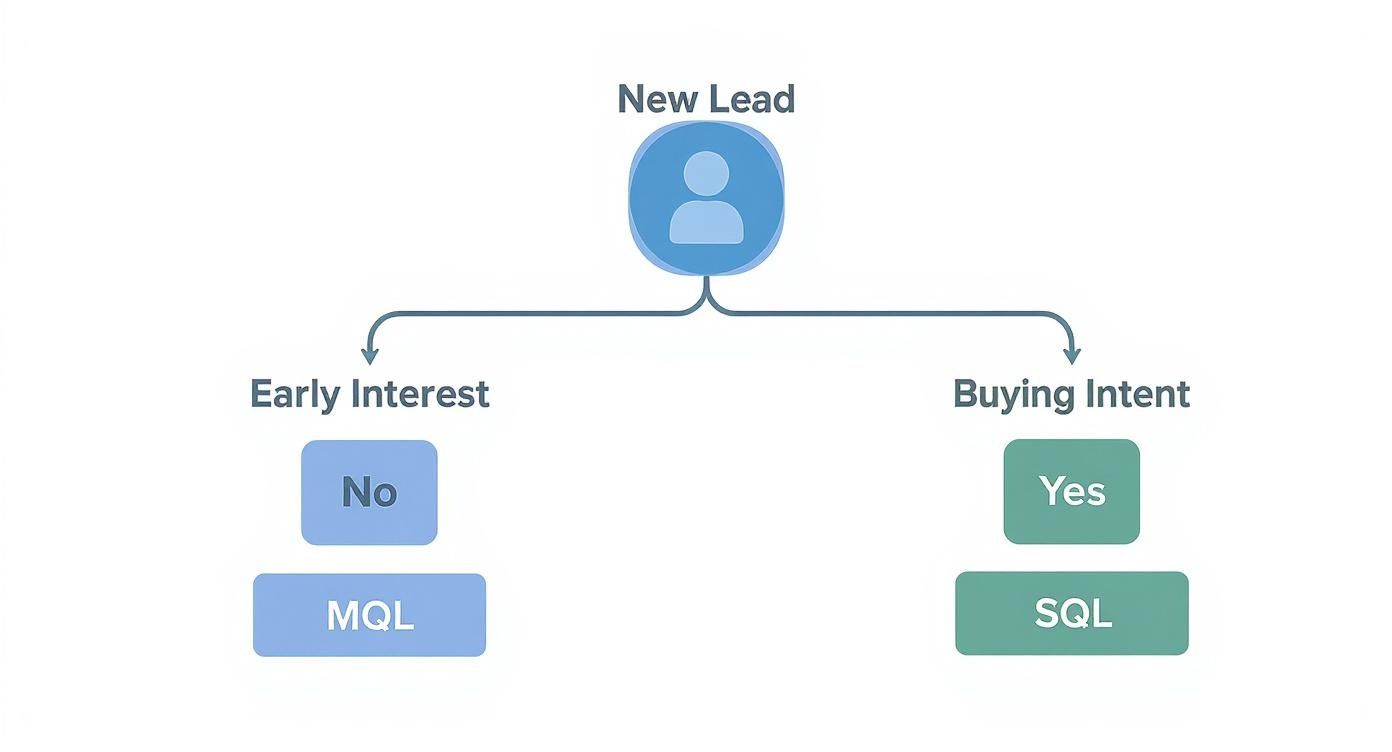
As you can see, that "buying intent" checkpoint is the crucial step that separates an MQL from an SQL. Frameworks like BANT are built to verify that intent.
Asking Smarter BANT Questions
The real magic of BANT isn't in the acronym itself, but in how you use it. You want to ask insightful questions that get to the heart of the matter. This shouldn't feel like an interrogation; the best reps weave these questions into a natural, consultative conversation, gathering info while building trust.
The goal isn’t to just tick boxes. It's to understand the prospect's world—their challenges, priorities, and decision-making process—to see if you can genuinely help them succeed.
For instance, instead of bluntly asking, "What's your budget?" you could try a more strategic approach. Something like, "What are you currently spending to manage this problem, including the cost of inefficiencies?" This simple shift reframes the conversation around value and ROI, not just price. If you want to dive deeper, our complete guide on how to qualify sales leads has plenty more strategies and frameworks.
While BANT is a fantastic place to start, it’s not the only game in town. More modern frameworks like CHAMP (Challenges, Authority, Money, Prioritization) and MEDDIC (Metrics, Economic Buyer, Decision Criteria, Decision Process, Identify Pain, Champion) offer different angles that might be a better fit for more complex sales cycles. The trick is to pick a framework, tweak it to fit your business, and use it consistently to build a pipeline full of high-quality sales qualified leads.
Building an Effective Lead Scoring Model
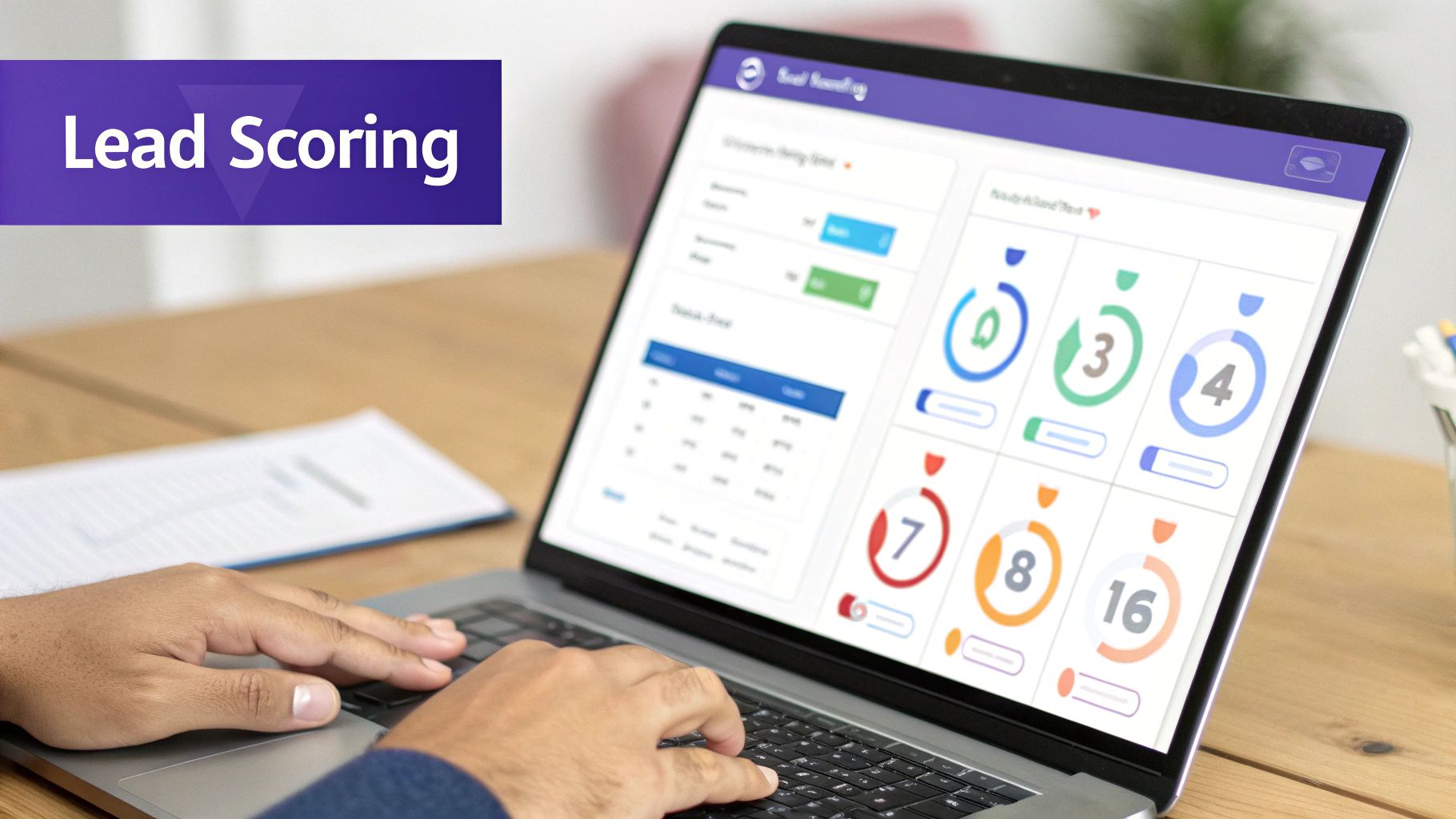
So, how do you turn all this qualification theory into a system that actually works and scales? The answer is a lead scoring model. Think of it as an automated engine that constantly sifts through your contacts, assigning points based on who they are and what they do.
This process ensures your best leads rise to the top so high-potential prospects don't slip through the cracks. It gives your sales team a clear, prioritized list of who to call next, taking the guesswork out of their day. The system works by blending two crucial types of data: information people give you directly and information you gather from their behavior.
Combining Explicit and Implicit Scoring
A truly effective model never relies on just one type of information. It weaves them together to create a complete picture of a lead's potential. It's about assessing both who they are and what they're doing.
-
Explicit Scoring (Fit): This is all about the hard data—the firmographic and demographic details that tell you how well a lead matches your Ideal Customer Profile (ICP). You assign points for attributes like their job title, company size, industry, or location. For instance, a "Director of Marketing" might earn +15 points, while an "Intern" gets a +0. A practical tip is to also assign negative scores for poor fits, such as a student email address (-10 points) or a competitor's domain (-20 points).
-
Implicit Scoring (Intent): This is where behavior comes in. A lead’s actions reveal their level of interest and how close they are to making a decision. Someone visiting your pricing page is showing a much stronger buying signal than someone who only reads a single blog post. You can learn more about how user actions signal readiness in our guide on what is intent data.
A great lead scoring model is like a GPS for your sales team. It doesn’t just show them a list of leads; it highlights the fastest and most promising routes to a closed deal.
This combined score tells you not only if a lead is a good fit for your business but also how engaged they are right now. A request for a product demo, for example, is a high-intent action worth +25 points, while a simple newsletter subscription might only be worth +5.
Once a lead's total score crosses a specific threshold you've set (e.g., 100 points), they officially become a sales qualified lead. This should trigger an immediate alert for a sales rep to reach out.
Refining Your Model Over Time
Lead scoring isn't a "set it and forget it" task. The best models are living systems that need regular check-ups and adjustments. The real test is simple: are the leads your model flags as "hot" actually turning into customers?
Look back at your closed-won deals. What did those customers have in common? What specific actions did they take right before they bought? Use those insights to tweak your point values. Maybe you find that leads who attend a particular webinar have a 50% higher close rate. That action clearly deserves a major point boost in your model. Conversely, if you notice leads who download a certain e-book rarely convert, you may want to lower its point value.
This constant feedback loop is what makes your system smarter over time, continuously sharpening its ability to pinpoint your next best customer. For a deeper dive into optimizing your system, check out these lead scoring best practices.
The Business Impact of a Strong SQL Process
Defining criteria and scoring leads is a lot of work. So, why bother? The truth is, a solid Sales Qualified Lead (SQL) process does more than just bump up revenue—it sends positive ripples across your entire business. It fundamentally changes the game for your sales and marketing teams, forcing a shift from a "more is better" mentality to a laser focus on quality.
This refined focus pays off in pure efficiency. Think about it: when your sales reps stop wasting hours chasing leads who are just kicking tires, they can pour that energy into what they're truly good at: building relationships and closing deals. They get to have meaningful, consultative conversations with people who are actually ready to buy. This isn't just theory; companies with mature lead management processes see a 9.3% higher sales quota achievement rate.
Boosting Sales Performance and Predictability
A well-oiled SQL process also brings something every sales leader craves: predictability. When the leads flowing into your pipeline have been properly vetted against criteria like Budget, Authority, Need, and Timeline (BANT), your pipeline stops being a list of hopes and starts being a reliable map of future revenue. You can forecast with real confidence because your projections are built on solid ground, not just wishful thinking.
This has a direct effect on your team's success. Research shows that companies that nail down their SQL definition see their sales teams achieve a 9.3% higher quota attainment rate. It makes sense—when you arm your reps with a pipeline full of high-potential leads, you’re dramatically improving their odds of winning. You can explore the full research on sales lead qualification from Zendesk to see the data for yourself.
Aligning Marketing and Sales for Growth
But perhaps the biggest win of all is the powerful alignment it creates between marketing and sales. When everyone agrees on what a "good lead" looks like, both teams start pulling in the same direction. Marketing shifts its efforts to generating high-quality leads that sales is excited to work, and sales, in turn, provides priceless feedback on which leads are closing.
A strong SQL process transforms the relationship between marketing and sales from a disconnected handoff to a collaborative partnership focused on driving revenue.
This feedback loop is where the magic happens. It helps marketing fine-tune its campaigns to attract even better prospects, while sales gets a clearer picture of marketing's impact. A practical example of this alignment is a weekly meeting where sales shares insights on SQL quality ("The leads from the webinar were great, but the ones from the e-book were tire-kickers"), allowing marketing to reallocate budget to more effective channels in real-time. The result is a smoother customer journey and a more cohesive, powerful revenue engine for the whole company.
Best Practices for Converting SQLs into Customers
https://www.youtube.com/embed/3PwVVFR8zg0
Once a lead hits that sales qualified lead (SQL) milestone, the race is on. Seriously, the clock starts ticking immediately. Any hesitation on your part is an open invitation for a competitor to swoop in or for your prospect's initial excitement to fade.
When it comes to turning an SQL into a customer, one thing matters more than anything else: speed to lead.
How much does it matter? Research by Lead Response Management found that responding to a lead within five minutes increases your odds of converting them by 9 times compared to responding after ten minutes. This isn't just about being quick for the sake of it; it’s about striking while the iron is hot and their interest is at its absolute peak. That immediate follow-up sends a powerful message that you're on the ball and ready to help.
Personalize Your Outreach
A cookie-cutter sales pitch is a death sentence for a promising SQL. Remember, this lead became "qualified" because they took specific actions. Maybe they downloaded a case study about a particular industry challenge or spent five minutes digging into your pricing page. That behavior is a treasure map.
Use that map! Your first outreach needs to connect directly to what they did. Ditch the generic "Thanks for your interest" and try something that shows you've been paying attention.
"I saw you were checking out our case study on improving logistics efficiency. A lot of companies in your space are struggling with that right now. I’d love to share a few ideas on how we've helped others solve it."
See the difference? You’ve instantly shifted from a salesperson pushing a product to a consultant offering a solution. That simple change builds trust and rapport right from the get-go.
Employ a Multi-Channel Strategy
Don't rely on a single email and hope for the best. Everyone has their preferred way of communicating, so spreading your follow-up across a few different channels is a smart move that drastically improves your odds of connecting. Data shows that sales cadences with 6-8 touchpoints achieve the highest conversion rates.
Try blending a few methods together for a powerful one-two punch:
- Phone Call: Nothing beats a direct call for a real, meaningful conversation. It’s often the fastest way to get things moving.
- Personalized Email: After the call (or if you get voicemail), send an email that recaps your conversation and includes a helpful resource or two.
- LinkedIn Connection: A connection request with a short, personalized note is a great, low-pressure way to build a professional relationship.
This multi-pronged approach keeps you on their radar without being annoying. While these tactics are perfect for that initial, critical engagement, remember that a solid long-term strategy is just as important. We cover that in more detail in our guide on what is lead nurturing. Put these practices to work, and you'll find your SQLs consistently turning into your best new customers.
Answering Your Top Questions About Sales Qualified Leads
As you start to fine-tune your sales process, a few practical questions about SQLs always seem to pop up. Getting these details right is what separates a smooth, efficient sales engine from one that constantly stalls.
Let's tackle some of the most common questions that come up when teams start putting the SQL definition into action.
How Long Does it Take for an MQL to Become an SQL?
Honestly, there's no universal timeline. The journey from a Marketing Qualified Lead (MQL) to a sales-ready SQL can be anything from a few minutes to several months. The two biggest factors are your product's complexity and the length of your typical sales cycle.
Think about it this way: for a simple B2C product, a customer might see an ad, download a guide, and request a demo all in one afternoon. That's a rapid-fire transition. But for a high-ticket enterprise software solution, a lead might need months of nurturing—attending webinars, reading case studies, and getting internal buy-in—before they're truly ready to talk to a salesperson. The trick is to watch for engagement triggers, not the clock.
What Happens if Sales Rejects a Lead?
It’s going to happen, and that’s okay. The most important thing is what you do next. When a salesperson rejects a lead, it shouldn't just be tossed aside. The key is to build a solid feedback loop between your sales and marketing teams.
An SQL rejection isn't a dead end; it's a detour. The lead should be sent back to marketing with specific notes explaining why they weren't ready. This process, often called "lead recycling," saves potential deals and sharpens your qualification criteria over time.
For example, a sales rep might reject a lead with the note, "Great fit, but timeline is 12+ months out." This feedback is gold—it tells marketing to place the lead into a long-term nurture sequence to keep them warm, rather than letting a future opportunity go cold.
Can a Lead Become an SQL Without Ever Talking to a Human?
You bet. This is becoming more and more common, especially for companies with a product-led growth (PLG) model. A user's actions inside your software can be a more powerful buying signal than any form they fill out.
For example, if someone on a free trial suddenly starts using advanced features, invites their entire team to the platform, or keeps visiting the pricing page, they are practically waving a flag saying, "I'm ready to buy!" Many platforms are now designed to automatically trigger an SQL status when a user hits a certain usage threshold, prompting sales to reach out proactively.
Ready to skip the guesswork and connect directly with high-intent, recently funded startups? FundedIQ delivers hand-curated lists of decision-makers at companies with fresh capital, ready to invest in growth. Stop chasing cold leads and start engaging prospects at the perfect moment. Explore your next customers with FundedIQ.