

Follow Up Email After No Response That Gets Replies
Sending a great follow up email after no response is a delicate dance. It's part timing, part genuine personalization, and part offering something truly valuable. The trick is to shift your mindset away from the generic "just checking in" and toward providing a real reason for them to hit reply. When you do that, you'll start cutting through the noise and getting the responses you've been waiting for.
Why Your Follow-Up Emails Are Being Ignored
We've all been there. You craft what you think is a perfect email, hit send, and then… crickets. It's easy to chalk it up to the other person being "too busy," but the truth is usually a bit more complicated. Figuring out why your messages are getting lost in the void is the first real step toward fixing the problem.
At the end of the day, it's a battle of volume versus value. The average professional is bombarded with over 121 emails per day according to Radicati Group, a number that's only growing. This turns their inbox into a high-stakes competition for attention. If your follow-up doesn't immediately scream "this is worth your time," it's getting archived or deleted. Simple as that.
The Psychology of Inbox Overload
Let's be honest: when people open their inbox, they aren't reading every word. They're scanning. They’re making snap judgments based on who the email is from, the subject line, and maybe the first sentence. Your message isn't just competing with other important work emails; it's fighting for space against newsletters, spam, and a hundred internal pings.
This sets a ridiculously high bar. Any message that feels like a copy-paste template or asks the recipient to do the heavy lifting is going to be ignored. It sends a clear signal that your request isn't as important as the dozens of other things on their plate. For example, asking "Did you get my last email?" forces them to stop, search, and work—a guaranteed path to the archive folder.
The Critical Role of Persistence
Here's where most people go wrong: they give up way too soon. They send one email, hear nothing back, and assume it's a lost cause. But smart, respectful persistence is the name of the game.
The numbers don't lie. Only 2% of sales are made on the first contact, while a whopping 80% of deals require five or more follow-ups to close. Yet, an estimated 92% of salespeople throw in the towel after just four attempts, which means they're walking away from a massive amount of opportunity. If you're curious, you can explore more sales follow-up statistics that paint a pretty clear picture.
A follow-up isn’t just a reminder. It’s a new opportunity to provide value, build rapport, and give them another reason to engage.
And sometimes, the problem is more technical. Your email might just be getting lost in cyberspace. It's not always about what you send, but whether it actually arrives. To make sure you're landing in the main inbox, you can check out our guide on how to improve email deliverability. Once you get a handle on these common pitfalls, you can start crafting a follow up email after no response that’s strategic, valuable, and nearly impossible to ignore.
Common Follow-Up Mistakes and How to Fix Them
It's easy to fall into bad habits when you're sending a lot of emails. Here’s a quick rundown of the most common mistakes I see people make and how to steer clear of them.
| Common Mistake | Why It Fails | Actionable Solution |
|---|---|---|
| Vague Subject Line | It gets lost in a crowded inbox and doesn’t create any urgency or interest. Subject lines like "Checking in" are easily ignored. | Be specific and compelling. Use their name or reference a previous conversation. Try: "Following up on our content marketing chat" |
| Putting the Work on Them | Asking "Did you have a chance to look at my proposal?" makes them feel guilty and requires them to go find your old email. | Make it effortless. Re-attach the document or summarize the key point in one sentence. Provide a clear, simple call-to-action. |
| Giving Up Too Soon | Most people need multiple touchpoints before they respond. Sending one follow-up and stopping leaves money on the table. | Create a simple follow-up sequence. Plan for 3-5 gentle, value-added nudges spaced a few days apart. |
| Sending a "Me-Focused" Email | Your email is all about what you need from them, with no mention of what's in it for them. | Flip the script. Every follow-up should offer something of value—a new resource, an interesting article, or a helpful tip. |
By avoiding these common traps, you'll immediately put yourself ahead of the pack and significantly increase your chances of getting that coveted reply.
Finding the Perfect Timing and Cadence
Let's be honest, sending a great follow-up email is only half the battle. If you send it at the wrong time, it’s just noise. Nailing your timing and cadence is what keeps you top-of-mind without turning into a pest.
Think of it this way: your first email is the opening line. If it doesn't get a response, your follow-up needs to make a real entrance. The trick is to give them enough breathing room to read your first message, but not so much time that they've completely forgotten who you are. A study by Woodpecker found that sending a follow-up within 1-3 days can boost reply rates by over 65%.
This is where a solid strategy comes in, starting with the all-important element of timing.
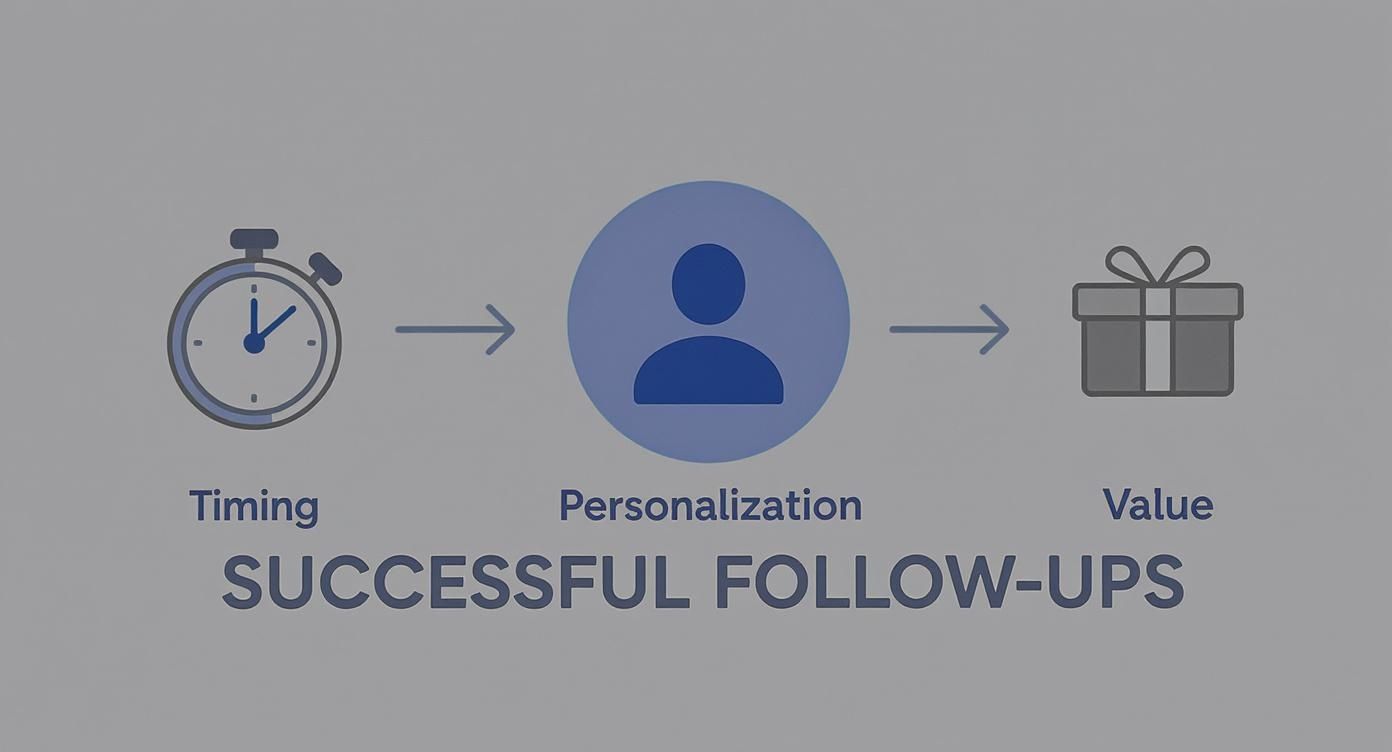
As you can see, getting the timing right is the foundation. It sets you up to deliver personalized value in a way that respects their inbox and actually earns their attention.
The 1-3-7 Day Model Explained
Over the years, a simple but effective framework has proven its worth time and again: the 1-3-7 day model. It gives you a reliable structure that stops you from bombarding someone's inbox.
Here’s a quick breakdown of how it works in practice:
- Day 1: You send the initial email.
- Day 3: The first follow-up goes out (2-3 business days later). This is your gentle nudge, perfect for catching someone who was busy and just missed it.
- Day 7: The second follow-up arrives (about a week after the first email). At this point, you need to bring something new to the table to reignite their interest.
After that initial sequence, I usually space out any further emails by at least another week. This rhythm shows persistence without coming across as desperate. You can find more detailed sequences by looking into different sales cadence best practices that might be a better fit for your specific industry.
Adapt Your Timing to the Context
The 1-3-7 model is a fantastic starting point, but it's not a rigid rule. You have to adapt. The right timing really depends on who you're talking to and why you reached out in the first place.
For example, if you just had a great chat with someone at a networking event, follow up within 24-48 hours while the conversation is still fresh in their mind. But if you’ve sent a complex sales proposal, you need to give them a few extra days to digest it before you check in.
Here are a few scenarios I see all the time:
- Post-Networking: A 1-2 day turnaround is perfect for cementing the new connection.
- Sales Prospecting: Give it 2-4 business days. This lets them consider your pitch without feeling pressured.
- Job Application: Wait 5-7 business days. Recruiters are juggling dozens of candidates and need that time.
- After a Meeting/Demo: Send a thank-you or summary email the same day. Then, follow up with more value 3-5 days later.
Navigating Time Zones and Weekday Chaos
Timing isn’t just about the number of days you wait—it's also about the specific time you hit "send." I've learned the hard way to avoid the Monday morning email dump. Your message will get buried. The same goes for Friday afternoons when everyone's mentally checked out for the weekend.
Based on what I've seen and what the data shows, mid-morning (around 10 AM) on Tuesdays and Thursdays are the sweet spots. People are settled in but not yet swamped.
And please, always check the recipient's time zone! A 10 AM email from your desk in New York is a painfully early 7 AM wake-up call in California. A quick Google search or a scheduling tool can save you from this rookie mistake.
While persistence is a virtue, there’s a definite line. An extensive analysis of 16.5 million cold emails showed that while the first email gets the highest reply rate at 8.4%, the numbers drop with each follow-up. Worse, sending four or more can triple your unsubscribe and spam complaints. This is why a concise, value-packed follow-up strategy is non-negotiable—it respects their inbox and gets you better results.
Crafting Follow Up Emails That People Actually Read

Knowing when to send a follow-up is half the battle. Knowing what to say is where the real art comes in. An effective follow-up email is a masterclass in brevity, value, and clarity. You’re not just pinging someone’s inbox to remind them you exist; you're giving them a fresh, compelling reason to engage.
The structure of your email can make or break your chances of getting a reply. Every single part, from the subject line that earns the click to the call-to-action that gets a response, has a job to do. This is where we’ll move past generic templates and really dig into the anatomy of an email that’s impossible to ignore.
The Power of a Compelling Subject Line
Let's be honest: your subject line is the gatekeeper. It's the first thing people see, and research consistently shows it's the biggest factor in whether your email even gets opened. Vague, lazy phrases like "Checking in" or "Following up" are just begging to be archived or deleted. In fact, 47% of email recipients open emails based on the subject line alone.
To cut through the noise, you need to be specific and provide context. The easiest win? Just reply to your original email thread. This keeps the entire conversation history intact, jogging their memory instantly. The "Re:" prefix does the heavy lifting for you.
If you’re sending a later follow-up and want to try a fresh angle, a new, direct subject line can work wonders:
- "Quick question about our content marketing chat"
- "A few ideas for [Their Company Name]"
- "Following up on the proposal for [Project Name]"
These examples work because they’re direct, personalized, and hint at the value waiting inside. You can find more great ideas by digging into email subject line best practices to boost your open rates. The key is to spark curiosity without sounding like clickbait.
Add New Value with Every Message
The single biggest mistake I see people make when writing a follow up email after no response is simply repeating their original request. It adds zero new value and, frankly, can come across as nagging. Instead, treat each follow-up as a new opportunity to be genuinely helpful.
Think of it as layering your value. If your first email introduced an idea, your follow-up can provide evidence or a new resource that supports it.
The golden rule of follow-ups is simple: never show up empty-handed. Each message should feel less like a reminder and more like a thoughtful, helpful touchpoint.
Here are a few practical ways to add real value:
- Share a Relevant Resource: Find a recent article, case study, or industry report that ties into your last conversation. Frame it naturally: "Saw this and thought of our conversation about [topic]."
- Offer a Surprising Insight: Provide a small piece of data or an interesting observation about their industry or even a competitor. This shows you’re paying attention to their world.
- Provide a Helpful Tool: Mention a free tool or a useful template that could help them solve a minor problem related to their role.
When you offer something useful, you shift the entire dynamic. You’re no longer just asking for their time; you’re giving them something of value. This generous approach builds goodwill and makes a reply feel much more natural for them.
Structuring Your Follow Up for Maximum Impact
Once you’ve nailed the subject line and have your value-add ready, the body of the email needs to be incredibly concise and scannable. Busy professionals don't read walls of text. Keep your sentences short and your paragraphs to just a line or two. Research from Boomerang suggests that emails between 50 and 125 words have the best response rates, hitting above 50%.
A simple, effective structure looks something like this:
- A Quick, Contextual Opener: Gently remind them of your last interaction. "I'm circling back on my email from last week about…"
- The Value Add: This is the heart of your email. "I came across this case study on [topic] and thought it might be useful for your team."
- A Clear, Low-Friction Call-to-Action (CTA): Make it ridiculously easy for them to say yes. Ditch the vague "Let me know your thoughts" and ask a simple, direct question.
A great CTA, for example, might be: "Does a 15-minute call next Tuesday or Thursday afternoon work to discuss this?" This only requires a simple yes/no and removes the mental energy of them having to check calendars and propose times. Crafting the right message is especially crucial for job seekers, and these job follow-up email tips offer some fantastic insights to help you make a lasting impression.
Follow-Up Template Breakdown for Different Scenarios
While every email needs a personal touch, it helps to understand the core components that work in different professional situations. Think of these as frameworks, not copy-paste scripts. Here's a breakdown of how you might adapt your approach based on the scenario.
This table offers a detailed look at follow-up email templates for various professional situations, highlighting key phrases and strategic elements that work.
| Scenario | Subject Line Example | Key Value Add | Effective Call-to-Action |
|---|---|---|---|
| Sales Prospecting | Re: A few ideas for [Company Name] | A link to a relevant case study or a short, customized video explaining a key benefit. | "Are you free for a 10-minute call next week to see if this is a fit?" |
| After a Job Interview | Re: Following up on the [Job Title] role | Reiterate your enthusiasm and briefly mention another relevant skill or idea you had post-interview. | "I'm looking forward to hearing about the next steps when you have an update." |
| Networking Follow-Up | Great connecting at [Event Name]! | Share an article related to your conversation or offer to make a helpful introduction for them. | "If you're open to it, I'd love to continue our conversation over a quick coffee next month." |
| After Sending a Proposal | Re: Proposal for [Project Name] | Highlight a specific, high-impact section of the proposal and how it solves their main pain point. | "Do you have any initial questions I can clarify about the proposal?" |
By tailoring your value proposition and call-to-action to the specific context, you dramatically increase the odds that your follow-up will not only be read but will also get the response you're hoping for.
Make It Personal to Get a Reply
Let's be honest: a generic follow-up is a deleted follow-up. Inboxes are battlegrounds for attention, and the single best way to make your follow up email after no response actually land is to prove it was written for a real person. Just using their first name isn't enough anymore; that’s table stakes.
The real goal is to make your email feel like a one-on-one conversation, not something blasted out to a list of a thousand people. This takes a few minutes of homework, but that small investment shows you have genuine interest and respect their time—making them far more likely to hit "reply."

Think Beyond "Hi [First Name]"
Real personalization is about finding a specific, relevant hook that connects your message to what’s happening in their world right now. You’re not trying to be a private investigator; you’re just paying attention to their professional life. A few minutes of targeted searching is all it takes.
Here are a few easy-to-find triggers you can use to start a real conversation:
- A Recent Company Win: Did their company just launch a new product, close a funding round, or get a great write-up? Check their company’s news page or LinkedIn feed.
- Something They Shared: Head over to their LinkedIn or Twitter. Referencing an article they posted or a comment they made shows you’re paying attention to their interests.
- A Quote from a Podcast or Interview: If they've been featured anywhere, mentioning a specific point they made is a powerful nod to their expertise.
- A Specific Business Challenge: Look at their job title and industry. You can often infer a common pain point and connect it directly to how you can help.
This simple shift turns your email from a generic "ask" into a timely, relevant conversation starter. It tells them you see them as an individual, not just another contact in your CRM.
How to Do Your Research in Under 5 Minutes
You don't need to fall down a research rabbit hole. The trick is knowing exactly where to look for high-impact details without wasting time.
Stick to these three goldmines:
- Their LinkedIn Profile: The "Activity" section is your best friend. See what they're posting, sharing, and commenting on. Their job description is also full of keywords about their top priorities.
- The Company's "News" or "Blog" Section: This is the perfect spot to find recent announcements, case studies, or press releases that you can tie into your email.
- A Quick Google News Search: Simply search for "[Company Name] news" to catch any significant media coverage you can reference.
By sticking to these sources, you can quickly arm yourself with a compelling reason to reach out that feels both natural and incredibly well-informed.
Personalization isn't just a sales tactic; it's a strategy that completely changes how someone perceives your email. It moves you from being an interruption to being a welcome, relevant connection.
The numbers back this up, and it's not even close. Standard cold email campaigns limp along with an average response rate of about 4.1%. But campaigns built on deep personalization and sharp targeting? They can see reply rates skyrocket to between 40% and 50%. Even smaller, hyper-focused campaigns (50 or fewer people) see a better-than-average response rate of 5.8%. It’s proof that quality beats quantity, every single time. You can dig deeper into how personalization impacts email response rates to see the full picture.
What This Looks Like in the Real World
Let's see this in action. Say you're following up with a Head of Marketing at a growing tech startup.
The Generic (and forgettable) Follow-Up:
"Hi Jane, just wanted to follow up on my previous email. Let me know if you had a chance to look at it."
The Personalized (and effective) Follow-Up:
"Hi Jane, I saw your recent LinkedIn post about the challenges of scaling content creation—your point about maintaining brand voice really resonated. We recently helped a similar SaaS company triple their output while strengthening their voice. Would a 15-minute chat about how we did it be useful?"
The difference is night and day, right? The first one is all about the sender's needs. The second is all about the recipient's world, her challenges, and her publicly stated interests. That's how you build instant rapport and earn a reply.
Knowing When to Walk Away with a Breakup Email
https://www.youtube.com/embed/ID4nKz-drxg
There's a huge difference between being persistent and just being a pest. We all want to be seen as diligent, but pushing too hard with follow-ups doesn't just get you ignored—it can actually harm your reputation. Knowing when to stop sending a follow up email after no response is a crucial skill. It’s a strategic move that respects the other person’s silence and protects your own professional standing.
While there’s no single magic number, a good rule of thumb is to cap your efforts at four or five total emails, and that includes your very first one. Once you get past that point, the odds of a reply plummet, but the chances of getting flagged as spam go way up. Every unanswered email you send can slowly erode any goodwill you were trying to build.
Why the "Breakup Email" Works
So, you’ve sent a few thoughtful, value-packed emails and have gotten nothing but crickets. It’s time for a different tactic. Instead of just vanishing into thin air, the best play is to send one final, polite message to close the loop. This is what we call the "breakup email."
This kind of message tells them you're going to stop contacting them about this specific topic, and it works surprisingly well for a few simple reasons:
- Fear of Missing Out (FOMO): People are wired to dislike losing things. When you signal that you're "closing the file," you create a little bit of scarcity. The opportunity they were passively ignoring is now about to disappear, which can jolt them into action. This is a classic example of loss aversion.
- It Clears Their Conscience: Let's be honest, they probably feel a little bad for not replying. Your email gives them an easy out and removes that guilt, making it much easier for them to fire back a quick, "So sorry, now isn't the right time."
- It’s Just Good Manners: Sending a closing note shows you respect their inbox and their time. You end the conversation on a professional, positive note, which people remember.
You’d be surprised how often these "last chance" emails get a reply. Some sales teams report that these types of emails can re-engage up to 33% of unresponsive leads. They have some of the highest response rates in any follow-up sequence because they finally give the busy or forgetful person a reason to engage.
How to Write a Graceful Final Message
The key here is to be polite and professional, not passive-aggressive. You're not trying to make them feel guilty. The tone should be one of respectful closure, not frustration.
Think of it this way:
- Acknowledge the situation: Lightly mention your previous attempts without any pressure.
- State your plan: Be direct and say this is your last email on the topic so you don't bother them.
- Offer a final nugget of value: Restate your main point or offer in one clean sentence.
- Keep the door open: Make it easy for them to get in touch later if things change on their end.
This last email isn't really about getting an immediate "yes." It's about protecting your reputation, keeping the relationship positive, and leaving a door open for the future.
Here’s a simple template you can adapt:
Subject: Permission to close your file?
Hi Alex,
I've reached out a few times about [the specific topic] but haven't heard back. I'm guessing this just isn't a priority for you at the moment.
So you know, this will be my last email on the subject.
If improving [their main goal] becomes a focus down the road, please don't hesitate to get in touch.
All the best to you and the team.
Best,
[Your Name]
This kind of message turns a dead end into a potential long-term connection. You’ll be remembered for your professionalism, not for flooding their inbox.
Your Follow-Up Email Questions, Answered
Even with a solid game plan, sending a follow up email after no response can feel a bit like shouting into the void. It’s a common frustration, so let’s clear the air and tackle the questions I hear most often from professionals trying to get that elusive reply.
How Many Follow-Up Emails Should I Send?
Look, there’s no magic number here, but both the data and my own experience show a pretty steep drop-off in replies after the third or fourth attempt. A good rule of thumb is to plan for a sequence of 3 to 5 emails in total, counting your very first message.
Once you push past that, you're entering the danger zone. The risk of annoying your contact—or worse, getting marked as spam—goes way up, and that’s not great for your reputation. The real key is to bring something new to the table with each email. If you’ve sent four messages without a peep and you're out of fresh ideas or value to add, it’s probably time to send a polite "breakup" email and focus your energy elsewhere.
Should I Reply in the Same Thread or Start a New Email?
For your first couple of follow-ups, absolutely reply to the original email thread. It's a simple move, but it’s incredibly effective.
This keeps all the original context right there for them to see. It instantly reminds them who you are and what you were talking about, so they don’t have to go digging through their inbox. That little "Re:" in the subject line does a lot of the work for you.
Now, if you’re on follow-up number three or four and still hearing crickets, it might be time to switch things up. Starting a fresh email with a new, punchy subject line can be a smart play. It’s a great way to slice through the noise if your earlier messages just got buried or archived.
What’s the Best Call-to-Action for a Follow-Up?
The best CTAs are specific and make it ridiculously easy for the other person to respond. Vague requests like "Let me know your thoughts" are killers because they put all the mental work on the recipient. Unsurprisingly, they’re easy to ignore. Your goal is to make saying "yes" as effortless as possible.
Instead, offer up a concrete, simple next step.
- Instead of this: "Feel free to reach out if you have questions."
- Try this: "Are you free for a quick 15-minute call next Tuesday or Thursday afternoon?"
Another tactic I love is asking a simple yes-or-no question. It removes all the friction.
- Instead of this: "What do you think of the proposal?"
- Try this: "Would it be helpful if I sent over the case study on [Specific Topic]?"
The best CTAs are easy to answer. They require a simple 'yes,' 'no,' or a specific piece of information, removing any decision fatigue for the recipient.
By getting rid of the guesswork and making the next step crystal clear, you dramatically boost your odds of getting a response.
Is It Okay to Use Humor in a Follow-Up?
Using humor can definitely make you stand out, but you have to know it's a high-risk, high-reward move. Whether it works depends entirely on your brand, your relationship with the person, and their industry. A clever GIF might work wonders with a contact at a creative agency but fall completely flat with someone in finance or law.
When in doubt, play it safe. A professional, value-driven tone is always a reliable choice. If you do decide to go for it, make sure the humor is actually funny and fits your professional image. Trust me, a bad joke is way worse than no joke at all.
At FundedIQ, we know that timing is everything. Successful outreach starts with finding the right people when they're ready to listen. We provide curated lists of recently funded startups, decision-maker contacts, and real-time buying signals so you can connect with high-intent leads instead of just guessing. Discover your next client with FundedIQ.