

A Guide to Inside Sales Outsourcing for Growth
- Why Businesses Are Turning to Inside Sales Outsourcing
- Choosing Your Sales Outsourcing Engagement Model
- What's the Real Cost? A Clear Look at Outsourcing ROI
- Making Your Outsourced Team Part of the Family
- Measuring Success with the Right Performance Indicators
- How to Select the Right Inside Sales Outsourcing Partner
- Got Questions About Inside Sales Outsourcing? We've Got Answers.
Inside sales outsourcing is when a business partners with an outside firm to manage its remote sales activities, like generating leads and setting appointments. This strategy gives companies instant access to specialized talent and top-tier sales technology, letting them skip the slow, expensive process of building an in-house team from the ground up.
Why Businesses Are Turning to Inside Sales Outsourcing
Imagine trying to build a high-performance race car from scratch. You'd have to find the right engineers, source all the parts, and spend countless hours tuning the engine—all while the race is already happening. For many growing companies, this is exactly what building an internal sales team feels like.
It’s a massive undertaking that drains time, money, and focus that should be going into your core product or serving your existing customers. For example, the average time to hire a sales development representative (SDR) is 41 days, and it can take another 3-4 months for them to become fully productive.
This is precisely why inside sales outsourcing has become such a popular growth strategy. It’s no longer just a way to cut costs; it’s now seen as a smart, strategic move for scaling revenue predictably.
A Modern Approach to Growth
A couple of major market shifts have made outsourcing more relevant than ever. First, the global move to remote work has made it completely normal to collaborate with teams located anywhere. At the same time, the pressure on businesses to create a steady, predictable stream of revenue has never been higher, forcing leaders to find more efficient ways to keep their sales funnels full.
Outsourcing lets you hand off the critical but time-consuming tasks at the top of your sales funnel. This frees up your internal team to focus on what they do best: closing deals and building strong customer relationships.
Some of the most commonly outsourced functions include:
- Lead Qualification: Sorting through initial interest to find prospects who are actually a good fit. For example, an outsourced team could take a list of 1,000 webinar attendees and identify the 75 who match the ideal customer profile and have budget authority.
- Appointment Setting: Booking qualified meetings on your account executives' calendars.
- Cold Calling and Email Outreach: Methodically reaching out to potential customers to spark interest. A specialized team can often make over 50 dials per rep per day, a cadence difficult for internal teams to maintain.
- Market Research: Exploring new industries or regions where you could expand.
When you hand these tasks over to a specialized partner, you get a proven process and a team of trained experts from day one. This means you get up to speed faster and see more consistent results. In fact, research shows that companies using outsourced Sales Development Representatives (SDRs) ramp up 40% faster. They can also see cost savings of up to 30% on overall sales expenses. You can dive deeper into these powerful sales outsourcing statistics on Konsyg.com.
Comparing In-House vs Outsourced Inside Sales
Deciding between building your own team and hiring a partner involves weighing several critical factors, from cost and speed to flexibility and expertise. This table breaks down the key differences to help you see which path aligns better with your business goals.
| Factor | In-House Team | Outsourced Partner |
|---|---|---|
| Time to Results | Slow (3-6+ months for hiring, training, and ramp-up) | Fast (Often operational within 2-4 weeks) |
| Cost Structure | High fixed costs (salaries, benefits, overhead, tech) | Flexible operating expense (predictable monthly fee) |
| Talent & Expertise | Limited to who you can hire and train | Instant access to specialized, pre-trained sales experts |
| Technology | Requires significant investment in sales tech stack | Leverages an established, best-in-class tech stack |
| Scalability | Rigid and slow; scaling up or down is difficult | Highly flexible; can scale team size quickly with demand |
| Management | Requires dedicated internal management and coaching | Managed by the partner, freeing up your leadership |
| Risk | High financial risk if new hires don't perform | Lower risk; tied to performance and contractual SLAs |
Ultimately, the choice depends on your company's stage, resources, and growth targets. An in-house team offers more direct control, but outsourcing provides speed, specialized expertise, and financial flexibility that can be a game-changer for businesses focused on rapid growth.
More Than a Vendor, It's a Partnership
The best outsourcing arrangements are true partnerships. You’re not just offloading tasks; you're integrating a team that acts as a genuine extension of your own. They learn your brand's voice, deeply understand your product's value, and work toward the same revenue goals you do. To get a better sense of what this kind of outreach requires, take a look at our guide on building effective cold call lists.
The strategic 'why' behind outsourcing is simple: it transforms a fixed, high-risk capital expenditure (hiring) into a flexible, predictable operating expense that is directly tied to performance and growth.
This change in mindset is key. You're buying outcomes—like qualified meetings and a bigger pipeline—instead of just paying for headcount. This gives you the agility to ramp up for a big launch or test a new market without the long-term financial burden of adding permanent staff.
Choosing Your Sales Outsourcing Engagement Model
Once you've decided that outsourcing your inside sales is the right move, the next big question is how. It's not a one-size-fits-all deal. The right partnership model has to fit your company's goals, budget, and the level of control you want to keep.
Think of it like building a house. You could hire a few specialists for specific jobs, bring on a dedicated crew for the whole construction phase, or just hand the blueprints to a general contractor who manages everything. Each approach works, but only one is right for your project.
The market for this is booming for a reason. The global outsourced sales services market hit $2.71 billion in 2024 and is expected to jump to $4.21 billion by 2034. The wider sales and marketing outsourcing space is even bigger, projected to grow from $28.65 billion in 2022 to a staggering $57.46 billion by 2030. You can dig deeper into these global sales outsourcing trends and forecasts on ActivatedScale.com.
This visual decision tree is a great starting point for figuring out whether to build in-house or partner up.
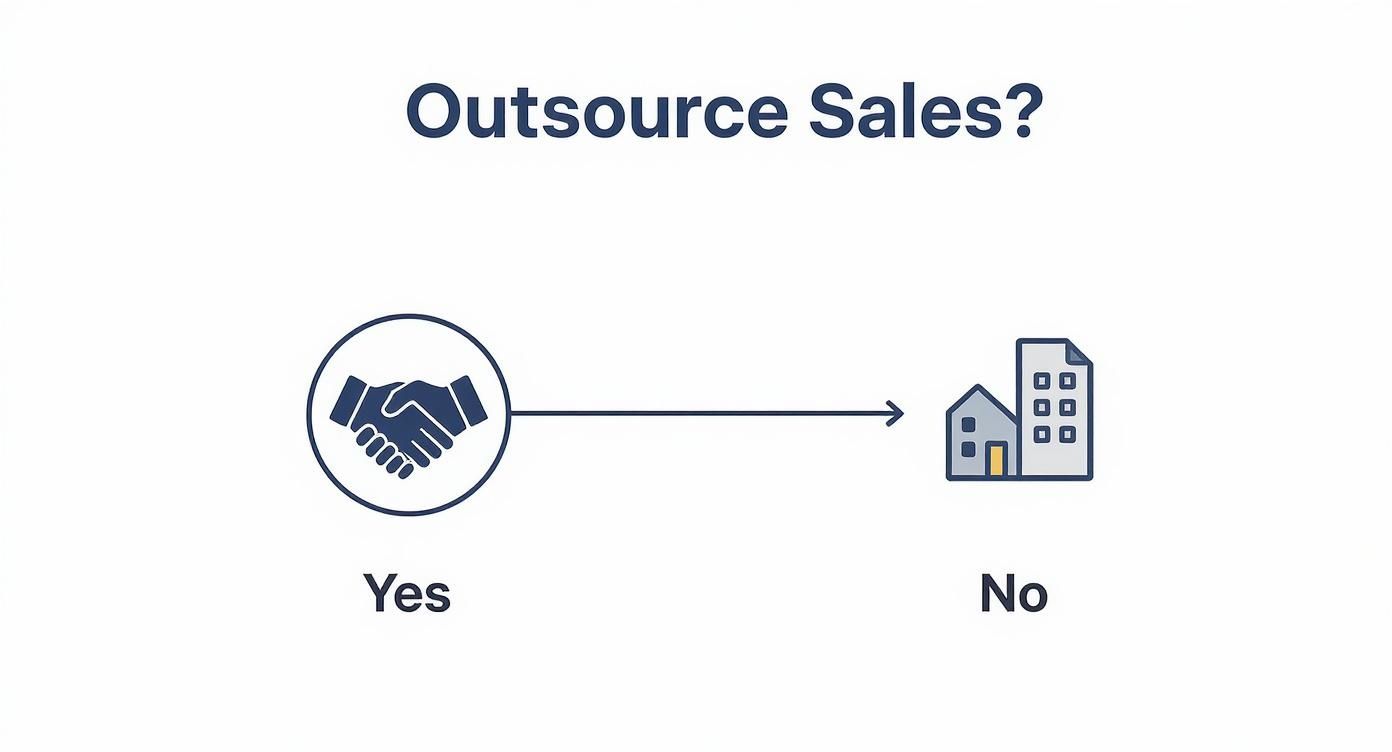
As you can see, the infographic really boils down that initial choice, helping you decide whether to invest in building an internal team or bringing in a strategic partner.
Team Augmentation for Flexible Support
Team augmentation is your most flexible, on-demand option. It’s perfect for when you need a little extra muscle for a short-term project or a specific campaign. Think of it like hiring a freelance writer to help your marketing team nail a big product launch. You get an extra set of hands exactly when you need them, without the overhead of a full-time hire.
This model is a perfect fit if you're looking to:
- Test a new market: Want to see if your product has legs in a new country or industry? A 3-month engagement with two augmented reps is a low-risk way to validate the market before committing to full-time hires.
- Support a product launch: Get a temporary boost in outreach to create buzz and book those critical first meetings.
- Cover seasonal peaks: A B2C company could hire an augmented team from October to December to handle holiday season demand, then scale right back down in January.
The trade-off for all that flexibility is depth. Because the reps are temporary, they won't become deep product experts or get fully ingrained in your company culture.
Dedicated Teams for Scalable Growth
When you’re playing the long game and need a more permanent, integrated solution, the dedicated team model is the way to go. Here, your outsourcing partner provides a team of reps who work only for you. They essentially become a remote extension of your own company, learning your brand, your sales process, and your culture from the inside out.
A dedicated outsourced team is like having a remote chapter of your own sales department. They’re 100% focused on your success, giving you the consistency of an in-house team with the scale and efficiency of an outsourced partner.
This model truly shines when you're focused on sustained growth. For instance, a SaaS company looking to crack the European market could use a dedicated team to build a consistent pipeline and establish a real presence over time. It costs more than team augmentation, but the results are far more predictable.
Fully Managed Services for a Turnkey Solution
For those who want a completely hands-off approach, there’s the fully managed services model. This is the most comprehensive option. You aren't just hiring reps; you're outsourcing your entire sales development machine—strategy, hiring, training, tech stack, management, and reporting.
It's like hiring a firm to build and run a professional sales engine for you. They handle every single detail of building your top-of-funnel pipeline and simply deliver a steady stream of qualified appointments straight to your account executives.
This is the best choice for businesses that want to pour all their energy into their core product and closing deals, leaving the complex work of pipeline generation to the experts. For example, a tech startup with brilliant engineers but no sales leadership could use a fully managed service to build revenue while they focus on R&D. It’s the highest level of investment, but it also removes the most internal headaches and offers the most predictable path to a full sales pipeline.
What's the Real Cost? A Clear Look at Outsourcing ROI
When you first look at inside sales outsourcing, it’s natural to focus on the monthly invoice. But that number is just one piece of a much larger puzzle. To really understand the financial impact, you have to look past the sticker price and compare it to the true, all-in cost of doing it yourself.
People often underestimate what it takes to run an in-house sales development team. An SDR’s salary is just the starting point. Once you factor in recruiting fees, benefits, payroll taxes, training time, management overhead, and all the necessary software licenses, the real cost for a single rep can easily top $100,000 a year. And that’s if you get it right on the first try—a bad hire can cost a company over $50,000 in recruiting, training, and lost opportunity costs, setting you right back at square one.
Outsourcing completely changes the math. You stop paying for individual heads and all the complexity that comes with them, and instead, you invest in a predictable pipeline machine.
To really see the difference, let's break down the costs side-by-side. The table below compares the typical annual expenses of hiring an in-house SDR versus partnering with an outsourced provider.
Cost Component Breakdown of In-House vs Outsourced
| Cost Category | In-House SDR (Annual Estimate) | Outsourced SDR (Annual Estimate) |
|---|---|---|
| Salary/Base Retainer | $60,000 | $72,000 (at $6k/month) |
| Commissions/Bonuses | $20,000 | Often included or performance-based |
| Recruitment Fees (20%) | $12,000 | $0 |
| Benefits & Payroll Taxes (30%) | $18,000 | $0 |
| Onboarding & Training | $5,000 | $0 |
| Tech Stack (CRM, Outreach, etc.) | $6,000 | Included |
| Management Overhead (20%) | $16,000 | Included |
| Total Estimated Cost | $137,000 | $72,000 |
As you can see, the direct retainer for an outsourced team is only part of the story. The real financial win comes from all the costs you don't have to pay.
The Hidden Savings Are Where You Really Win
The biggest financial upside of outsourcing comes from cost avoidance. When you hire a firm, you're not just getting a salesperson; you're offloading a whole host of operational headaches and expenses that are now their problem, not yours.
Here’s where you’ll see the most significant savings:
- Recruiting and Hiring: Forget about paying for job ads, headhunter fees, or spending dozens of hours interviewing candidates. That’s all handled.
- Training and Ramp-Up: Your partner bears the entire cost of training reps on sales fundamentals and getting them up to speed, a process that can take months internally.
- The Tech Stack: Good outsourced firms come with their own fully-loaded tech stack—think Salesforce, Outreach, ZoomInfo, and more. This alone can save you thousands of dollars a month in software subscriptions.
- Management Overhead: This might be the biggest hidden benefit. Your sales leaders are freed from the day-to-day grind of coaching, managing, and motivating SDRs, letting them focus on what they do best: closing deals.
The core idea behind inside sales outsourcing is simple: it transforms a high, fixed, and unpredictable capital expense (building a team) into a flexible operating expense that’s tied directly to results.
This gives you incredible financial agility. You can scale your sales efforts up or down as needed without the long-term commitments and risks that come with hiring full-time employees.
A Simple Way to Calculate Your ROI
To get buy-in from your team or leadership, you need to show them the money. A straightforward way to build your business case is to measure the pipeline value generated against the cost of the program.
Here’s the basic formula:
ROI = (Pipeline Value Generated – Cost of Outsourcing) / Cost of Outsourcing
Let's make this real. Say you invest $8,000 per month in a managed SDR service. After six months, you’ve spent a total of $48,000. In that time, the team has booked 60 qualified meetings for your sales executives.
Now, let's assume your average deal size is $25,000 and your team historically closes 10% of the qualified meetings they take.
- 60 meetings x 10% close rate = 6 new customers
- 6 customers x $25,000 average deal size = $150,000 in new revenue
Finally, plug those numbers back into the ROI formula:
($150,000 – $48,000) / $48,000 = 2.125 or a 212.5% ROI
This simple calculation turns a gut decision into a data-driven one. It proves that outsourcing your inside sales isn't just another expense—it's a revenue engine that can pay for itself many times over. When you’re looking at providers, don’t get stuck on the monthly fee. Focus on the total pipeline value and the return on your investment.
Making Your Outsourced Team Part of the Family
Signing the contract isn't the finish line—it's the starting gun. The real success of an outsourced inside sales partnership hinges on how well you integrate the new team into your existing operations. The goal is simple: blur the lines between "us" and "them" until you have one cohesive sales engine firing on all cylinders.
Don't think of your new partner as just another vendor. Treat them like a remote extension of your own sales department. This mindset shift requires a deliberate plan for onboarding, communication, and getting your tech stacks to talk to each other. Get this right, and you transform a simple service agreement into a powerful growth partnership.

Getting the Technology Right
Your tech stack is the central nervous system connecting your in-house team with your outsourced partners. If your systems don't sync up, you’re creating data silos, inviting miscommunication, and adding friction that will absolutely sabotage your results. For this to work, seamless integration isn’t just a nice-to-have; it's a necessity.
The most critical piece of this puzzle is your Customer Relationship Management (CRM) system. It has to be the single source of truth for every lead, every note, and every bit of progress. Your outsourced team needs direct access, not some separate, walled-off system that requires someone to manually shuttle data back and forth.
A shared CRM means every action the outsourced rep takes is instantly visible to your internal account executives. That real-time visibility is the key to smooth handoffs and giving prospects a consistent experience.
To make this happen, you'll need to focus on a few key areas:
- CRM Access: Give your outsourced reps their own licenses and set up a dashboard that shows them exactly what they need to see. If you're exploring options, you might find our guide on the best CRM for agencies helpful.
- Sales Engagement Tools: Make sure their outreach tools (think Outreach or SalesLoft) sync flawlessly with your CRM. Every email, call, and social media touchpoint should be logged automatically.
- Communication Channels: Pull them into your company's main communication hub, whether that's Slack or Microsoft Teams. Set up a dedicated channel just for them to share daily updates, ask questions, and celebrate wins.
This technological handshake ensures everyone is reading from the same playbook and looking at the same data. No more guesswork.
Weaving Them into Your Culture and Workflow
Technology provides the plumbing, but it's your company culture and daily processes that make the collaboration feel genuinely seamless. You want your outsourced reps to feel like they’re part of the team—invested in your success, not just hired guns chasing a commission.
Kick things off with a deep-dive onboarding that goes way beyond the sales script. Immerse them in your company's mission and values. Invite them to your virtual all-hands meetings and give them shout-outs for their wins, right alongside your internal staff. To truly make this work, it's worth exploring proven strategies for sales and marketing alignment to ensure every part of your revenue engine is working in concert.
From there, establish a communication rhythm that keeps everyone on the same page. This cadence is the heartbeat of a healthy partnership.
Key Communication Touchpoints
- Daily Stand-ups: A quick 15-minute morning video call works wonders. Use it to cover priorities, clear roadblocks, and share any quick wins from the day before.
- Weekly Tactical Meetings: Set aside 30-60 minutes each week to review performance against KPIs, dig into campaign data, and tweak your approach for the week ahead.
- Monthly Strategic Reviews: This is a higher-level meeting with leadership from both sides. You'll discuss the overall health of the program, the quality of the pipeline, and set strategic goals for the next quarter.
By investing in both the tech and the cultural side of integration, you’re not just hiring a service. You’re building a resilient, high-performing extension of your company that can drive predictable and sustainable growth.
Measuring Success with the Right Performance Indicators
You’ve heard it a thousand times: what gets measured gets managed. This is especially true when you're outsourcing inside sales. To really understand the impact of your partnership, you have to look past vanity metrics like call volume or email sends. Real success is measured by key performance indicators (KPIs) that tie directly to your bottom line.
When you focus on the right numbers, you transform the partnership from a line item on your budget into a predictable revenue engine. It’s how you make data-backed decisions, fine-tune your campaigns, and prove your investment is actually paying off. It also fosters a culture of accountability and constant improvement with your outsourcing partner.

Core KPIs That Truly Matter
Every campaign has its own nuances, but a handful of core metrics will always tell you how healthy and effective your outsourced sales program is. These are the KPIs that move beyond just tracking activity and start measuring real movement through your sales funnel.
Here are the essential indicators you should be watching like a hawk:
- Qualified Appointments Set: This is the bread and butter for most outsourced SDR teams. The key word here is "qualified." A qualified meeting means the prospect fits your Ideal Customer Profile (ICP), has a real business need, and holds decision-making power. It's always about quality, not quantity; 10 rock-solid meetings are infinitely more valuable than 30 duds.
- Pipeline Value Generated: This KPI puts a dollar sign on all that appointment-setting activity. You can calculate it simply by multiplying the number of qualified opportunities by your average deal size. This is the metric that gets executives to sit up and pay attention because it shows the direct revenue impact of the program.
- Lead-to-Close Conversion Rate: This is the ultimate test. It measures the percentage of opportunities sourced by your outsourced team that actually convert into paying customers. Even though your internal team is handling the close, a consistently low rate here could signal a problem with lead quality—something you'll need to dig into with your partner.
Focusing on these three metrics gives you a clear, unbiased picture of how things are really going.
Interpreting the Data and Taking Action
Just tracking the numbers is only half the job. The real magic happens when you interpret that data and use it to make smart adjustments. Think of it as a feedback loop—this is the engine that drives continuous improvement in any outsourcing relationship. Regular performance reviews, ideally on a weekly basis, are non-negotiable.
During these meetings, you and your partner should be poring over the KPI data together, looking for trends and spotting areas that need a little love.
The point of a performance review isn't just to read off numbers. It's to ask "why." Why did this email sequence crush it while that one fell flat? Why are conversion rates dipping in the finance industry? These are the conversations that lead to meaningful strategic changes.
This kind of collaboration ensures your campaigns never get stale. If appointment quality slips, you can tighten up the qualification criteria. If a certain message isn't hitting home, you can brainstorm new angles together. It's this iterative process that turns a good partnership into a great one, keeping your campaigns optimized for the best possible results.
This relentless drive for efficiency is a huge benefit of outsourcing. In fact, companies that outsource functions close to their sales operations report an average 32% reduction in labor costs. They also see up to a 25% improvement in process efficiency, often within the first year alone. You can dive deeper into these powerful outsourcing statistics on doit.software.
How to Select the Right Inside Sales Outsourcing Partner
Let's be blunt: choosing a partner for your inside sales outsourcing is the single most critical decision you'll make in this entire journey. Get it right, and you'll have a seamless extension of your team driving predictable growth. Get it wrong, and you could burn your budget, tarnish your brand, and push your sales goals back by months, if not longer.
This isn't a decision to take lightly or rush through. You need a thorough vetting process to find a firm that truly aligns with your goals, culture, and the way you operate. Think of it less like hiring a simple vendor and more like bringing on a strategic business partner.
Your Vetting Checklist: The Must-Haves
Before you even book your first discovery call, create a scorecard of what actually matters. A structured evaluation helps you compare potential partners on an even playing field, cutting through the polished sales pitches to see who can really deliver.
Your checklist should nail down these core areas:
- Industry and Niche Experience: Have they actually worked in your world before (e.g., SaaS, fintech, medtech)? Don't just take their word for it. Ask for specific case studies and references from companies that look a lot like yours. For example, if you sell cybersecurity software, a partner with proven success selling to CISOs is invaluable.
- Rep Training and Development: How do they get their sales reps up to speed? You need to know how they teach both core sales skills and the nuances of your specific product or service. A commitment to ongoing training is a huge green flag.
- Technology and Integrations: What’s in their toolbox? Look at their CRM, sales engagement platforms, and data enrichment tools. Make sure their tech stack is modern and, crucially, can integrate cleanly with your existing systems.
- Data Security and Compliance: This is non-negotiable. How will they protect your customer data and intellectual property? They need rock-solid protocols and full compliance with regulations like GDPR and CCPA.
As you evaluate partners, it helps to understand the strategies for hiring remote sales representatives, since this is often how these firms build their teams. Knowing what good talent acquisition looks like will help you judge the quality of their people.
Critical Questions for Your Discovery Calls
Once you have a shortlist, it’s time to start digging. Use your initial calls to ask pointed questions that get to the heart of how they operate. This is your chance to move beyond the surface-level claims and understand their processes, transparency, and approach to quality.
A great outsourcing partner doesn't just make promises; they show you a clear, data-driven plan. They're transparent about what's achievable and how they intend to get there.
Walk into every conversation prepared with your list of must-ask questions. This puts you in control and ensures you gather the intel needed to make a smart decision.
Key Questions to Have on Hand:
- Reporting and Transparency: What specific metrics do you report on, and how often will we see them? Can we get direct access to a live dashboard to see progress in real-time?
- Quality Assurance: How do you actually monitor call quality and email outreach? Will we be able to listen to call recordings or review email copy before it's sent?
- Onboarding and Ramp-Up Time: Walk me through your onboarding process. Realistically, how long does it take for a new client to start seeing meaningful results?
- Team Structure: Who is our main point of contact? Will we have a dedicated account manager, and how much direct access will we have to the reps working on our account?
Pay close attention to how they answer, not just what they say. If you get vague responses, promises that sound too good to be true, or a completely inflexible pricing model, consider those major red flags. Finding a partner that fits your unique needs is the cornerstone of any successful outsourced lead generation program.
Got Questions About Inside Sales Outsourcing? We've Got Answers.
Even after you've done all the research, taking the leap into outsourcing your inside sales can feel like a big step. It's totally normal to have some last-minute questions bubbling up. We've been there.
Let's walk through some of the most common concerns we hear from businesses just like yours.
"Will I Lose Control Over My Brand's Voice?"
This is probably the number one worry, and it's a fair one. But the short answer is no—not if you choose the right partner. A great outsourcing firm doesn't take over your brand; they become an extension of it.
The whole process kicks off with you and your new partner sitting down together to hammer out the sales playbook, scripts, and messaging guidelines. You're in the driver's seat. Think of them less as a third-party vendor and more as your team down the hall. With regular check-ins, transparent dashboards, and constant communication, you'll always know exactly what's being said and how your brand is being represented.
"Can an Outsourced Team Really Understand My Complex Product?"
Absolutely. In fact, the best ones are built for exactly this kind of challenge. Top-tier firms often specialize in specific, technical industries—think SaaS, fintech, or cybersecurity. Their entire reputation is built on how quickly and deeply they can learn a new, complex solution.
When you're talking to potential partners, put them to the test. Ask to see case studies from companies in your niche. Talk to their current clients. A serious firm will have a bulletproof onboarding and training program designed to turn their reps into genuine experts on your product, its value, and where it fits in the market. They don't just memorize lines; they internalize your business.
The most effective outsourcing firms don't just sell for you; they become genuine advocates for your product. Their ability to grasp complex solutions and articulate value is what separates a good partner from a great one.
"Isn't This Just for Big Companies?"
Not even close. If anything, inside sales outsourcing can be a game-changer for startups and small-to-mid-sized businesses (SMBs). It's the ultimate way to level the playing field.
Think about it: you get instant access to a seasoned sales team and a sophisticated tech stack that would cost a fortune to build from scratch. You get to skip the time-consuming (and expensive) process of hiring, training, and managing an in-house team. For a growing business, this means you can start building a pipeline and testing new markets with the kind of speed and power that's usually reserved for your biggest competitors—all while keeping your overhead lean. It's a massive shortcut to revenue growth.
Ready to stop guessing and start engaging with high-intent prospects? FundedIQ delivers curated lists of recently funded startups, complete with verified decision-maker contacts and critical buying signals. Skip the endless research and connect with companies at the exact moment they’re ready to invest in growth. Discover your next best customer today at FundedIQ.