

Marketing Digital Startups: Master Growth Playbook
Winning at marketing for digital startups isn’t about who has the biggest budget. It's about being smarter before you spend your first dollar. Real success comes from a deep, almost obsessive, understanding of a specific audience and carving out a unique space in the market. In fact, according to CB Insights, the #2 reason startups fail is a lack of market need. This foundational work is what makes every future campaign click.
Building a Startup Marketing Foundation That Lasts

I’ve seen it a hundred times: founders get excited and jump straight into running paid ads or churning out blog posts. It feels productive, but without a solid foundation, it's like building a house on sand. It looks good for a minute, then crumbles under the first bit of pressure.
The startups that win are the ones who are deliberate. They put in the work upfront to get three things right:
- Ideal Customer Profile (ICP): Getting past surface-level demographics to truly understand the problems, motivations, and buying triggers of your perfect customer.
- Brand Positioning: Pinpointing exactly what makes you different and why that ICP should choose you over anyone else (including the option to do nothing).
- Competitor Analysis: Finding the gaps in the market—the opportunities your rivals have completely missed—that give you a clear path forward.
Nail Your Ideal Customer Profile
Think of your Ideal Customer Profile as the single most important document in your marketing playbook. It's not just a fuzzy persona with a stock photo. A truly powerful ICP gets into the psychographics—the human stuff that drives decisions. What’s their biggest professional headache? What key performance indicators (KPIs) are they responsible for?
For instance, a B2B SaaS startup with a project management tool could say their ICP is "Marketing Managers." That’s okay, but it’s not great. A killer ICP is: "Marketing Managers at Series A tech companies (50-100 employees) who are drowning in cross-functional content campaigns, are measured on lead generation, and are beyond frustrated with clunky spreadsheets."
See the difference? That level of detail tells you exactly what messaging to use, what content to create, and where to find them.
A well-defined ICP turns marketing from a guessing game into a calculated science. It ensures your message lands with precision, resonating with the exact people who need your solution the most.
Carve Out Your Unique Brand Positioning
Once you know who you're talking to, you have to decide what you’re going to say. That's your brand positioning—it’s the distinct space you own in your customer’s mind. A clear positioning statement is the core of any good branding strategy for startups.
The digital marketing industry was valued at a massive $667 billion in 2024, with online ads making up about 72.7% of all ad spending worldwide. That’s a lot of noise. Your only option is to be different.
For example, when the project management space was crowded with complex tools like Jira, Trello entered the market with a simple, visual, card-based positioning that was radically different. You can stand out by targeting a super-specific niche, having one killer feature that nobody else does, offering an unbelievable customer experience, or even competing on price (though that's a tough game to play long-term). This clarity is non-negotiable, and it's also where you should start implementing essential SEO best practices for 2025 to make sure your unique message can be found.
To help you get started, I've put together a simple checklist of the foundational pieces you need in place before you launch any major campaigns.
Your Startup's Marketing Foundation Checklist
This table breaks down the core elements every digital startup needs to dial in. Think of it as your pre-flight check before you hit the accelerator on your marketing spend.
| Component | Key Objective | Example Action |
|---|---|---|
| Ideal Customer Profile | Define the perfect customer with extreme precision. | Conduct five 30-minute interviews with current happy customers to uncover their exact pain points and "aha!" moments. |
| Brand Positioning | Clearly articulate what makes you unique and valuable in the market. | Draft a one-sentence positioning statement: "For [ICP], we are the only [Category] that [Unique Differentiator]." |
| Competitor Analysis | Identify market gaps and opportunities your competitors have overlooked. | Sign up for three competitors' free trials and map out their user onboarding flow to find areas you can improve upon. |
| Core Messaging | Develop a consistent narrative that speaks directly to your ICP's needs. | Create a one-page "Messaging Hub" document with approved taglines, value propositions, and boilerplate descriptions. |
| Initial SEO Keyword List | Target a small set of high-intent keywords you have a realistic chance of ranking for. | Identify 10-15 "long-tail" keywords (e.g., "project management tool for remote marketing teams") related to your ICP's problems. |
| Website Foundation | Ensure your website is technically sound, fast, and conversion-focused. | Run your site through Google's PageSpeed Insights and fix any critical errors that impact user experience. |
Getting these elements right isn't just a "nice-to-have"—it’s the difference between a marketing engine that sputters and one that hums. Take the time to build this foundation, and every dollar you spend later will work exponentially harder for you.
Finding Your Winning Channels with Smart Experiments
When you're running a startup, every single marketing dollar has to pull its weight. The old "spray and pray" method—scattering your budget across every channel you can think of and hoping something works—is a surefire way to burn through cash.
A much savvier approach is to run small, controlled experiments. The goal is to figure out exactly where your best customers are hiding and which messages actually make them listen. Think of yourself as a marketing scientist; you’re using data, not just gut feelings, to decide where to invest.
Test the Waters with Lean Paid Ad Experiments
Paid ads on platforms like Google or LinkedIn are fantastic for getting quick feedback. You don't need a huge budget to get started. In fact, you can learn a ton with just $500 to $1,000.
At this stage, your goal isn't to sign up thousands of users. It's all about validating your core assumptions:
- Audience Targeting: Are you actually reaching the right people? LinkedIn's filters for job titles and company size are perfect for zeroing in on specific B2B audiences.
- Messaging: Does your core value proposition connect? Pit 2-3 different ad headlines against each other, each one speaking to a different pain point.
- Offer: Is your call-to-action strong enough? See if a "request a demo" CTA outperforms a "download our e-book" one.
Imagine you're an early-stage SaaS company. You could spin up a small LinkedIn campaign targeting "Marketing Directors at fintech startups" with two different ads. One ad could be all about "saving time on reporting," while the other focuses on "improving campaign ROI." The click-through rates will give you a clear signal about which message is resonating more.
Build Foundational Organic Assets
While paid ads give you immediate data, organic channels like SEO and content marketing are about building for the long haul. Think of it as creating an asset that grows in value over time. For a startup, this means forgetting about doing everything at once and instead focusing on a few high-impact activities.
Kick things off by creating a few pillar content pieces. These aren't your average blog posts; they're comprehensive, deeply valuable resources that solve a major problem for your ideal customer. For instance, HubSpot's "Ultimate Guide to…" series established them as a thought leader and generates millions in traffic value. A single, well-researched pillar post can bring in more qualified traffic than a dozen fluffy articles ever will.
Of course, to create content that hits the mark, you have to know who you're talking to. Our detailed guide on how to create buyer personas can walk you through defining that audience with absolute precision.
Don't just write about your product. Write about your customer's problems. If you become the go-to resource for solving their challenges, they’ll naturally want to see what you're selling.
Get Scrappy with Strategic Partnerships
Partnerships are a seriously underrated growth lever for startups. They let you tap into a pre-built, trusting audience without having to spend a fortune on ads. We’re not talking about massive corporate alliances here—think smaller, tactical collaborations with non-competing brands that serve the same people you do.
Here are a few ideas to get you started:
- Co-Marketing: Find a company with a complementary tool and host a joint webinar. You both promote it to your email lists, instantly doubling your reach. For example, an email marketing tool could partner with a landing page builder.
- Content Swaps: Write a guest post for a popular industry blog. In return, they can contribute an article to yours. It’s a classic win-win that builds valuable backlinks and gets your brand in front of fresh eyes.
- Referral Agreements: Set up a simple deal where you offer another startup a small commission for every qualified lead they send your way. This creates a performance-based channel with virtually no upfront risk.
By blending lean paid tests, solid organic content, and scrappy partnerships, you create a balanced marketing portfolio. This methodical approach to marketing digital startups takes the guesswork out of growth and helps you systematically find the most profitable ways to scale.
Designing a Simple and Effective Growth Funnel
Getting traffic to your site is one thing. Actually turning those visitors into paying customers is a whole different ballgame. That’s where your growth funnel comes in. The goal isn't to build some monstrously complex machine; it's to create a clear, logical path that guides people from "Who are you?" to "Here's my credit card."
Think of it from your customer's perspective. At each step, they're asking a question. What do they need to see or learn to feel confident enough to take the next step? Your job is to anticipate those needs and meet them with the right piece of content or the right offer, right when they need it.
This whole process is about testing, learning, and then doubling down on what works. You don't just set it and forget it.
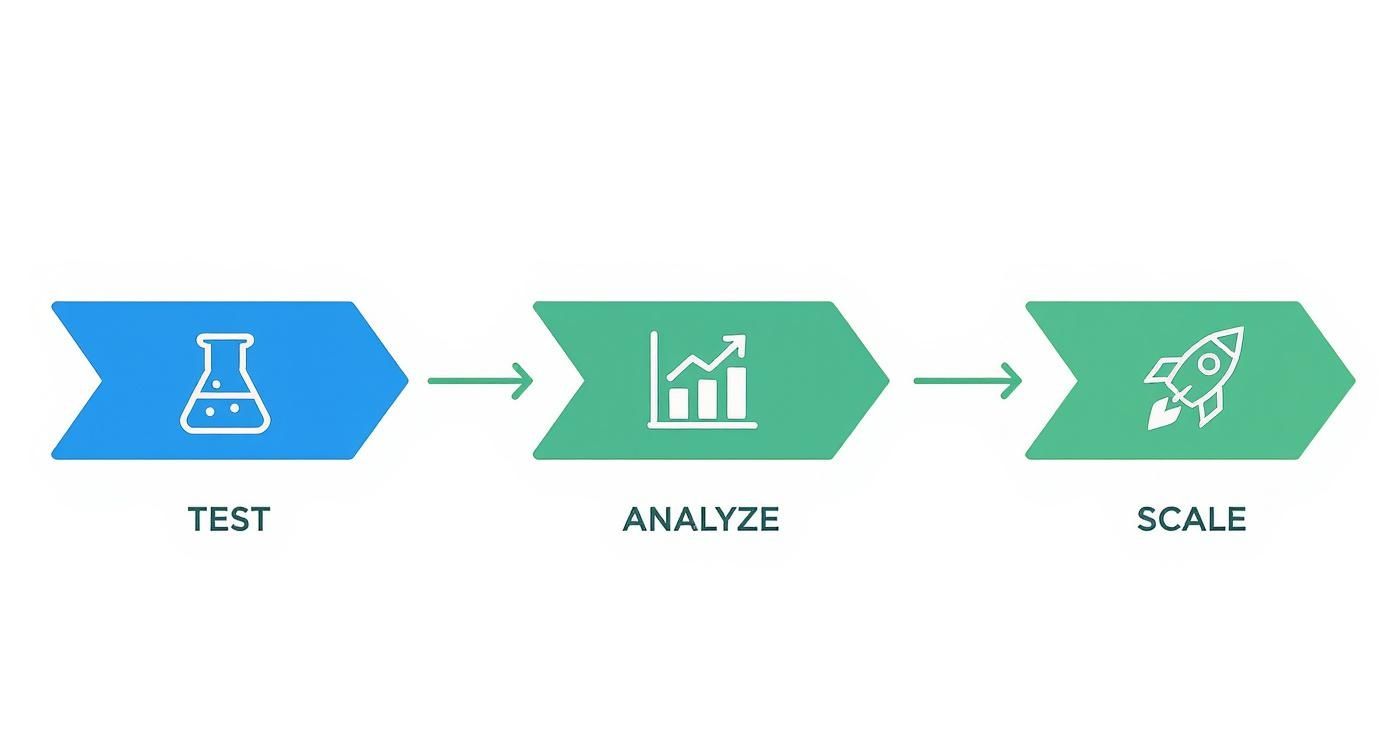
A great funnel is never truly "done." It's a living system you constantly tweak and improve based on real data.
Sparking Interest at the Top of the Funnel
At the very top, people have a problem, but they might not know a solution like yours even exists. Your goal here isn't to make a sale—it's to be genuinely helpful and get on their radar.
Forget the hard sell. Focus on pure, unadulterated value.
- Solve Problems with Blog Posts: Write the kind of in-depth articles that directly answer the questions your ideal customer is searching for on Google.
- Stop the Scroll on Social: Use platforms like LinkedIn or Instagram to run ads that offer something valuable upfront. Think free checklists, surprising industry stats, or a mini-guide.
A great example? A fintech startup could publish a post like, "5 Invoicing Mistakes That Are Quietly Killing Your Agency's Cash Flow." It solves a real pain point and instantly positions them as an expert, all without begging for a demo.
Nurturing Leads in the Middle
Okay, so someone read your post or downloaded your guide. They're intrigued. Now they’ve moved into the middle of your funnel, where they’re actively weighing their options. This is your chance to build trust and show them why your solution is the right one.
This is where a simple, automated email sequence works wonders. Once they download that guide, kick off a 3 or 4-part email series over a couple of weeks. Each email could share another useful tip, a short customer success story, or even a link to a free template or calculator. You’re staying top-of-mind by continuing to be helpful.
The middle of the funnel is where you turn curiosity into conviction. It’s not about pushing for a demo yet. It's about proving you understand their world and can actually help them win.
Driving Action at the Bottom
Now we get to the money end of the funnel. Your prospect is on the verge of making a decision. They’re likely comparing you to a couple of competitors, and they just need that final nudge. Your job is to make saying "yes" an absolute no-brainer.
Get direct and make your offer compelling.
- Present an Irresistible Offer: This is the time for a free trial, a personalized demo that speaks directly to their business needs, or a limited-time introductory price.
- Show, Don't Tell, with Case Studies: Nothing closes a deal like hard proof. Showcase case studies with real, tangible results—think a 25% jump in efficiency or $10,000 in documented monthly savings. This kind of social proof is pure gold.
By mapping out these simple stages, you create a journey that feels natural to your prospects, making them far more likely to become happy, loyal customers.
Using AI as Your Startup Marketing Copilot
Let's be real—AI isn't some far-off concept anymore, especially not for a scrappy startup. Think of it less as a robot overlord and more like hiring a whole team of specialists for the cost of a single software subscription. It's how you make your small team punch way above its weight, giving you the efficiency and insights of a much larger competitor.
You don't need to get lost in the weeds of complex data science. For early-stage marketing, the gold is in accessible AI tools that can radically speed up the daily grind, from writing social posts to personalizing user journeys.

Take a tool like ChatGPT. Its simple chat interface lets you ask for anything from ad copy variations to a full-blown campaign outline. It’s a game-changer for getting ideas out of your head and onto the page.
Automate Content Creation and Ideation
Content is a beast that always needs feeding, and it can eat up a huge chunk of your time. This is where AI really shines. It can be your brainstorming partner and your first-draft machine, easily cutting your content production time in half.
Here’s how you can put it to work immediately:
- Generate blog post outlines around a keyword you want to rank for.
- Draft several social media posts for a single idea, so you can A/B test what resonates.
- Repurpose existing content by rewriting a webinar transcript into a blog post or a series of tweets.
- Condense long case studies into sharp, punchy email copy.
Instead of battling writer's block for an hour, you start with a solid draft that’s maybe 80% of the way there. Your job becomes refining that output and injecting your brand's unique personality—a much faster and more creative process.
Personalize the Customer Experience at Scale
Everyone knows personalization drives conversions, but for a startup, it often feels like an impossible task. In fact, McKinsey found that 71% of consumers expect personalization and 76% get frustrated when they don't find it. AI completely changes the game. It lets you deliver those tailored experiences that used to require a massive team and budget.
AI-driven platforms can analyze user behavior on your site in real-time, instantly showing them the most relevant products, articles, or calls to action. It’s like having a personal shopper for every single visitor.
AI isn’t here to replace marketers. It's here to supercharge them. It takes over the repetitive, data-heavy lifting, which frees you up to focus on what humans do best: big-picture strategy, creative thinking, and building real relationships with customers.
This isn't just a passing trend; it's a fundamental shift in how modern marketing operates. Big companies are all in, with 71% of marketers planning to invest at least $10 million in AI over the next three years. Even more telling, 83% of CMOs are optimistic about what the tech can do.
For a startup, this is a massive green light. You can build a smarter, more efficient marketing engine from day one. You can find more on these AI marketing trends and stats over at Marketing Dive.
Measuring What Matters to Fuel Your Growth
For a fast-moving startup, making smart decisions on the fly is everything. Data isn't just a spreadsheet of numbers—it's your compass. It shows you what’s actually working, what’s a complete waste of money, and where your best opportunities are hiding in plain sight.
The classic startup mistake? Getting completely sidetracked by "vanity metrics" like social media likes or a spike in website visitors. Sure, those numbers feel good, but they tell you almost nothing about the actual health of your business.
Real growth comes from obsessively tracking the key performance indicators (KPIs) that are directly tied to revenue.
Focus on Actionable Metrics, Not Vanity
If you want to build a business that lasts, you have to get a handle on the basic economics of your customer relationships. It all boils down to a few core metrics that every founder and marketer should know by heart.
These are the numbers that investors grill you on and the ones that genuinely dictate your startup's future.
- Customer Acquisition Cost (CAC): This is your total spend on sales and marketing to get one new customer in the door. If you don't know your CAC, you're flying blind, unable to tell if your channels are actually profitable.
- Lifetime Value (LTV): This is the total revenue you can reasonably expect from a single customer over their entire time with you. It’s the other side of the coin to CAC.
- LTV to CAC Ratio: This is where the magic happens. When your LTV is significantly higher than your CAC, you've got a sustainable business model. The gold standard is a ratio of 3:1 or higher—that’s the signal that you're ready to hit the accelerator.
Getting a firm grasp on how to calculate these figures is the first real step toward building a predictable growth engine. For a deeper look, our guide on how to measure marketing ROI will walk you through the formulas.
Vanity metrics make you feel good, but actionable metrics help you build a good business. Stop chasing likes; start chasing a healthy LTV:CAC ratio.
Setting Up Your Analytics Dashboard
You don't need a crazy-expensive, complicated setup to get started. Free tools like Google Analytics 4 are more than powerful enough to track user behavior, key conversion events, and where your traffic is coming from.
The trick is to keep it simple. Your dashboard should be a clean, at-a-glance view of your most critical funnel metrics.
Here’s a quick rundown of what to focus on versus what to ignore. It’s a common trap for new founders to get hung up on the numbers in the right-hand column because they are easier to track and often look impressive. Don't fall for it.
Actionable vs Vanity Metrics for Startups
| Metric Type | Essential KPI (Focus Here) | Vanity Metric (Avoid Obsessing) |
|---|---|---|
| Website Performance | Conversion Rate (e.g., demo requests, free trial sign-ups) | Total Page Views or Time on Page |
| Lead Generation | Cost Per Qualified Lead (CPL) | Total Number of Downloads or Email Subscribers |
| Business Health | Customer Lifetime Value (LTV) | Social Media Follower Count |
| Channel Efficiency | Customer Acquisition Cost (CAC) by Channel | Number of Likes or Shares on a Post |
Focusing on the KPIs in the middle column will give you a true picture of your business's health and point you toward real growth opportunities, not just superficial engagement.
Build a Continuous Optimization Loop
Tracking metrics is only half the battle. The real value comes from turning those insights into action. This is where a continuous optimization loop comes in—it’s a simple, repeatable process for making things better over time.
Think of it as a cycle.
First, analyze the data. Look at your dashboard and find a weak spot or a drop-off point. Maybe your landing page gets a ton of clicks from your ads, but very few people actually sign up. A typical SaaS landing page converts at around 3-5%, so if you're at 0.5%, that’s a clear signal.
Next, form a hypothesis. Based on what you see, make an educated guess. For instance: "I believe changing the headline to focus on the tangible outcome will increase conversions by 15%."
Then, run a test. Use a simple A/B testing tool to show 50% of your visitors the old headline and 50% the new one. Let it run until you have a statistically significant result.
Finally, measure and iterate. Check the results. Did your new headline win? Great, implement it for all traffic and move on to your next hypothesis. This simple loop is the real engine of startup growth.
By constantly testing and refining, you turn guesswork into a scientific process, ensuring your marketing gets smarter and more effective with every cycle. This methodical approach is also essential for mastering marketing automation ROI, as it provides the data you need to justify and optimize your investments in your tech stack.
Your Top Startup Marketing Questions, Answered
Trying to navigate marketing for a new startup can feel like a guessing game. To give you some clarity, I've pulled together some of the most common, make-or-break questions I hear from founders and marketers. The answers here are direct, practical, and meant to help you make smarter moves.
So, How Much Should a Startup Actually Spend on Marketing?
There’s no magic number here, but a good rule of thumb for an early-stage startup is to allocate 10-20% of your projected revenue to marketing. This gives you enough runway to run some meaningful experiments without burning through your cash too quickly.
If you're pre-revenue, think about it differently. Set aside a fixed budget for learning. Something in the range of $500 to $2,000 per month is often plenty to start gathering the data you desperately need. The goal isn't just to spend—it's to invest in finding out what works. Start small, track everything, and once you find a channel that's delivering, double down. Let the early wins fund the next phase of growth.
What's the Single Best Marketing Channel for a New Startup?
I'll be blunt: the "best" channel doesn't exist. The right channel for you is simply wherever your Ideal Customer Profile (ICP) hangs out online. Stop looking for a silver bullet and start thinking like a scientist.
For example, if you're a B2B SaaS company selling to CTOs, you'll probably have the most luck with LinkedIn ads or by getting active in niche engineering communities. But if you’re a direct-to-consumer brand with sustainable home goods, your people are almost certainly on Instagram and TikTok.
The best startup marketers I know don't guess—they run tests. Pick two or three channels that seem like a good fit and run small, controlled experiments to see what actually brings in qualified leads, not just vanity metrics like clicks.
Should We Focus on SEO or Paid Ads First?
This is the classic chicken-or-egg marketing question. My advice? Use them together. Think of it this way: paid ads are for speed, SEO is for sustainability.
Running paid ads on Google or LinkedIn gets you instant feedback. You can quickly figure out if your messaging is hitting the mark, if your landing page converts, and if you’re even targeting the right people. The insights you get are gold and can shape your entire strategy.
SEO is the long game. It’s about building a powerful, defensible asset for your company—a steady stream of high-quality organic traffic that keeps coming even when you pause your ad budget. The smart play is to let them feed each other. Use the high-converting keywords and ad copy from your paid campaigns to jumpstart your SEO and content efforts. This creates a powerful feedback loop where each channel makes the other stronger.
At FundedIQ, we connect agencies with startups right when they have the budget and intent to buy—immediately after securing funding. Check out our platform to get a curated list of prospects with verified contacts and real-time buying signals.