

How to Send Follow Up Emails After No Response
Let’s be honest: sending a carefully crafted email only to hear crickets is frustrating. But here’s the thing—it’s rarely a hard 'no.' More often than not, it’s just a sign that your prospect is swamped. Your email probably landed at the wrong moment, got buried under a mountain of other messages, or simply wasn't the most urgent fire they needed to put out that day. In fact, a study by Iko System found that only 2% of sales are made on the first contact.
The first step to winning at outreach is to stop seeing silence as rejection. It’s not. It’s an opportunity to show your persistence and prove your value.
Why Giving Up After One Email Is a Losing Game
When you’re trying to connect with busy founders and decision-makers, persistence isn't just a good idea; it's everything. The data doesn't lie on this one.
Sending a single follow up email after no response can boost your reply chances by 21%. A second one? That adds another 25%. The real eye-opener is that a full 50% of all sales happen after the fifth touchpoint. Yet, an almost unbelievable 48% of salespeople throw in the towel after just one attempt. They’re leaving half the deals on the table.
The reality is that most deals are won in the follow-up. Your first email is just an introduction; the messages that come after are what build the relationship and prove you're relevant.
Thinking this way means you need to get familiar with the principles of lead nurturing. It’s a shift from making a one-time pitch to building a sustained, valuable conversation over time.
This playbook is all about building a follow-up system that actually works, especially if you're an agency trying to get the attention of funded startups. We’ll break down the core pieces that turn that initial silence into real conversations:
- Strategic Timing: When you follow up is just as important as what you say.
- Compelling Messaging: Each email needs to bring something new to the table. No "just checking in."
- Deep Personalization: Using triggers like fresh funding rounds makes your outreach impossible to ignore.
- Clear Measurement: You can't improve what you don't track. We'll cover the KPIs that matter.
By putting a solid system in place, you stop hoping for a reply and start engineering one. For a deeper look at the philosophy behind this, check out our guide on what is lead nurturing.
Finding the Perfect Follow-Up Cadence
Figuring out when to send follow up emails after no response is less of a science and more of an art. Get it right, and you land a reply. Get it wrong, and you’re headed straight for the trash folder. Following up too fast reeks of desperation, but waiting too long lets any flicker of interest die out completely. The real goal is to find a rhythm that keeps you on their radar without becoming an annoyance.
Let's be real: busy founders at funded startups are in a constant state of email triage. Your first message might have been great, but it probably wasn't the most urgent thing on their plate at that moment. A smart follow-up simply bumps your message back to the top of the pile when they might have a bit more breathing room.
This sequence shows how to space out your touchpoints to get noticed without burning bridges. It’s all about strategic patience.
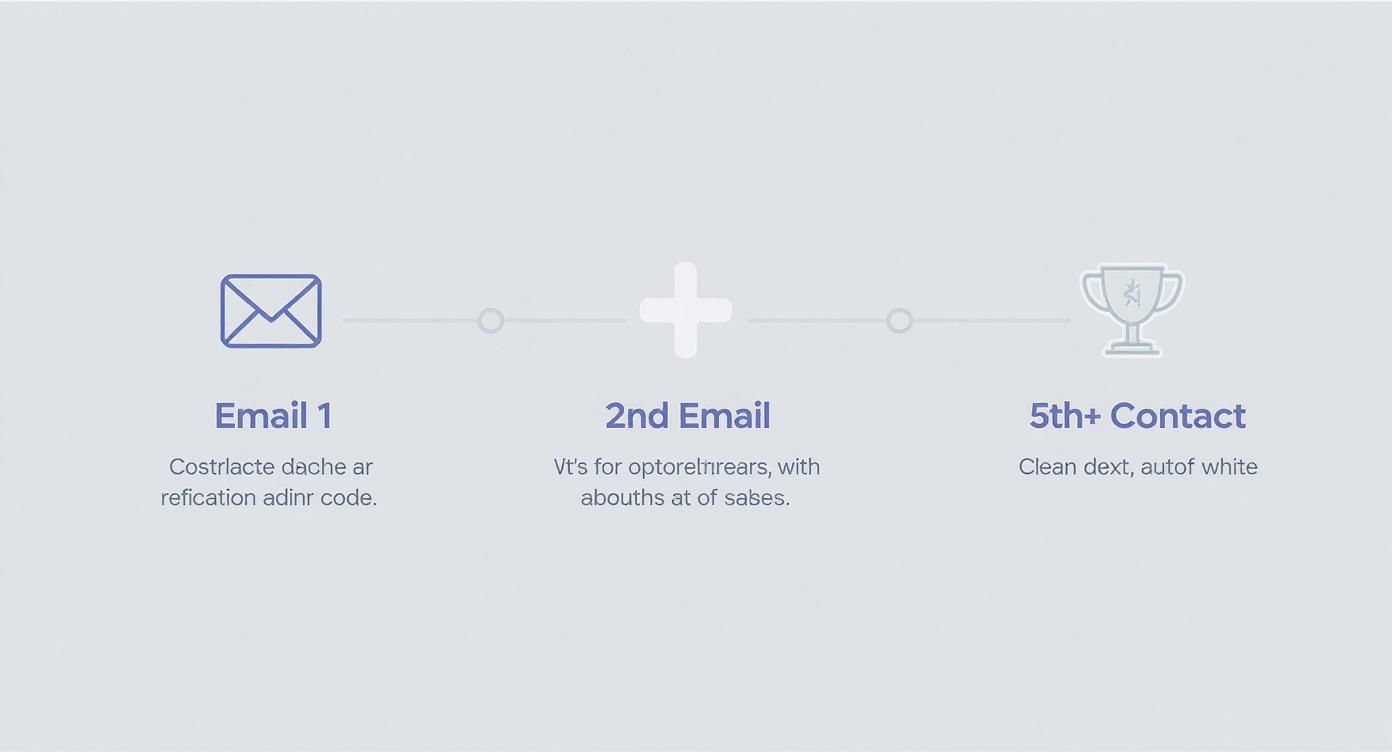
The big takeaway here is that persistence works. Most of the positive replies I've seen come after multiple, well-timed messages, not the first one.
Building Your Follow-Up Timeline
One of the biggest mistakes I see is people sending follow-ups randomly. A structured cadence shows you're a professional who respects the prospect's time. The best approach is to start with a short interval and then gradually increase the time between each email.
This strategy implicitly acknowledges that if someone hasn't replied after a few pings, they probably need more space. Hitting their inbox daily is a surefire way to get marked as spam. A thoughtful rhythm, however, signals confidence and patience.
That first wait is the most important. Data from Growth List shows that waiting just three days before your first follow-up can increase reply rates by 31%. It’s the sweet spot. On the other hand, if you wait more than five days, you can expect a 24% drop in responses. Time is of the essence, but you can't rush it.
A Practical Cadence for Agencies
When you're an agency trying to connect with fast-moving startups, you need a balanced cadence. You have to be persistent to cut through the noise but not so aggressive that you burn a bridge with a potential long-term partner.
Below is a practical timeline you can use as a starting point. It’s a framework that’s worked well for us, designed to maximize engagement without overwhelming your prospect's inbox.
Sample Follow-Up Email Cadence
| Touchpoint | Day | Recommended Action | Rationale |
|---|---|---|---|
| Email 1 | Day 1 | Initial Outreach | Send your compelling, personalized cold email. |
| Email 2 | Day 4 | First Follow-Up | A 3-day pause is the optimal window to re-engage. |
| Email 3 | Day 9 | Second Follow-Up | Extend the gap to 5 days, giving them more space. |
| Email 4 | Day 16 | Third Follow-Up | Wait a full week (7 days) to avoid fatigue. |
| Email 5 | Day 30 | "Breakup" Email | A final, friendly goodbye after a 2-week pause. |
This structure isn't just a schedule; it’s a strategy built on respect. Each time you extend the pause, you’re showing them you're a considerate partner, not just another sales rep hammering their inbox.
How to Adjust Your Cadence on the Fly
Of course, no single timeline is a silver bullet. You’ve got to be ready to adjust based on who you're contacting.
If you're emailing a C-suite executive at a Fortune 500 company, you'll probably want to add a few more days between each touchpoint. Their calendars are notoriously insane. For example, a C-level exec receives over 200 emails per day, so a longer gap helps your message stand out from the daily flood.
On the flip side, if you’re reaching out to a founder of a seed-stage startup with a time-sensitive offer, you might shorten the gaps for the first two follow-ups to create a bit more urgency. Industry norms also matter—a creative agency can often get away with a more frequent, personality-driven cadence than a firm selling cybersecurity software. For a deeper dive, check out our guide on sales cadence best practices.
The best cadence is always the one that feels authentic to your brand and respects your audience. Start with a proven framework like the one above, keep a close eye on your reply rates, and don't be afraid to tweak your approach based on what the data tells you.
Writing Subject Lines That Actually Get Opened
Let's be honest. Your entire follow-up sequence lives or dies in the split second a prospect glances at their inbox. It doesn't matter how brilliant your email is if they never open it.
Studies show that nearly half of all recipients decide whether to open an email based on the subject line alone. A weak one sinks your message to the bottom of the inbox abyss. A great one cuts right through the noise. This isn't about being clever or using clickbait; it's about connecting with a busy person in a way that respects their time.

From my experience, the most effective subject lines tap into one of three psychological triggers: curiosity, urgency, or immediate value. Let's dig into how to use each one to your advantage.
Sparking Curiosity with Personalization
Curiosity is a powerful human driver. If you can craft a subject line that hints at something relevant and specific to your prospect, it's almost impossible for them to ignore. This is where your research on their recent funding round becomes your secret weapon.
Ditch the generic "Checking in." Instead, use a detail that proves this isn't just another automated blast. You're showing them you've done your homework.
Here are a few I've seen work incredibly well:
- "Quick question about [Company Name]'s recent funding"
- Why it works: It's direct, respects their time, and is hyper-relevant to what's happening in their world right now. They can't help but wonder what your question is.
- "Idea for scaling post-Series A"
- Why it works: This speaks directly to their next big challenge. You're not selling; you're offering a valuable idea tied to a major business milestone.
- "Saw your feature in [Publication]"
- Why it works: It's a genuine, personal touch that shows you’re paying attention. This builds instant rapport before they even click "open."
The goal is to make your subject line feel like the start of a real conversation, not the output of a mail merge. True personalization isn't just a
{{first_name}}tag; it's demonstrating you understand their world.
For a deeper dive, our complete guide to email subject line best practices is a great resource.
Leading with Value or Urgency
Sometimes, a more direct approach is what you need. A subject line that promises immediate value or creates a subtle sense of urgency can be just as effective as one built on curiosity. This isn't about using fake countdown timers, but about framing your message in a way that makes them feel they might miss out on something useful.
The trick is to stop thinking about what you're selling and focus entirely on the problem you can solve for them.
Try out some of these value-first angles:
- "A different approach to user acquisition"
- "Reducing churn for SaaS startups"
- "Resources for your new product launch"
Each one of these promises a tangible insight or helpful information. It makes opening the email a low-risk, potentially high-reward action for them.
The Great Debate: Same Thread vs. New Thread
Ah, the classic question. Should you reply to your own email or start fresh? I've found that the answer changes depending on where you are in the follow-up sequence.
-
Same Thread (Re:) for the first 1-2 follow-ups.
- Keeping the conversation in one thread makes it easy for them to see the original context. The "Re:" prefix is familiar and feels less intrusive, like you're just continuing a conversation they haven't gotten to yet. This approach can boost open rates by as much as 45% because it mimics an ongoing dialogue.
-
New Thread for follow-ups 3 and beyond.
- If the first couple of attempts didn't get a response, that original subject line clearly isn't working. It's time for a pattern interrupt. A completely new subject line can catch their eye in a way that another "Re:" just won't. This is your chance to pivot your angle—maybe from value to curiosity, or from curiosity to social proof.
Writing a Follow-Up That Actually Gets a Reply
Okay, you've nailed the subject line and your timing is perfect. Now for the hard part: writing a message that moves the conversation forward. This is where you have to ditch the generic "just checking in" fluff and start delivering real substance.
The most effective follow up emails after no response are never one-size-fits-all. They're strategic. Each message in your sequence should feel different because it has a different job to do. Are you trying to share knowledge, build credibility, or just spark a human connection?
Let's walk through four proven approaches for crafting follow-ups that don’t just get opened—they actually get a response.
H3: The "Value-Add" Follow-Up
This is my go-to strategy, and for good reason. Instead of asking for their time, you give them something valuable. The whole point is to offer up a genuinely helpful resource that positions you as a thoughtful expert, not just another person trying to sell them something.
The key is relevance. If you're targeting a recently funded startup, they’re probably obsessed with scaling, hiring, or landing their next big customer. A generic article just won't cut it.
Your value-add could be something like:
- A short, insightful blog post you wrote about a common scaling challenge.
- A link to a podcast episode where an expert in their industry shares their playbook.
- A case study (it doesn't even have to be your own) that shows how another company solved a problem they're likely facing.
Here’s how that looks in the real world:
Subject: Re: Your recent funding
Hi Alex,
Following up on my last note. I was thinking about your team's focus on scaling post-Series A and remembered this excellent article on avoiding common growth pitfalls.
Thought it might offer a useful perspective as you navigate this next phase.
Best,
[Your Name]
H3: The "Social Proof" Follow-Up
Nothing builds trust faster than seeing that a company just like yours has already found success. This email uses a past client's win to make your pitch feel tangible and less risky for the new prospect.
This works especially well when you're targeting a specific niche, like funded startups. When you can highlight a success story with another company in a similar stage or industry, it creates an instant connection. You're not just telling them you can help; you're showing them you already have.
The trick is to keep it punchy. Don't attach a long, formal case study. Just pull out a single, powerful stat or a quick quote that does the heavy lifting for you.
Here's a quick example:
Subject: Quick idea for [Company Name]
Hi Sarah,
Just had a thought I wanted to share. We recently worked with [Similar Company], another B2B SaaS startup that just closed their Series A, and helped them decrease their customer acquisition cost by 22% in three months.
Their situation felt very similar to what you're building at [Company Name]. If you're curious to hear how we did it, I'd be happy to share a few key insights.
Cheers,
[Your Name]
Social proof is a powerful shortcut for the brain. It taps into a simple heuristic: "If it worked for a company like them, it can probably work for me, too."
H3: The "Context Bump" Follow-Up
The "context bump" is a subtle, low-pressure way to pop back into their inbox. Instead of directly saying, "Hey, you didn't answer my last email," you use a recent company event as a natural, timely reason to get in touch.
With funded startups, these triggers are everywhere if you know where to look:
- A new executive hire announced on LinkedIn.
- A recent feature in an industry publication like TechCrunch.
- A major product launch or feature update.
- A founder mentioning a specific challenge in a podcast interview.
This approach shows you're actually paying attention and are genuinely interested in what they're building. It feels less like a sales pitch and more like a relevant check-in from someone in their world.
Let's see it in action:
Subject: Congrats on the new feature launch!
Hi Ben,
Saw the announcement about your new analytics dashboard—looks incredible. Congrats to you and the team.
It reminded me of our earlier conversation. Features like that often create new opportunities for user engagement, which is something we specialize in.
No pressure at all, but if that's a focus for you in Q4, I'd be happy to share what's working for others in the space.
Best regards,
[Your Name]
This isn’t just a hunch; the data backs it up. Sending just two to three follow-up emails can boost response rates by up to 65.8%, with the first one alone increasing replies by 49%. When you add a layer of genuine personalization like this, the impact is even greater. If you want to dive deeper into the numbers, you can discover additional insights on how personalization impacts email response rates.
To help you decide which angle to use, it's useful to see them side-by-side. Each template serves a unique purpose in your sequence.
Follow-Up Email Template Comparison
| Template Type | Primary Goal | Best For | Example Key Phrase |
|---|---|---|---|
| Value-Add | Build trust and authority | Early in the sequence (Email #2) | "Thought this might be helpful…" |
| Social Proof | Reduce risk and show results | Mid-sequence to add credibility (Email #3) | "We helped a similar company achieve…" |
| Context Bump | Re-engage with relevance | When a recent event occurs | "Saw the news about your…" |
| Breakup Email | Create urgency or close the loop | Final email in the sequence | "I won't follow up again, but…" |
Think of these as different tools in your toolkit. You wouldn't use a hammer to turn a screw, and you shouldn't send a breakup email as your first follow-up. Mix and match them based on what feels right for the prospect.
H3: The "Breakup" Email
So you've sent three or four thoughtful follow-ups and all you've heard is… crickets. It's time to politely close the loop. The "breakup email" isn't passive-aggressive or guilt-inducing; it's a professional courtesy that respects both your time and theirs.
The psychology here is pretty interesting. By taking away the option to connect, you can sometimes trigger a sense of loss aversion that finally nudges them to reply. Even if the answer is "not right now," getting that clarity is a win. In fact, HubSpot found that breakup emails can reactivate 11% of prospects who previously went cold.
A great breakup email is always:
- Polite and respectful.
- Clear that this is your last attempt to get in touch.
- Easy for them to re-engage if they suddenly have a change of heart.
Here's how to bow out gracefully:
Subject: Closing the loop
Hi Maria,
I've reached out a few times about how we might help with [Problem Area] but haven't heard back, so I'll assume the timing isn't right or it's not a priority.
I won't follow up again, but please feel free to reach out if things change in the future.
Wishing you and the [Company Name] team all the best.
Sincerely,
[Your Name]
How to Measure and Optimize Your Follow-Up Strategy
A great outreach strategy is never static; it evolves. Sending follow up emails after no response without tracking what’s working is like driving with your eyes closed. You might get there eventually, but you’re burning a lot of fuel and probably missing some huge opportunities.
If you want to stop guessing and start winning, you need to let the data guide you.
This means looking past vanity metrics. Open rates are nice, but they don't pay the bills. The real goal is to figure out which emails, subject lines, and calls-to-action are actually starting conversations and bringing in new business. By focusing on the right key performance indicators (KPIs), you can turn your outreach into a system that gets smarter with every email you send.

Defining the KPIs That Actually Matter
To really dial in your follow-up sequence, you need to track the numbers that connect directly to your bottom line. Forget overwhelming dashboards. Just focus on a few core KPIs that tell you the real story.
These are the numbers that give you real, actionable insights:
- Reply Rate Per Touchpoint: This is your north star metric. Are you getting more bites on the second follow-up or the fourth? Knowing this helps you find your sweet spot, letting you double down on your most effective messages and maybe even cut out steps that aren’t pulling their weight. For instance, you might find that your reply rate jumps from 4% on Email 1 to 11% on Email 3.
- Positive Reply Rate: Let's be honest, not all replies are created equal. A "not interested" is a dead end, but a "tell me more" is an open door. Tracking the sentiment of your replies shows you how well your actual message is landing with the right people.
- Meeting Conversion Rate: This is where the rubber meets the road. This KPI measures how many of those positive replies turn into a scheduled meeting. It tells you exactly how well your call-to-action is performing and whether you're successfully turning interest into action.
Tracking these core metrics is the first step toward building a predictable pipeline. It shifts your mindset from "I hope this works" to "I know what works and how to do more of it."
Getting Started with Simple A/B Testing
Once you have your baseline numbers, it's time to start experimenting. A/B testing isn't some complex process reserved for huge marketing teams; it's a simple, powerful way to fine-tune your follow-ups. The idea is straightforward: change one thing between two versions of an email (your 'A' and 'B') and see which one performs better.
The key to good A/B testing is to be methodical. Only test one element at a time. If you change both the subject line and the call-to-action at once, you’ll never know which change actually made the difference.
What Should You A/B Test in Your Follow-Ups?
You don't need a fancy lab to get started. Just begin with the elements that will have the biggest impact on your results. For a follow up email after no response, these variables are the perfect place to start.
Here are a few practical ideas:
- Subject Lines: Pit a curiosity-driven subject line ("Quick question about [Company]'s funding") against a value-driven one ("An idea for scaling post-Series A"). See which hook gets more people to open the door.
- Calls-to-Action (CTAs): Compare a "hard" ask, like "Book a 15-minute call here," with a "soft" ask, like "Is this a priority for you right now?". You might find a lower-friction CTA gets you more conversations started.
- Message Length: Is a short and sweet three-sentence follow-up better than a slightly longer one with more context? Test a minimalist version against one that’s a bit more detailed. Ideal email length for responses is often cited as being between 50 and 125 words.
- Send Times and Days: Conventional wisdom loves Tuesdays and Thursdays, but your specific audience of startup founders might be burning the midnight oil on a Sunday. Try sending a batch on Monday morning and another on Wednesday afternoon to see what truly works for your niche.
By consistently measuring these KPIs and running simple tests, you create a feedback loop that sharpens your strategy over time. Every send becomes a chance to learn, ensuring your outreach delivers better results with each campaign.
Common Questions About Follow-Up Emails
Even with a killer strategy, sending follow-up emails can feel like you're just shouting into the void. Over the years, I've seen the same questions trip up even the most seasoned sales teams. Let's clear up some of those common hurdles with a few quick, battle-tested answers.
Think of this as your go-to playbook for the tricky parts of following up. It's all about giving you the confidence to hit "send," knowing why you're making each move.
How Many Follow-Up Emails Are Too Many?
You're trying to walk that fine line between persistent and just plain annoying. The data, and my own experience, point to a sweet spot of 3-5 follow-up emails in a sequence. After the fourth message, you start seeing diminishing returns, and the risk of getting flagged as spam goes way up.
But here’s the real secret: it’s not just about the number, it's about the value. If every email is just a lazy "bumping this up," even two feels like too many. On the other hand, if each message offers a new resource, a relevant case study, or a fresh insight, you've earned the right to show up in their inbox.
A polite "breakup" email is your best friend. It’s a professional way to close the loop, respects everyone's time, and funny enough, the sense of finality often sparks that long-awaited reply.
Should I Follow Up in the Same Thread or a New One?
This is a classic tactical question, and the answer changes depending on where you are in the sequence. For your first couple of follow-ups, always reply in the same thread.
It keeps the original context right there for them (e.g., "Re: Your original subject"), making it easy to catch up. It feels like you’re just continuing a conversation, not starting a new, jarring one. This is a low-friction approach that works best early on.
But if you’re still getting radio silence after two or three tries, it’s time to shake things up. For that third or fourth attempt, start a brand-new email with a completely fresh subject line. This is your pattern interrupt. It's a chance to re-engage them with a different hook, maybe shifting from a value-prop message to a more timely one based on a recent company trigger. For a more in-depth look at this very challenge, check out this excellent guide on how to effectively follow up on an email with no response.
What Is the Best Way to Personalize a Follow-Up?
Good personalization is about their professional world, not their personal life. Seriously, no one cares that you both like the same college football team. What they do care about is whether you understand the problems their business is facing right now.
Ditch the generic fluff and zero in on recent, public company news. These signals are gold because they show you've actually done your homework.
- A recent funding round: "Saw the news about your Series A—congrats! As you gear up to scale the sales team, I had a few thoughts on how to avoid the common pitfalls with [your service area]."
- A new product launch: "The new analytics feature looks fantastic. We actually helped a similar SaaS company boost user adoption by 15% right after their last major release."
- A recent article or interview: "Caught your interview on the [Podcast Name] podcast and your point about [specific topic] really hit home. It connects directly to…"
This is the kind of personalization that proves your email isn't just another blast. It shows you're a thoughtful professional who gets their world and has something genuinely valuable to offer.
Ready to stop guessing who to contact? FundedIQ delivers hand-curated lists of recently funded startups, complete with verified decision-maker contacts and real-time buying signals. Start your outreach with prospects who are ready to invest in growth. Get your first list of high-intent leads today.