12 Best Intent Data Providers for B2B Sales Teams in 2025
·
In the hyper-competitive B2B market, guessing which accounts are ready to buy is a recipe for wasted resources. The most successful sales and marketing teams aren’t just working harder; they’re working smarter by tapping into buying signals. This is where intent data comes in: it’s the digital breadcrumb trail your ideal customers leave as they research solutions online. For instance, a company downloading three whitepapers on “cloud security” and visiting pricing pages for related software is a far hotter lead than one that only visited a blog post.
Leveraging this data transforms your outreach from a cold interruption into a timely, relevant conversation. The core challenge is that many of these valuable signals are anonymous until you apply technologies like web visitor identification to connect activity to specific accounts. Effective intent data platforms excel at this, giving you a crucial head start on your competition. A study by Forrester found that sales teams using intent data are 2.2x more likely to exceed their pipeline goals.
But with a crowded market, how do you choose the right platform? This guide cuts through the noise. We provide a comprehensive analysis of the 12 best intent data providers, breaking down their specific strengths, ideal use cases, and practical limitations. We will explore everything from enterprise-grade ABM platforms like Demandbase and 6sense to specialized solutions such as FundedIQ for tracking venture-backed companies.
Our goal is to give you the factual insights and direct comparisons needed to find a provider that aligns perfectly with your budget, workflow, and strategic goals. Each review includes screenshots, direct links, and a clear breakdown of pros and cons, ensuring you can make an informed decision without sifting through marketing jargon. We’ll help you move beyond hunches and start engaging the right prospects at the exact moment they are looking for a solution like yours.
1. FundedIQ
Best For: Agencies and B2B teams targeting high-growth, recently funded startups.
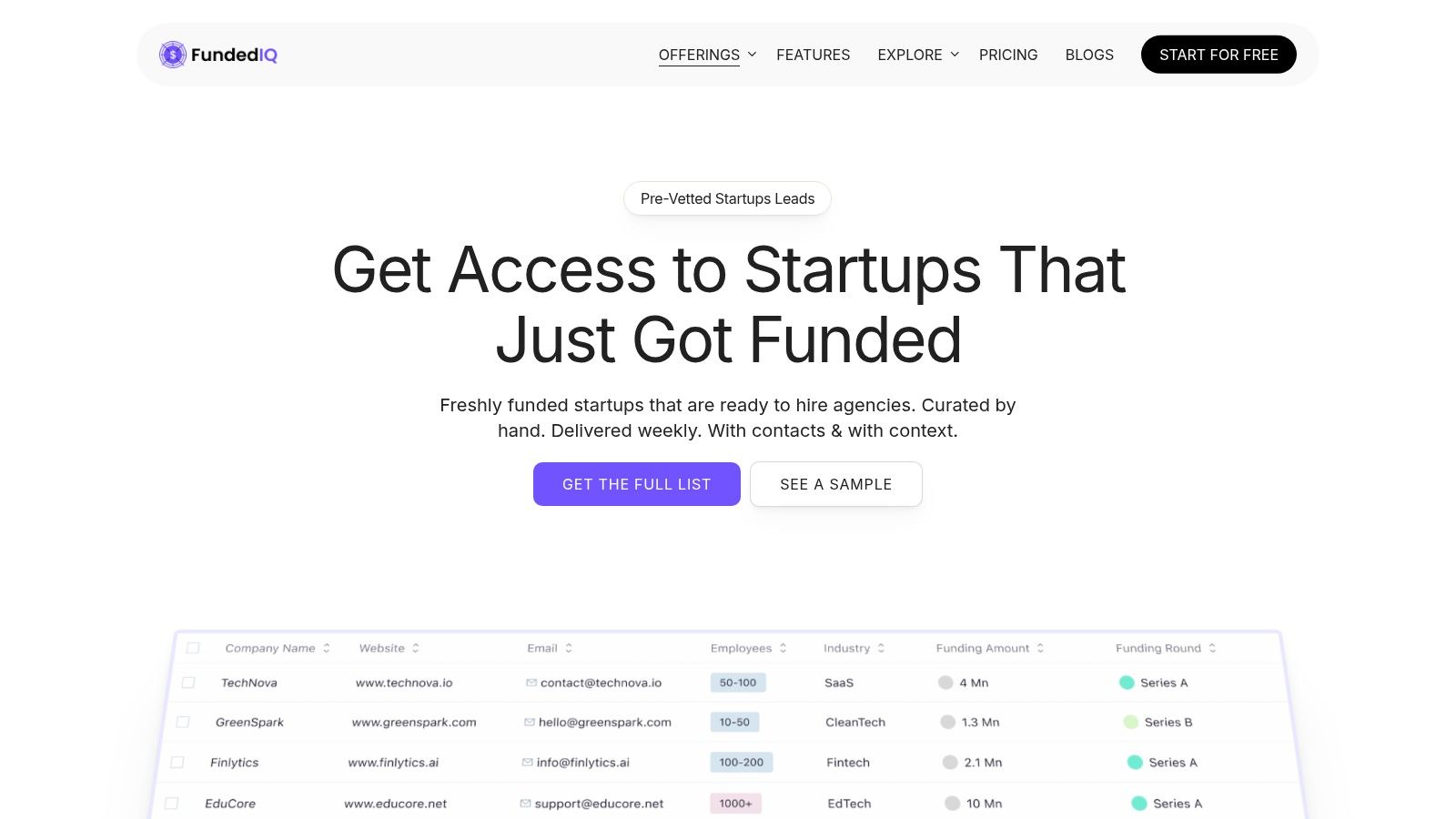
FundedIQ establishes itself as a premier choice among the best intent data providers by delivering a highly specialized and actionable dataset: recently funded startups. Instead of casting a wide, generic net, it focuses on the most powerful buying signal in the startup ecosystem, a recent injection of capital. A company that just raised a $10M Series A is a prime candidate for new HR software, marketing agencies, and office equipment. This approach provides subscribers with a weekly, hand-curated list of companies that are not just growing, but are actively investing in new tools, services, and talent to scale.
What truly sets FundedIQ apart is its meticulous, human-centric data validation process. Each startup profile is manually verified, and contact information for key decision-makers is aggregated from over 15 premium sources. This “waterfall enrichment” method significantly boosts data quality, reportedly yielding up to 40% more reachable emails than standard scraping tools. This commitment to quality ensures that sales and marketing teams spend less time dealing with bounced emails and more time engaging qualified prospects.
Key Insight: The platform’s social proof is compelling, with users reporting tangible ROI in weeks, not months. Examples include a $42K project landed from a single list and a $310K ARR boost within six months, highlighting the immediate impact of targeting capital-rich companies.
Deep Intelligence for Precision Outreach
The platform excels by enriching company profiles with layers of contextual data that enable hyper-personalized outreach.
- Buying Signals: Access to real-time indicators like hiring surges, new ad campaigns, website expansions, and estimated IT spend helps you tailor your pitch to a company’s immediate needs. For instance, a performance marketing agency can pinpoint a startup that just launched a major ad campaign, using that specific data point as a compelling conversation starter: “Saw you just launched a new campaign on LinkedIn—here’s how we can improve your CPL by 20%.”
- Tech Stack Data: Knowing a company’s current technology stack (e.g., their CRM, marketing automation platform, or cloud provider) allows for highly relevant solution-selling and competitive positioning.
- Funding Context: Detailed information on funding rounds, amounts, and investors provides invaluable context for understanding a startup’s growth trajectory and strategic priorities, allowing you to align your value proposition perfectly.
This depth of information transforms cold outreach into warm, informed conversations that are far more likely to convert.
Pricing, Pros & Cons
| Pricing | Access: Flat $47/month for instant access to weekly lists. Includes a 60-day money-back guarantee. |
|---|---|
| Pros | |
| High-Intent Leads: Focus on funded startups provides a direct pipeline of buyers. | |
| Superior Data Quality: Manual validation and multi-source enrichment increase email deliverability. | |
| Actionable Intelligence: Rich data points enable highly personalized and effective outreach. | |
| Low Risk & High Value: Affordable, transparent pricing with a generous money-back guarantee. | |
| Cons | |
| Niche Focus: Highly specialized on startups; not suitable for teams targeting enterprise or late-stage companies. | |
| Quality Over Quantity: Not designed for massive, high-volume campaigns that require bulk data lists. |
Learn more at FundedIQ.co
2. Bombora
Bombora is a cornerstone in the B2B intent data landscape, widely recognized as one of the best intent data providers due to its unique Data Co-op model. Instead of relying solely on bidstream data, it aggregates consent-based content consumption signals from a proprietary network of thousands of B2B publisher websites, research firms, and event platforms. This cooperative, which includes over 5,000 B2B sites, provides a more transparent and reliable view of which businesses are actively researching specific topics relevant to your products.
The core offering is its “Company Surge” score, which identifies accounts exhibiting a significant increase in research activity around specific topics compared to their historical baseline. For example, if an account’s normal research on “cybersecurity” is a score of 30, but this week it jumps to 85, it indicates a strong buying signal. This data is delivered weekly, allowing marketing and sales teams to prioritize accounts showing active buying signals for timely and relevant outreach.
Key Features and Implementation
Bombora’s strength lies in its ecosystem. While you can purchase data feeds directly, most businesses consume its insights through a vast network of platform integrations. This makes operationalizing the data seamless within your existing GTM stack.
| Feature Breakdown | Details |
|---|---|
| Data Source | Consent-based B2B Data Cooperative |
| Primary Metric | Company Surge® Score (Topic-based) |
| Data Level | Account-level by default |
| Integrations | Salesforce, HubSpot, 6sense, Demandbase, RollWorks, SalesIntel, etc. |
Pricing and Access
Bombora is geared towards enterprise clients, with pricing typically based on annual contracts. The cost varies depending on the number of topics you want to track and the volume of surging accounts you need. There are limited direct self-service options, as most access is facilitated through its extensive partner network.
Pros:
- High-Quality Data: Its cooperative, consent-based model is a market differentiator from less transparent bidstream sources.
- Ecosystem Integration: Easily plugs into hundreds of major sales and marketing platforms.
- Industry Standard: Widely adopted and trusted across the B2B industry.
Cons:
- Account-Level Focus: Primarily identifies which companies are in-market, not the specific individuals doing the research.
- Enterprise Pricing: The investment level is better suited for established mid-market and enterprise companies.
Website: https://bombora.com
3. 6sense
6sense has evolved from a predictive analytics tool into a comprehensive, AI-driven Account Engagement Platform, positioning itself as a central nervous system for GTM teams. What makes it one of the best intent data providers is its ability to not just provide native intent signals but also to ingest and unify third-party data from sources like Bombora, G2, and others. This creates a single, holistic view of account activity, removing the silos that often plague marketing and sales operations.
The platform excels at identifying accounts that fit a company’s Ideal Customer Profile and are in the early stages of a buying journey, often before they are visible to competitors. Its AI-powered models analyze anonymous web traffic and keyword-level research signals across over 40 languages, assigning a “6sense Buying Stage” to each account to help teams prioritize their efforts effectively. For example, it can distinguish an account in “Awareness” (just starting research) from one in “Decision” (comparing vendors), allowing for tailored messaging.
Key Features and Implementation
6sense is designed as an end-to-end platform, not just a data source. Implementation involves integrating it deeply into your CRM and marketing automation platforms to orchestrate multi-channel campaigns, from targeted advertising and email nurtures to sales outreach, all based on unified intent signals.
| Feature Breakdown | Details |
|---|---|
| Data Source | Native bidstream, anonymous web analytics, and third-party data aggregation |
| Primary Metric | 6sense Buying Stages (Target, Awareness, Consideration, etc.) |
| Data Level | Account-level and contact-level (via contact acquisition features) |
| Integrations | Salesforce, HubSpot, Marketo, Outreach, Salesloft, and major ad platforms |
Pricing and Access
6sense is an enterprise-grade platform with custom, quote-based annual pricing. The investment reflects its role as a core GTM platform and requires significant commitment to onboarding and cross-functional team adoption for maximum ROI. It is not designed for teams looking for a simple, standalone intent data feed.
Pros:
- Unified Intent Hub: Consolidates multiple high-quality intent sources into a single platform for analysis and activation.
- Full-Funnel Activation: Powers orchestration across advertising, marketing, and sales channels from one place.
- Strong Analyst Recognition: Widely regarded as a leader in the ABM and B2B intent data space.
Cons:
- Enterprise Platform: Requires a significant investment and change management for successful adoption.
- Complexity: The platform’s extensive capabilities come with a steeper learning curve compared to point solutions.
Website: https://6sense.com/platform/intent-data
4. Demandbase
Demandbase is a comprehensive Account-Based Marketing (ABM) platform where intent data is a core, integrated component rather than a standalone product. It offers its own proprietary intent signals sourced from bidstream and other online activity, covering a vast keyword and language base. A key differentiator is its ability to serve as an intent data aggregator, allowing users to ingest and unify signals from partners like Bombora, G2, and TechTarget directly within the platform.
This unified approach embeds intent directly into account intelligence dashboards, scoring models, and prospecting workflows. Teams can analyze historical trends over a 13-month period, pinpoint surging topics, and trigger actions within their GTM plays without ever leaving the Demandbase environment. For example, a sales rep can see that a target account’s interest in “contract management software” spiked 3 weeks ago and has remained high, signaling a perfect time for outreach. This makes it one of the best intent data providers for teams seeking an all-in-one solution.
Key Features and Implementation
Demandbase’s power comes from its native integration of intent data into a broader GTM platform. Intent signals directly inform account scoring, journey stage progression, and advertising audiences, creating a seamless activation loop from signal to engagement.
| Feature Breakdown | Details |
|---|---|
| Data Source | Proprietary bidstream data plus third-party partner integrations |
| Primary Metric | Keyword-based intent, trending/surge scores |
| Data Level | Account-level, with deep analytics and historical views |
| Integrations | Native integrations with Salesforce, Marketo, etc., plus a full ABM suite |
Pricing and Access
Demandbase is designed for mid-market to enterprise companies committed to an ABM strategy. Pricing is quote-based and varies based on the specific modules and data packages selected. It is not a self-service tool; access requires a significant investment and is best suited for organizations looking to make Demandbase a central pillar of their GTM technology stack.
Pros:
- Large Signal Volume: Proprietary data covers over 810k keywords and 133 languages.
- Unified Platform: Seamlessly integrates and activates intent within a single, powerful ABM solution.
- Data Aggregation: Centralizes first-party and third-party intent for a holistic view.
Cons:
- Platform Dependency: The highest value is realized when using the full Demandbase GTM platform.
- Enterprise Pricing: The investment is substantial and structured for larger organizations.
Website: https://www.demandbase.com/products/account-intelligence/intent/
5. Informa TechTarget (Priority Engine)
Informa TechTarget’s Priority Engine platform leverages a powerful, first-party approach to intent data. It uniquely gathers opt-in buyer research signals exclusively from its vast network of over 150 specialized technology editorial websites (like SearchSecurity or TechCrunch). This closed-loop system provides high-fidelity insights into which accounts and, crucially, which specific individuals are actively researching solutions within defined technology categories.
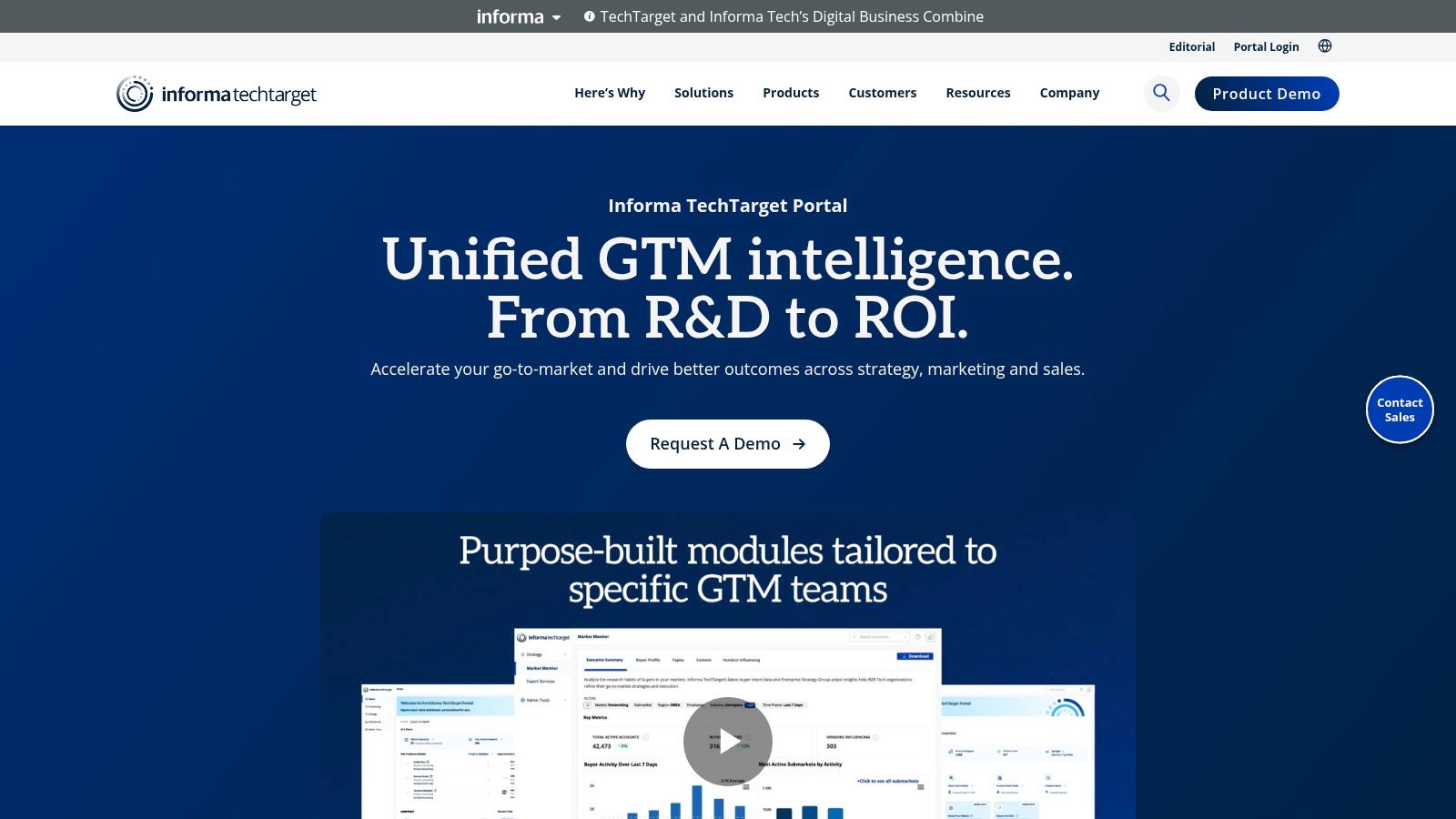
Unlike providers who rely on broader, third-party data, Priority Engine offers a direct window into the content consumption of engaged, in-market buyers. It identifies active buying teams and provides contact-level details, making it one of the best intent data providers for sales teams looking to activate insights quickly. For example, it won’t just tell you that “Company X” is interested in “data storage,” but that “John Doe, IT Director at Company X,” downloaded two whitepapers on the topic this week. The platform is designed to expose both the accounts and the people within them who are demonstrating purchase intent.
Key Features and Implementation
The platform’s core value is its ability to tie intent signals directly to known prospects who have consented to engagement on TechTarget properties. This creates a highly actionable dataset that can be fed directly into sales and marketing systems for immediate follow-up.
| Feature Breakdown | Details |
|---|---|
| Data Source | First-party, opt-in data from 150+ TechTarget editorial sites |
| Primary Metric | Prospect-level content engagement and topic interest |
| Data Level | Account, Buying Group, and Prospect-level |
| Integrations | Salesforce, Marketo, HubSpot, Eloqua, Outreach, Salesloft, etc. |
Pricing and Access
Access to Priority Engine is geared towards enterprise and high-growth technology vendors. Pricing is quote-based and determined by the scope of market segments, number of topics tracked, and the required data volume. The model is built around annual subscriptions, reflecting its role as a strategic GTM intelligence tool.
Pros:
- High-Fidelity First-Party Data: Signals are direct, consented, and sourced from a highly relevant B2B tech content network.
- Prospect-Level Detail: Goes beyond the account level to identify specific individuals and buying team members.
- Strong Sales Activation: Provides clear, actionable insights that sales teams can use for immediate and relevant outreach.
Cons:
- Niche Focus: Coverage is exceptionally strong in IT and enterprise tech but may be less comprehensive for other industries.
- Enterprise-Oriented Pricing: The investment is primarily suited for established B2B technology companies.
Website: https://www.techtarget.com/products/priority-engine/
6. ZoomInfo
ZoomInfo is a comprehensive B2B intelligence platform where intent data is a key component of its broader SalesOS and MarketingOS offerings. Rather than being a pure-play intent provider, it bundles intent signals with its massive database of company and contact information. ZoomInfo’s intent data is sourced from its own network and includes signals like keyword and topic tracking, as well as website visitor identification through its WebSights feature. This makes it one of the best intent data providers for teams seeking an all-in-one solution.
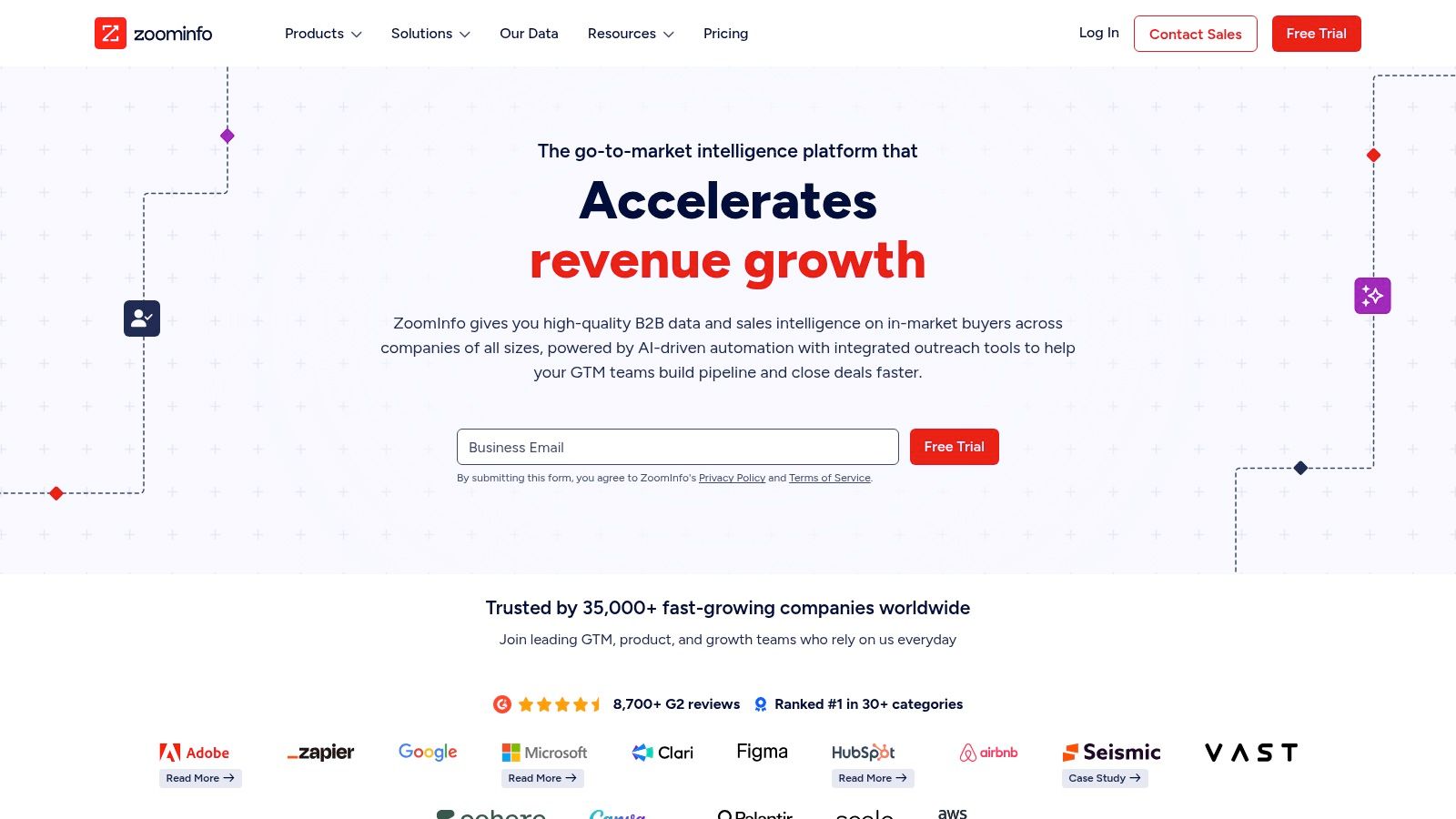
The platform’s primary advantage is its ability to activate intent data directly within the same ecosystem used for prospecting and outreach. For those interested in a deeper understanding of this space, you can learn more about what sales intelligence is and how it works. ZoomInfo also enriches its offering by integrating third-party intent sources, such as review-site intent from G2, providing a multi-faceted view of buyer activity. A practical example would be creating a list of companies in the manufacturing sector showing intent for “ERP software” in the last 30 days, and then immediately finding verified contacts for CFOs and COOs at those companies, all within one interface.
Key Features and Implementation
ZoomInfo is designed to be a central hub for GTM teams, making it easy to build target account lists based on intent, find the right contacts within those accounts, and launch campaigns without leaving the platform. Implementation is focused on integrating it deeply with your CRM and MAP.
| Feature Breakdown | Details |
|---|---|
| Data Source | Proprietary network, publisher data, website visitor ID, third-party integrations (e.g., G2) |
| Primary Metric | Intent topic surges, website visitor alerts (WebSights Buyer ID) |
| Data Level | Account-level and contact-level |
| Integrations | Salesforce, HubSpot, Marketo, SalesLoft, Outreach, and a large marketplace of others |
Pricing and Access
ZoomInfo’s pricing is opaque and typically involves multi-year contracts with a customized quote based on platform features, user seats, and data credits. It is known for being add-on heavy, so intent data and other advanced features often come at an additional cost to the core subscription.
Pros:
- Single Vendor: Combines high-quality contact data, company data, intent signals, and activation tools in one platform.
- Extensive Ecosystem: Strong native integrations with virtually every major sales and marketing tool.
Cons:
- Opaque & Add-On Pricing: Costs can escalate quickly, making it a significant investment, especially for smaller teams.
- Signal Variability: The accuracy of intent and visitor identification signals can depend on network coverage and specific setup.
Website: https://www.zoominfo.com
7. G2 (Buyer Intent)
G2 offers a unique and powerful form of intent data by capturing signals directly from its software marketplace, where millions of buyers actively research and compare business technology. Unlike broad, topic-based intent, G2’s signals are highly specific and product-proximate, indicating that a company is not just researching a problem but actively evaluating solutions like yours. This makes it one of the best intent data providers for teams focused on bottom-of-the-funnel activities.
The platform provides granular insights into which companies are viewing your G2 profile, comparing your product to competitors, exploring your pricing page, or researching the software category you belong to. For example, an alert that “Company ABC” just compared your CRM to Salesforce and HubSpot is an extremely strong buying signal. These signals represent high-value prospects actively engaged in the final stages of their decision-making process, making the data incredibly actionable for sales and marketing outreach.
Key Features and Implementation
G2’s Buyer Intent data is most effective when integrated directly into your GTM workflows. You can access the data within the G2 portal, pull it via API, or, more commonly, pipe it into your CRM or marketing automation platform. This allows for the creation of automated alerts and targeted campaigns aimed at accounts showing strong purchase intent.
| Feature Breakdown | Details |
|---|---|
| Data Source | First-party user activity on the G2 software marketplace |
| Primary Metric | Specific buyer actions (e.g., profile views, comparisons, category views) |
| Data Level | Account-level, with potential for contact-level data in some plans |
| Integrations | Salesforce, HubSpot, Marketo, 6sense, Demandbase, Outreach, and more |
Pricing and Access
Access to G2’s Buyer Intent data requires a paid subscription to its vendor platform. Pricing tiers vary based on the level of data granularity and the features you need. Basic plans may offer limited signals, while premium tiers unlock richer data points like competitor comparisons and alternative product views. The investment is best suited for B2B SaaS companies with a significant presence in categories listed on the G2 marketplace.
Pros:
- High-Intent Signals: Data is from buyers actively evaluating and comparing specific software solutions.
- Product-Proximate: Signals are directly tied to your product and your competitors, making them highly relevant.
- Strong Integration Ecosystem: Seamlessly connects with major CRM and marketing automation platforms.
Cons:
- Requires a Paid G2 Plan: The most valuable signals are locked behind higher-priced vendor profiles.
- Niche Focus: Most effective for software and tech companies; less relevant for other B2B industries.
Website: https://www.g2.com/products/buyer-intent
8. TrustRadius (Downstream Intent)
TrustRadius offers a specialized form of intent data known as “downstream intent,” derived directly from user activity on its B2B software review platform. Unlike broad-topic intent from across the web, TrustRadius provides high-fidelity signals from buyers actively engaged in the late stages of their purchasing journey. This includes tracking which companies are viewing your product pages, pricing information, and direct competitor comparisons on their site.
This granular, product-level data identifies accounts that are beyond initial research and are now in the critical evaluation phase. For GTM teams, these are some of the most valuable signals available, indicating a high probability of an imminent purchase decision. By pinpointing this late-stage activity, sales and marketing can prioritize outreach with contextually relevant messaging focused on competitive differentiation. A practical insight is that these signals can be used to arm a sales team for a competitive deal, for instance, by knowing which three competitors a prospect is actively evaluating.
Key Features and Implementation
The value of TrustRadius’s data lies in its specificity and the environment it comes from. These signals originate from a trusted, verified-review ecosystem where buyers are making final considerations. The data can be accessed via an API or through integrations, allowing it to be fed directly into your ABM platforms or CRM for immediate activation.
| Feature Breakdown | Details |
|---|---|
| Data Source | First-party activity from the TrustRadius review platform |
| Primary Metric | Account-level views of specific product, category, and competitor pages |
| Data Level | Account-level |
| Integrations | API access, direct data feeds, and select platform integrations (e.g., 6sense, Demandbase) |
Pricing and Access
Access to TrustRadius’s full Downstream Intent data suite is available for paying vendors. Pricing is quote-based and typically part of a broader subscription package for vendors listed on the platform. It’s designed for B2B software companies that want to leverage late-stage buying signals to gain a competitive edge and shorten sales cycles.
Pros:
- High-Fidelity Signals: Data comes from users actively evaluating solutions, indicating strong purchase intent.
- Late-Stage Insight: Provides a powerful complement to broader, top-of-funnel intent data providers.
- Competitive Intelligence: See which accounts are comparing you directly against your rivals.
Cons:
- Niche Coverage: The volume of signals is dependent on the traffic and popularity of your specific software category on their site.
- Requires Vendor Subscription: Full access is a premium offering tied to a vendor partnership.
Website: https://solutions.trustradius.com/vendor/intent-data/downstream-intent-data/
9. Foundry (formerly IDG)
Foundry, the media and data company formerly known as IDG, offers a compelling intent data solution built on its extensive portfolio of first-party technology media properties. As one of the best intent data providers for tech marketers, Foundry leverages deep engagement signals from its well-known editorial sites (like CIO, Computerworld, and Network World), search topics, and offline event attendance. This proprietary data, representing over 220 million annual engagements, provides a high-fidelity view into the research behaviors of active technology buyers.
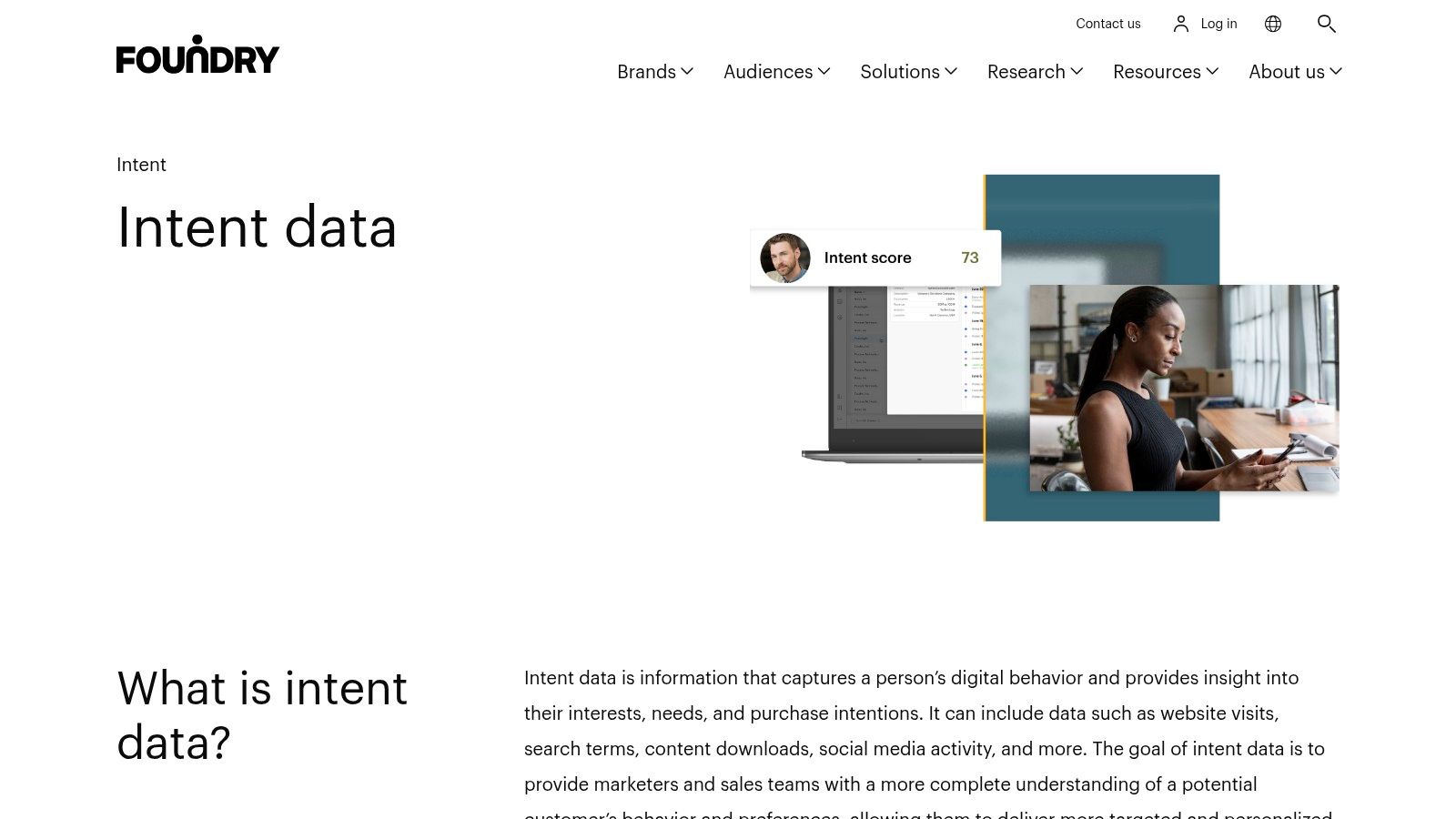
The key differentiator for Foundry is its ability to deliver contact-level intent signals, moving beyond account-level insights to pinpoint specific individuals demonstrating buying behavior. This data is natively activated through its own Triblio ABM platform, creating a tightly integrated system for running personalized advertising campaigns, website personalization, and sales outreach orchestration based on real-time signals.
Key Features and Implementation
Foundry’s strength is its closed-loop ecosystem. The intent data is sourced from its own audience and is designed for immediate activation within its ABM platform, reducing the friction often found when trying to connect disparate data and activation tools.
| Feature Breakdown | Details |
|---|---|
| Data Source | Proprietary first-party data from owned media sites and events |
| Primary Metric | Topic-based engagement and event-driven behaviors |
| Data Level | Contact-level and account-level signals |
| Integrations | Native activation through the Triblio ABM platform |
Pricing and Access
Access to Foundry’s intent data is typically bundled into broader media or ABM program packages. Pricing is quote-based and tailored to specific client needs, often encompassing data, activation, and media buys. It is not available as a standalone, self-service data feed, positioning it for companies committed to a more comprehensive, integrated GTM program.
Pros:
- High-Fidelity Tech Data: The first-party, tech-focused footprint provides very relevant signals for IT vendors.
- Integrated Activation: The native connection to the Triblio platform allows for seamless campaign execution.
- Contact-Level Detail: Offers visibility into the specific people driving the research, not just the company.
Cons:
- Niche Focus: Heavily skewed towards the technology market, making it less suitable for non-tech industries.
- Bundled Pricing: Often requires a larger investment in a full program rather than just a data subscription.
Website: https://foundryco.com/our-solutions/what-is-intent-data/
10. Madison Logic (ML Insights)
Madison Logic stands out by tightly coupling intent data with multi-channel activation within a single account-based marketing (ABM) platform. It unifies proprietary engagement signals, extensive B2B research data, and technographic insights to power its ML Insights engine. This provides a comprehensive purchase-propensity score, identifying not just which accounts are in-market, but also the key personas within them, making it one of the more actionable intent data providers for integrated campaigns.
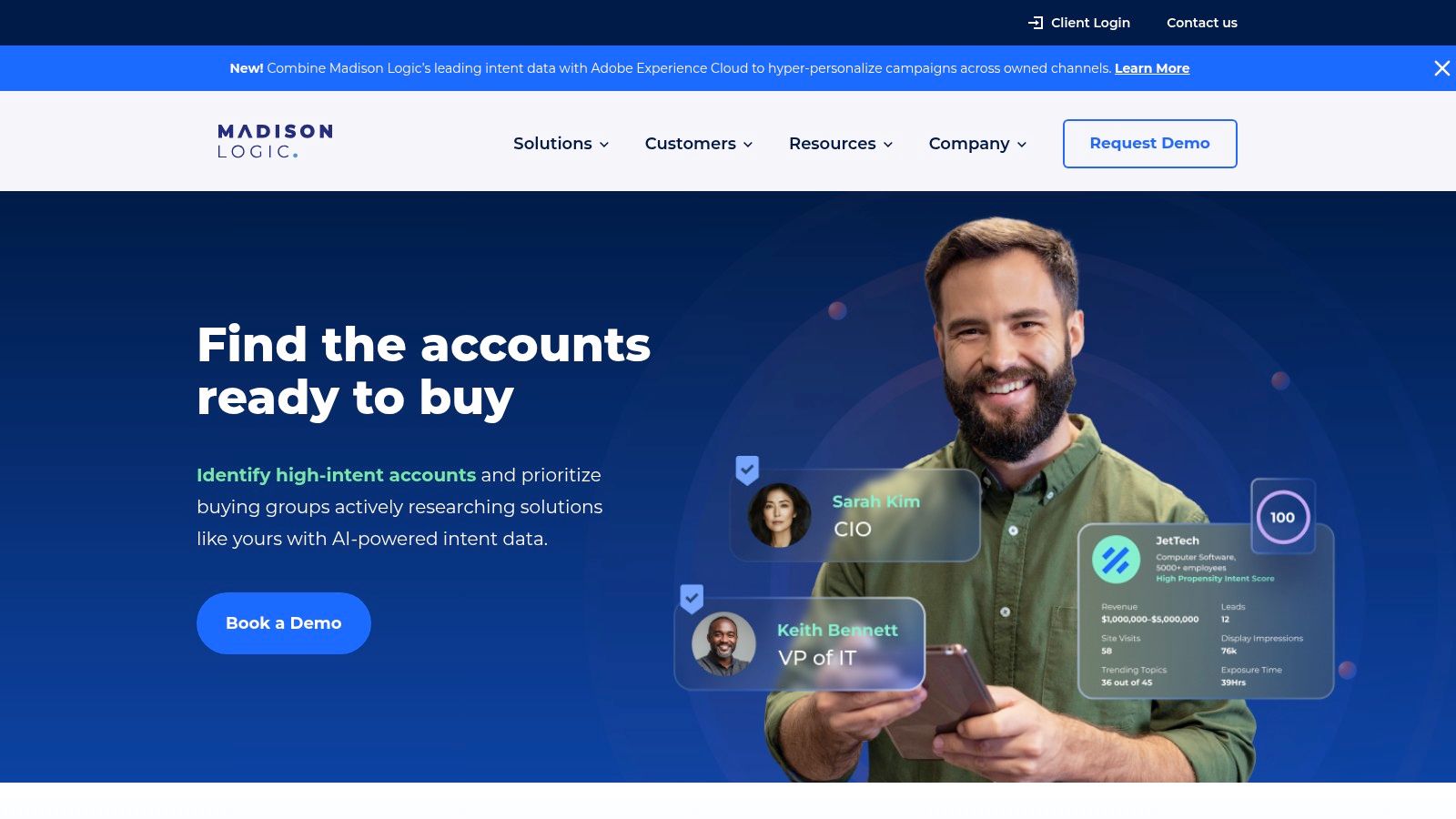
The platform’s core strength is its ability to immediately activate these insights across display, CTV, audio, LinkedIn, and content syndication. According to their data, clients see a 17% increase in pipeline velocity and a 34% lift in deal size. This closed-loop system allows marketers to engage high-intent accounts with relevant messaging at the right time and directly measure the resulting pipeline impact, bridging the common gap between data discovery and execution.
Key Features and Implementation
Madison Logic is designed as an end-to-end solution. Its AI-powered scoring models analyze signals from its vast proprietary dataset to prioritize accounts and contacts, which can then be targeted through its native advertising channels. This creates a seamless workflow from insight to engagement.
| Feature Breakdown | Details |
|---|---|
| Data Source | Proprietary multi-source data (engagement, research, technographics) |
| Primary Metric | ML Insights Account and Persona Scoring |
| Data Level | Account and buying-group level |
| Integrations | Salesforce, Marketo, HubSpot, Eloqua, and other major MAP/CRM platforms |
Pricing and Access
Madison Logic is structured for mid-market to enterprise clients with established ABM programs. Pricing is based on customized packages that bundle the ML Insights platform with media spend across its activation channels. Access is provided through managed services or direct platform use, depending on the client’s needs and budget.
Pros:
- Unified Data and Activation: Combines intent insights and media execution in one platform for a streamlined workflow.
- Measurable Pipeline Impact: Focuses on connecting ABM activities directly to revenue and pipeline goals.
- Multi-Channel Reach: Activates campaigns across a wide range of channels including display, LinkedIn, and CTV.
Cons:
- Enterprise-Focused: The investment and required ABM maturity are best suited for larger organizations.
- Account-Level Intent: While it identifies personas, the primary intent signals are surfaced at the account or buying-group level.
Website: https://www.madisonlogic.com/solutions/ml-insights/
11. Gartner Digital Markets (Capterra, GetApp, Software Advice)
Gartner Digital Markets leverages its massive portfolio of software review sites, including Capterra, GetApp, and Software Advice, to offer highly specific, bottom-of-funnel intent data. This network captures signals from millions of in-market software buyers actively comparing solutions, making it one of the best intent data providers for B2B SaaS companies. With a combined audience of over 60 million annual software buyers, the data scale is significant. Instead of broad topical research, its data pinpoints which businesses are evaluating specific software categories and competitors.
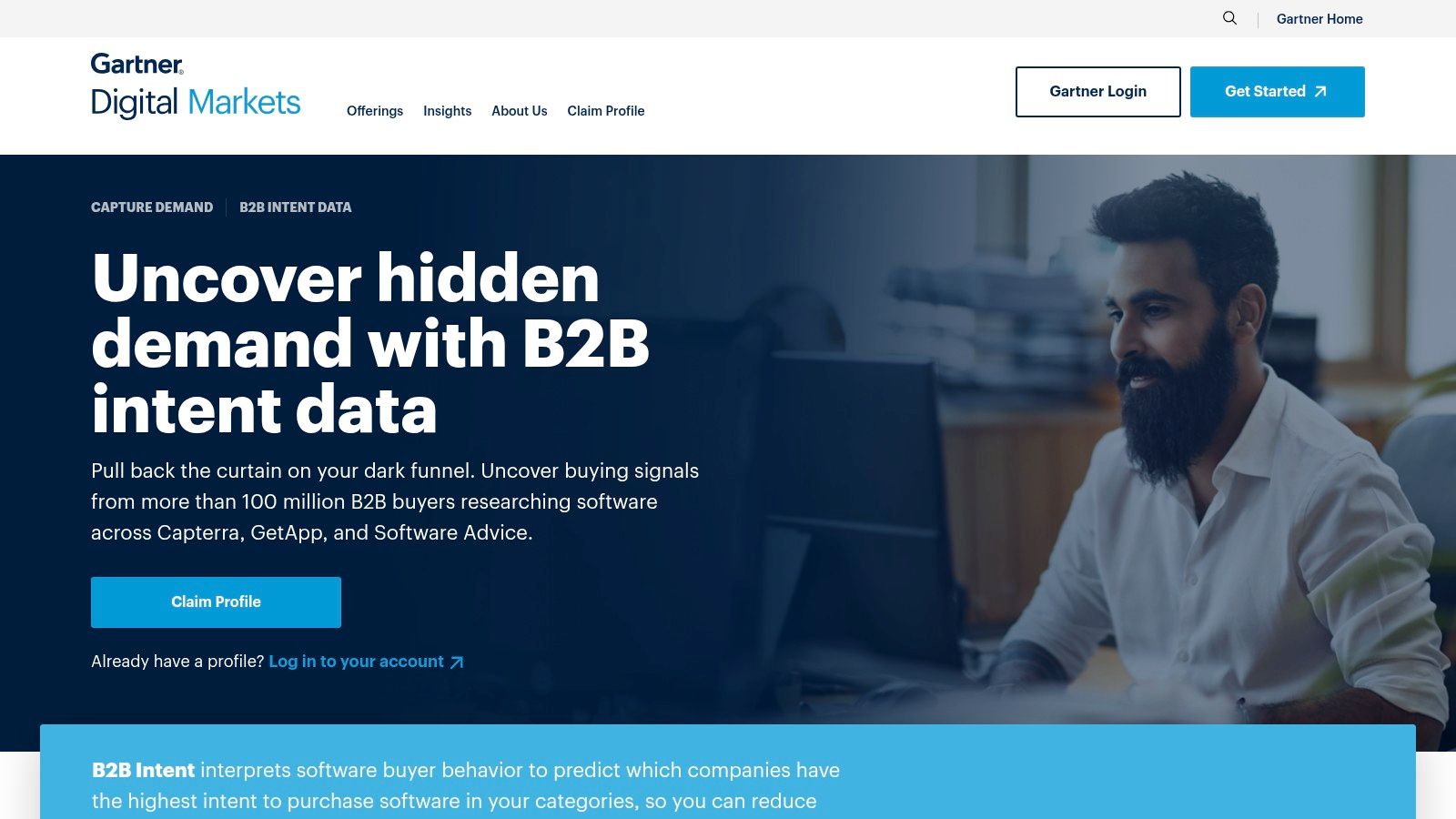
The platform provides category-specific intent models that help vendors uncover hidden demand and identify accounts showing purchase-ready behavior. This allows GTM teams to prioritize outreach to prospects who are in the final stages of their decision-making process, moving beyond general interest to active evaluation.
Key Features and Implementation
The value of Gartner Digital Markets’ intent data lies in its context. The signals are generated by users actively comparing features, pricing, and reviews on its marketplaces. Activation is primarily handled through integrations and data exports, allowing software vendors to feed this high-value information directly into their marketing automation and CRM platforms for targeted campaigns.
| Feature Breakdown | Details |
|---|---|
| Data Source | First-party user activity on Capterra, GetApp, and Software Advice |
| Primary Metric | High-intent actions (e.g., category comparisons, vendor shortlisting) |
| Data Level | Account-level and contact-level insights |
| Integrations | Direct data exports, APIs, and guides for popular GTM platforms |
Pricing and Access
Access to this high-value intent data is typically bundled with paid vendor programs and advertising packages on the Gartner Digital Markets platforms. It is not offered as a standalone, self-service data subscription. Pricing is tailored to software vendors and depends on the scope of their participation and the categories they wish to monitor.
Pros:
- High-Intent, Software-Specific Data: Captures signals from a massive audience of active software shoppers.
- Bottom-of-Funnel Focus: Excellent for identifying accounts in the final stages of the buying cycle.
- Global Reach: The marketplaces attract a significant international user base.
Cons:
- Niche Focus: Highly valuable for software vendors but less applicable for companies outside the SaaS industry.
- Bundled Access: Not available as a standalone product; requires investment in their broader marketing solutions.
Website: https://www.gartner.com/en/digital-markets/b2b-intent-data
12. NetLine (INTENTIVE)
NetLine’s INTENTIVE platform carves out a unique niche among the best intent data providers by focusing on true, buyer-level intent signals. Instead of aggregating anonymous account-level behavior, it captures explicit, first-party data from users who voluntarily register for content across its vast B2B content syndication network of over 15,000 assets. This approach is augmented with offline data from Informa-powered events, providing a holistic view of an individual’s buying journey.
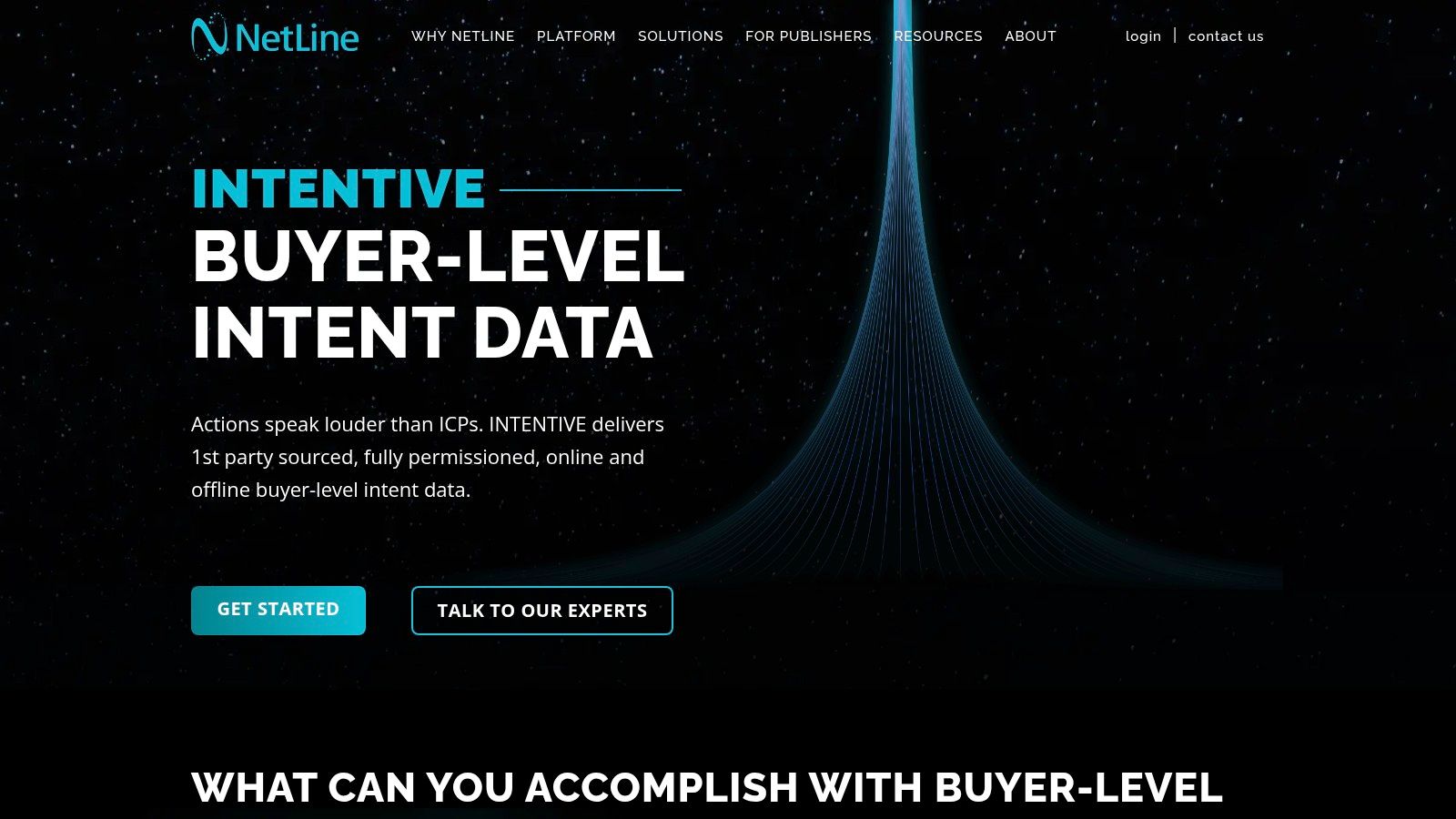
The platform delivers the “who, what, when, and where” of B2B research, identifying specific individuals actively consuming content relevant to your solutions. It goes beyond simple topic surges by providing context, including project confirmation and purchase timing indicators, directly from the user. For instance, it can surface a lead who has not only downloaded an ebook on AI but also self-reported that their company has an active project with a 3-6 month purchase timeline. This makes it a powerful tool for accelerating content-led demand generation and enabling highly targeted sales outreach.
Key Features and Implementation
INTENTIVE is designed to feed actionable, contact-level leads directly into your pipeline. The data is fully permissioned and can be integrated into CRM and MAP systems to trigger immediate follow-up sequences. It provides the granular detail needed to move beyond account-based marketing to true person-based engagement.
| Feature Breakdown | Details |
|---|---|
| Data Source | First-party content registrations and offline event data (Informa) |
| Primary Metric | Individual buyer activity with project timing and need confirmation |
| Data Level | Contact-level (buyer-level) |
| Integrations | Salesforce, HubSpot, Marketo, plus standard data exports (CSV) |
Pricing and Access
Access to INTENTIVE is typically structured through custom, quote-based packages tailored to your specific targeting criteria and volume needs. It is best suited for organizations that have established content marketing programs and the CRM/MAP infrastructure to act on the detailed buyer-level signals it provides.
Pros:
- True Contact-Level Data: Identifies the actual person researching, not just the company.
- First-Party Permission: All data is captured with user consent, ensuring high quality and compliance.
- Content-Led Strategy Fit: Perfectly aligns with demand generation and sales acceleration motions based on content engagement.
Cons:
- Niche Coverage Dependency: Data availability is tied to the reach of the NetLine and Informa network within your specific industry.
- Requires Workflow Integration: To maximize value, data must be actioned within a connected CRM or marketing automation platform.
Website: https://www.netline.com/platform/intentive.html
Top 12 Intent Data Providers Comparison
| Solution | Core features | Quality / Reach (★) | Value & Pricing (💰) | Target Audience (👥) | Unique advantage (✨) |
|---|---|---|---|---|---|
| FundedIQ 🏆 | Weekly hand‑curated funded‑startup lists; verified decision‑maker contacts; tech stack, traffic & buying signals | ★★★★★ Verified contacts; up to +40% more reachable emails | 💰 $47/mo flat; 60‑day money‑back; no commitment | 👥 Growth, creative, content, recruitment, tech agencies | ✨ Manual validation + waterfall enrichment; GDPR/CAN‑SPAM compliant — Recommended 🏆 |
| Bombora | Consent‑based Data Co‑op; Company Surge topical scoring; partner feeds | ★★★★ Account‑level surges; broad topical coverage | 💰 Enterprise/quote; feed or partner integrations | 👥 B2B marketers, ABM teams | ✨ Market standard for account intent; wide ecosystem |
| 6sense | AI account intelligence; unified native & third‑party intent; activation hub | ★★★★ Consolidates multiple intent sources for activation | 💰 Enterprise, quote‑based | 👥 Enterprise GTM & ABM teams | ✨ Unified intent hub + cross‑channel activation |
| Demandbase | Proprietary intent + partner feeds; 13‑month trends; prospecting center | ★★★★ Large signal volume & language support | 💰 Quote/enterprise — best as core ABM platform | 👥 ABM‑focused enterprises | ✨ Deep analytics & Salesforce prospecting integration |
| Informa TechTarget (Priority Engine) | First‑party editorial research signals; prospect & buying‑group visibility | ★★★★ High‑fidelity, consented tech research signals | 💰 Quote/enterprise | 👥 IT vendors, tech‑market sellers | ✨ First‑party research from 150+ tech sites; strong sales workflows |
| ZoomInfo | Contact/company data + intent; WebSight visitor ID; activation in SalesOS/MarketingOS | ★★★ Single‑vendor data + orchestration; broad integrations | 💰 Opaque pricing; add‑on heavy | 👥 Sales & marketing teams needing unified data | ✨ All‑in‑one data, intent and orchestration platform |
| G2 (Buyer Intent) | Product/category research signals; API & CRM integrations | ★★★ Downstream, product‑proximate evaluation signals | 💰 Paid plan unlocks richer signals | 👥 Product/SaaS vendors, SDRs | ✨ Signals tied to product research & comparisons |
| TrustRadius (Downstream Intent) | Review‑site downstream signals: product, pricing & competitor research | ★★★ High‑fidelity late‑stage evaluation signals | 💰 Subscription/quote required | 👥 Vendors targeting evaluation‑stage buyers | ✨ Verified‑review downstream intent |
| Foundry (formerly IDG) | Editorial, search & event signals; contact‑level intent; Triblio activation | ★★★ Strong tech‑buyer footprint + event signals | 💰 Quote/enterprise | 👥 Tech vendors & enterprise ABM | ✨ Contact‑level + event‑driven behaviors via Triblio |
| Madison Logic (ML Insights) | Proprietary engagement + technographics; persona scoring & multi‑channel activation | ★★★ Measurable pipeline impact from combined data+media | 💰 Mid/enterprise budgets | 👥 Mid‑market & enterprise ABM teams | ✨ Data‑to‑activation across display, CTV, audio, LinkedIn |
| Gartner Digital Markets | Buyer intent from Capterra/GetApp/Software Advice marketplaces | ★★★ Massive software‑shopping audience & category models | 💰 Paid programs/packages | 👥 Software/SaaS vendors | ✨ Large software‑specific buyer pool; hidden‑demand discovery |
| NetLine (INTENTIVE) | Permissioned content‑registration buyer signals; contact‑level journey context | ★★★★ True contact‑level intent with project timing | 💰 Quote‑based; CRM/MAP integrations | 👥 Content‑led demand gen & sales acceleration teams | ✨ Permissioned buyer IDs + offline event blending |
Making Intent Data Work for You: A Final Checklist
Navigating the landscape of the best intent data providers can feel overwhelming, but making an informed choice is the critical first step toward a more proactive and effective go-to-market strategy. We’ve explored a dozen powerful platforms, from comprehensive ABM suites like 6sense and Demandbase to specialized B2B review site signals from G2 and TrustRadius, and the unique, high-value signals from FundedIQ focused on recently funded companies.
The key takeaway is that there is no single “best” provider for everyone. The right choice hinges entirely on your organization’s specific needs, maturity, budget, and internal resources. An enterprise-level platform with predictive analytics and orchestration might be transformative for a large sales organization, but it would be costly and underutilized by a lean startup.
How to Choose the Right Intent Data Partner
To distill the insights from our detailed reviews, consider your primary objective. Are you looking to cast a wide net or execute a precise, surgical strike?
- For Broad-Based, Top-of-Funnel Targeting: If your goal is to identify general interest across a wide market, providers with vast data co-ops like Bombora or media-driven insights from Foundry and Informa TechTarget offer unparalleled scale. They are excellent for identifying new accounts showing early-stage research behavior.
- For High-Fidelity, Bottom-of-Funnel Signals: When you need to know who is actively evaluating solutions right now, B2B review platforms are indispensable. G2’s Buyer Intent and TrustRadius’s Downstream Intent provide signals from accounts deep in the consideration phase, making them ideal for prioritizing sales outreach.
- For All-in-One ABM Orchestration: If you have the team and budget to support a full-funnel Account-Based Marketing program, platforms like 6sense and Demandbase are the market leaders. They combine intent data with predictive analytics and ad execution, creating a unified system for targeting and engaging high-value accounts.
- For High-Value, Niche Targeting: For teams that need to identify companies with a clear, immediate need and the budget to act, specialized data is key. This is where FundedIQ shines, by focusing on companies that have just received significant funding, a powerful trigger event that often precedes major purchasing decisions for new software and services.
Your Implementation Checklist: Turning Data into Revenue
Choosing from the list of best intent data providers is only half the battle. Successful implementation is what truly drives ROI. Before you sign a contract, use this checklist to ensure you’re prepared.
- Assess Your Tech Stack: Does the provider integrate seamlessly with your CRM (e.g., Salesforce, HubSpot) and sales automation tools (e.g., Outreach, Salesloft)? Manual data entry creates friction and kills adoption. A native integration is almost always a non-negotiable requirement.
- Define Your Activation “Playbook”: What will you do with the data? Create a clear, documented process. For example, if an account shows a “spike” in intent, will it trigger a 5-step email sequence, a targeted LinkedIn ad campaign, or a direct call from a BDR? Without a plan, the data is just noise.
- Establish Success Metrics: How will you measure success? This could be an increase in sales pipeline, a shorter sales cycle, or a higher conversion rate from MQL to SQL. As you implement these new strategies, it’s also crucial to understand how to effectively track campaign performance and prove value, especially on key channels. Properly measuring attribution and ROI on LinkedIn becomes essential for demonstrating the impact of your intent-driven efforts.
- Start with a Pilot Program: Don’t try to boil the ocean. Select a small, focused segment of your target market or a single sales team to run a pilot. This allows you to test your playbook, refine your approach, and prove the concept internally before a full-scale rollout.
Ultimately, the goal of intent data isn’t just to acquire more information; it’s to start more relevant conversations at the perfect time. By carefully matching the right tool to your team’s specific context and preparing a clear activation strategy, you can transform your outreach from speculative to strategic, ensuring you’re always engaging the right buyers when they are most ready to listen.
Ready to target companies with a clear and immediate need for your services? FundedIQ filters out the noise by focusing exclusively on recently funded startups, delivering high-quality, actionable signals directly to your team. Skip the complexity and get straight to the opportunities.
Start identifying your next best customers with FundedIQ
A closed funding round is the least ambiguous intent signal there is, and it is public. We compare the tools that track it in what these tools actually cost.