

Master the Follow-Up Email After No Response
- Why Your First Email Is Just the Starting Point
- Why Your Email Didn't Get a Reply (It's Probably Not What You Think)
- Figuring Out Your Follow-Up Cadence and Timing
- How to Write Follow-Up Emails That Actually Get Opened
- Get Genuinely Personal to Cut Through the Noise
- A Few Common Questions About Following Up
Sending a follow-up email after no response isn't being pushy—it’s just smart strategy. The reality is, that first message is rarely the one that gets the conversation started. Most of the real connections I’ve seen happen after the second or third try. It’s all about persistence, building a relationship over time with genuinely helpful touchpoints.
Why Your First Email Is Just the Starting Point
We’ve all been there. You pour your energy into crafting the perfect outreach email, hit send feeling good about it, and then… crickets. That silence can feel like a flat-out rejection, but most of the time, it's just your message getting lost in the chaos.
Think about it: your prospect's inbox is a warzone. They’re juggling urgent deadlines, back-to-back meetings, and a constant flood of notifications. Your carefully written email is just one of hundreds vying for their attention.
When you see that first email as the opening line of a conversation, not the entire pitch, your whole approach changes. The real work starts after you click send. Of course, this all assumes you're reaching out to the right people in the first place, which is why it's so important to understand how to build email lists that actually convert. With that foundation, the follow-up becomes a natural next step, not a desperate afterthought.
The Power of Professional Persistence
The numbers don't lie—sticking with it works. A staggering 80% of sales require at least five follow-up attempts after that first contact. Yet, almost half of all salespeople (48%) give up after just one unanswered email. That's a huge opportunity just left on the table.
There’s a clear disconnect here. Buyers need multiple touchpoints to build trust and see the value in what you're offering, but most sellers quit way too early.
A follow-up isn't just a "Hey, me again!" reminder. It's a chance to add more value. Each message is an opportunity to share a new resource, a fresh idea, or a different angle that might just click with them at that exact moment.
Shifting Your Outreach Mindset
Start thinking of your outreach as a campaign, not a one-off email. This simple mental shift prepares you to play the long game and focus on what actually works.
A solid follow-up strategy really boils down to a few key things:
- Strategic Timing: You need to figure out the right rhythm for your messages—enough to stay on their radar but not so much that you become an annoyance.
- Added Value: Every single follow-up needs to give them something new. A relevant article, a compelling case study, a quick tip—anything that's genuinely helpful.
- Authentic Personalization: Ditch the generic templates. Show them you've done your homework and have a real, specific reason for reaching out.
When you adopt this perspective, radio silence stops feeling like a dead end. Instead, it’s just a signal that it’s time to make your next move.
Why Your Email Didn't Get a Reply (It's Probably Not What You Think)
So, you sent a carefully crafted email and heard nothing back. Crickets. It’s easy to take that silence personally and assume your prospect just isn't interested. But after years of sending thousands of emails, I can tell you that a lack of response is almost never a hard "no."
The truth is, your email is just one drop in an absolute firehose of information. The average professional gets hit with over 120 emails every single day. Your message isn't being ignored out of spite; it’s being buried by a relentless avalanche of other priorities. Once you grasp this, you can stop feeling defeated and start thinking like a strategist.
What's Really Going On in Their Inbox
Most of the time, radio silence boils down to a handful of very common, very human reasons. Understanding these scenarios helps you frame your follow-up with the right mix of empathy and value, rather than just poking them with a stick.
Here are the usual suspects I see time and time again:
- The Overloaded Inbox: This is the big one. Your email landed, they probably even glanced at it, but then three meetings, a client emergency, and 50 other emails happened. It’s now buried on page two, forgotten.
- Just Bad Timing: You might have caught them the day before they left for vacation or right in the middle of a frantic push to hit a quarterly deadline. Your message wasn't bad; your timing was just unlucky.
- The Value Wasn't Obvious: If your prospect couldn't figure out "what's in it for me?" within about five seconds, they moved on. People don't have the mental energy to decode vague or confusing offers.
- You've Got the Wrong Person: It's also entirely possible you're talking to someone who simply isn't the right person to make a decision. They’re too busy to play traffic cop and forward your email to the right department.
Your goal isn't to become a mind reader. It's to operate under the assumption that they're a busy professional, just like you, and a polite, helpful follow-up is not an interruption—it's a welcome reminder.
Was Your First Email Truly Actionable?
Let's be honest for a second. How clear was your call-to-action (CTA)? I see this all the time: a great email that ends with a weak, passive request like, "Let me know what you think." This puts all the work back on the prospect. They have to stop, think, and formulate a response from scratch.
It’s a tiny bit of friction, but it’s often enough to kill any momentum you had.
Compare these two approaches:
The Vague Way: "I'd love to hear your thoughts."
The Direct Way: "Are you free for a 15-minute chat next Tuesday or Thursday afternoon to explore this?"
The second one is crystal clear. It’s a simple yes/no question that requires minimal effort to answer. If your first email was a little fuzzy, your follow-up is the perfect chance to provide that clarity. By viewing the silence as a sign of busyness, not rejection, you can craft a second touchpoint that genuinely helps them take the next step. This mindset shift is everything.
Figuring Out Your Follow-Up Cadence and Timing
Perfecting the follow-up email is as much about when you send it as what you say. We've all been there—send a message too soon, and you look pushy. Wait too long, and that initial spark of interest fizzles out completely.
Nailing that balance is the key to staying on their radar without becoming just another annoyance in a crowded inbox.
The rhythm of your follow-up, what we call a sales cadence, is simply your planned sequence of touchpoints. This isn't about firing off emails randomly when you remember. It's a deliberate strategy that blends persistence with professionalism, ensuring you keep the momentum going and show you’re genuinely invested in solving their problems.
Finding the Sweet Spot for That First Follow-Up
That period right after your first email is make-or-break. It's where most people either give up too early or follow up way too aggressively. Luckily, the data gives us a pretty clear roadmap.
Here’s a hard truth: just sending one more email can boost your reply rates by 50%. But the timing is everything. Research shows that waiting three days before that first nudge can increase replies by 31%. On the flip side, if you wait more than five days, you're looking at a 24% drop in responses. That’s a tight window, but it’s a clear one.
This simple timeline gives you a great visual for spacing things out.
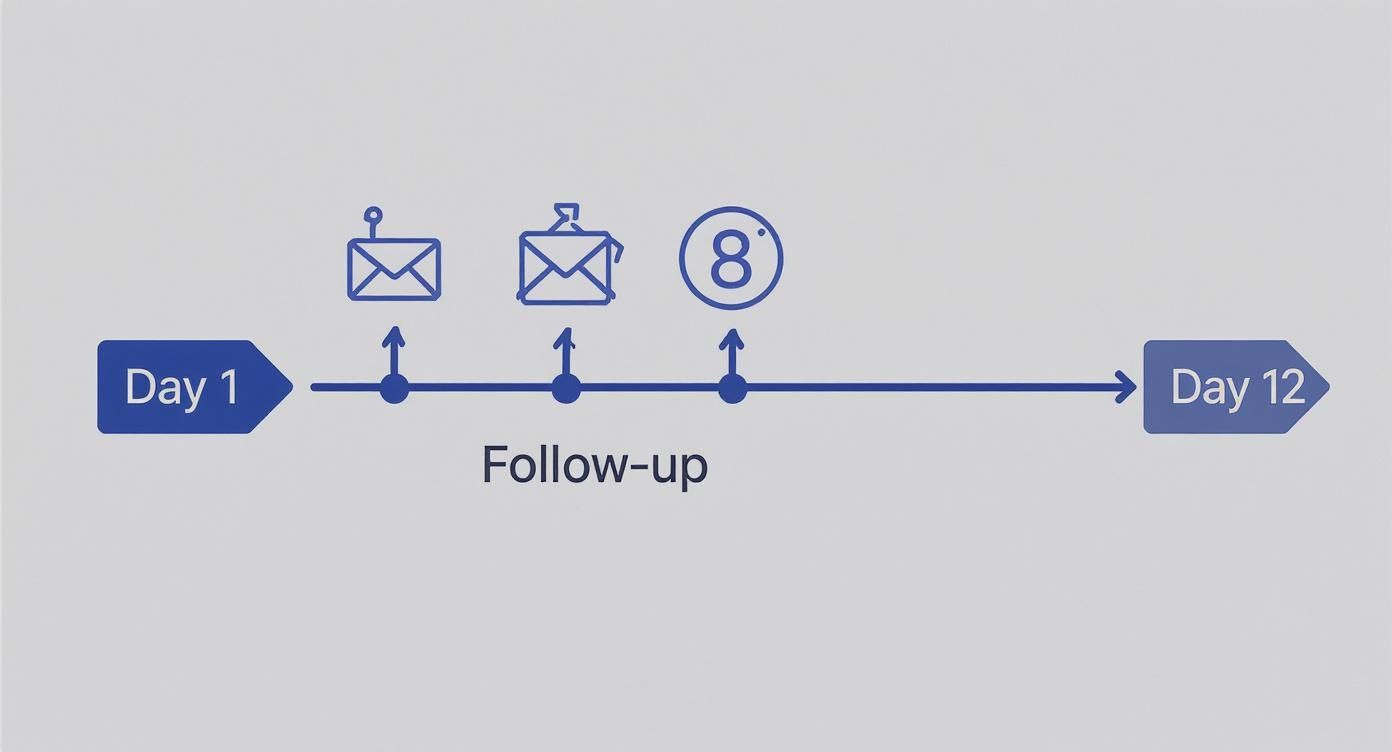
The big takeaway here is that a little strategic patience in that first week, followed by consistent, spaced-out nudges, is what keeps you top-of-mind without driving people crazy.
Building a Cadence That Actually Works
While that "three-day rule" is a solid starting point, a one-size-fits-all approach is a recipe for failure. Your cadence needs to breathe. It has to adapt to who you're talking to and how they're (not) responding.
Here are a few things I always consider when mapping out a sequence:
- Industry Norms: Are you reaching out to a fast-paced tech startup? They'll likely be fine with quicker follow-ups. But if you’re targeting a more traditional industry like manufacturing or finance, you’ll want to build in more breathing room between messages.
- Who You're Emailing: C-level execs have calendars that would make your head spin. Spacing your emails out every 5-7 days is far more respectful and effective than the standard 2-3 day gap you might use for a manager.
- Engagement Signals: This is a big one. Did they open your email multiple times? Click a link? These are green lights. A positive signal like that justifies a quicker follow-up, maybe within 24-48 hours, to strike while the iron is hot.
Let's be clear: a sales cadence isn't about annoying someone into submission. It's about creating a series of well-timed, valuable interactions that build familiarity and trust. You’re making it easy for them to say "yes" when the time is right.
Here’s a sample cadence you can steal and adapt. I’ve found it provides a great framework for staying persistent and professional without ever feeling like spam.
Sample Follow-Up Cadence for Optimal Engagement
This timeline is a fantastic starting point for persistent, professional outreach that gives your contact plenty of opportunities to reply without feeling overwhelmed.
| Attempt | Day | Recommended Action | Focus of the Message |
|---|---|---|---|
| 1 | 1 | Initial Outreach | Introduce your core value proposition clearly and concisely. |
| 2 | 4 | First Follow-Up | Gently remind them of the first email and re-state the main benefit. |
| 3 | 8 | Add Value | Share a relevant resource, like a case study or blog post, that helps them. |
| 4 | 15 | Quick Check-In | Use a brief, question-based email to make replying easy. |
| 5 | 22 | The "Break-Up" | Politely close the loop, leaving the door open for future contact. |
This multi-touch strategy unfolds over several weeks, respecting their time while keeping the conversation alive.
If you're ready to go even deeper, our guide on sales cadence best practices breaks down more advanced strategies. By mixing data-backed timing with a flexible, human approach, you can build a powerful follow-up system that turns silence into real conversations.
How to Write Follow-Up Emails That Actually Get Opened

Alright, you've nailed the timing. Now for the tricky part: crafting a follow-up email after no response that someone actually wants to read. A great follow-up is so much more than just a reminder that you exist. It’s a masterful blend of a magnetic subject line, a crisp email body, and a call-to-action that’s impossible to refuse.
The real goal here is to ditch the generic templates and focus on the principles that make people stop and pay attention. If you want to get noticed in a crowded inbox, you have to master the art of the open. By breaking down the core components, you can build messages that feel personal, add real value, and make hitting "reply" feel like the easiest thing they'll do all day.
Crafting Subject Lines That Are Impossible to Ignore
Let's be honest, the subject line is everything. It's your first—and often only—shot to make an impression. A weak subject line is a one-way ticket to the trash folder. No pressure, right?
The best ones are always clear, short, and hyper-relevant to the person on the other end. They should feel like a natural part of an ongoing conversation, not a cold pitch lobbed over the fence.
Here are a few battle-tested approaches that consistently cut through the noise:
- Bring Back Context with "Re:": This is the simplest trick in the book. Just reply to your original email. The "Re:" automatically adds context, helping them remember your last message and framing this as a continuing discussion.
- Spark Curiosity with a Question: A straightforward question can be surprisingly powerful. Something like "Quick question about [Topic]" is short, easy to read on a phone, and naturally piques their interest. It’s just hard to ignore.
- Keep It Direct and Simple: Sometimes, less is more. "Following up" or "Checking in" are professional, get straight to the point, and don't try to be overly clever.
Your subject line should be a clear signal, not a puzzle. Always aim for clarity over cleverness. One study found that personalized subject lines can generate 50% higher open rates, which just goes to show how a little bit of relevance can make a huge impact.
The Anatomy of the Email Body: Three Proven Angles
Once they’ve opened your email, the clock is ticking. You have seconds to make your case. Keep the body of your email incredibly short and focused on a single goal. Long, winding paragraphs are the fastest way to get your message ignored.
Instead of just "checking in," always lead with a specific angle. It gives your message a clear purpose and gives them a fresh reason to engage. Here are three effective strategies you can rotate through your follow-up sequence.
The Gentle Nudge
This is your classic, low-pressure check-in, and it's perfect for your first or second follow-up. It’s a simple, polite reminder designed to bring your original message back to the top of their inbox without adding new information or making them feel pressured.
This approach works because it’s empathetic. It acknowledges that your contact is busy and your email might have just slipped through the cracks—which happens to everyone. For more ideas, you can find a ton of inspiration for crafting the perfect email opening line.
Example of a Gentle Nudge:
Subject: Re: Our conversation about improving agency lead flow
Hi Alex,
Just wanted to gently follow up on my previous email. I know how things can get buried in the inbox!
Let me know if you had a moment to consider it.
Best,
[Your Name]
The Value-Add
The value-add is easily one of the most powerful follow-up techniques out there. Instead of asking for something, you’re giving something away for free. This simple shift completely reframes your position from a persistent salesperson to a helpful, trusted resource.
The key is to share something genuinely useful and relevant to their specific challenges. It shows you're actually thinking about their problems, which is huge for building rapport.
What kind of value can you add?
- A link to a killer article or blog post (yours or someone else's)
- A case study showing how you helped a similar company
- An invite to a relevant webinar you're hosting
- A link to a helpful tool or resource they might not know about
Example of a Value-Add:
Subject: Thought you'd find this interesting
Hi Sarah,
I came across this article on [Topic] today and immediately thought of our conversation about [Their Challenge].
The part about [Specific Point] seems especially relevant to what your team is focused on right now.
Hope it's helpful!
Cheers,
[Your Name]
The Final "Break-Up" Email
After you've tried a few times with no luck, it's time to politely close the loop. The "break-up" email is your last-ditch effort to get a response by professionally letting them know you're going to stop following up.
It sounds counterintuitive, but this tactic is surprisingly effective. The fear of missing out (FOMO) often kicks in, prompting a reply from people who were interested but just kept putting it off. At the very least, it helps you clean up your pipeline by getting a definitive "no," so you can focus your energy where it counts.
Example of a Break-Up Email:
Subject: Closing the loop
Hi David,
I've reached out a few times about [Your Offer] but haven't heard back, so I'll assume your priorities have shifted.
I'm closing your file for now, but if anything changes on your end, please don't hesitate to reach out.
Wishing you all the best.
Regards,
[Your Name]
Get Genuinely Personal to Cut Through the Noise
Let's be honest: just dropping a prospect's {{first_name}} into a generic template isn't personalization anymore. It's the bare minimum, and everyone sees right through it. In a world where every inbox is a battlefield for attention, your follow-up email has to feel like it was written for an audience of one.
True personalization goes way deeper. It shows you’ve actually done your homework, that you understand their world, and that you have a compelling reason to be in their inbox. This is how you transform a forgettable "just checking in" nudge into a valuable touchpoint that gets a reply.
Go Beyond Basic Merge Tags
The data doesn't lie: personalized cold emails see a 32% higher response rate than generic ones. The real strategy is to move past surface-level details and connect with what’s actually happening in your prospect's world. If you want to dive deeper, you can discover more insights about sales follow-up statistics that show just how much relevance matters.
This means finding a real hook—a specific event or signal that makes your outreach timely and thoughtful. It’s about proving you’re not just another salesperson blasting out emails, but a potential partner who pays close attention.
Use Trigger Events for Perfect Timing
One of the absolute best ways to personalize a follow-up is by referencing a trigger event. These are public developments about the company that create a natural, logical reason for you to reach out. Suddenly, you're not just "following up"; you're reacting to something new and highly relevant to their business.
Keep an eye out for signals like these:
- Recent Funding Rounds: A company that just landed a new round of funding is all about growth. They're actively looking for tools and services to help them scale. Your follow-up can directly mention their funding and explain how you help them put that new capital to good use.
- New Executive Hires: When a new leader joins the C-suite, they almost always have a mandate to shake things up, review processes, and find new solutions. Reaching out with an idea that aligns with their new role is incredibly timely.
- Adopting New Technology: Did you notice they just started using a new CRM or marketing automation platform? You can frame your follow-up around how your solution integrates with or supercharges that new tool.
Finding these details consistently requires good data. This is where a process like data enrichment becomes a game-changer, layering these crucial insights right onto your contact lists. You can get a full breakdown of what is data enrichment and see how it powers this next-level personalization.
By referencing a specific, recent event, you immediately prove your relevance. You’re not just sending another email; you’re starting a timely business conversation based on their company’s current priorities.
Build Real Rapport with Personal Signals
Beyond what the company is doing, personal signals can be even more potent for building a genuine connection. These are things tied directly to the individual you're contacting—their achievements, their content, their public interests. It shows you see them as a person, not just a title on an org chart.
Sure, this takes a little digging, but the payoff in response rates is massive.
Here’s how that looks in the real world:
Subject: Re: Your post on scaling remote teams
Hi Jessica,
Following up on my previous note. I saw your recent LinkedIn post about the challenges of scaling remote engineering teams and it really resonated.
Your point about maintaining culture was spot on. We helped [Similar Company] tackle that exact issue by [Brief, Relevant Benefit].
Thought you might find our case study on it useful. No pressure, just sharing in case it's helpful.
Best,
[Your Name]
This works because it’s specific, it adds value, and it connects directly to something the prospect is clearly passionate about. It feels less like a sales pitch and more like a helpful contribution to a conversation they already started. When you focus on these deeper layers of personalization, your follow-ups will finally start earning the replies they deserve.
A Few Common Questions About Following Up
Even with the best plan in hand, you're going to run into those "what if" moments. It's natural. You start to second-guess yourself, wondering if you're being persistent or just plain annoying.
Let's tackle some of the most common questions that come up when you're trying to build a professional outreach cadence that actually gets results.
How Many Follow-Up Emails Is Too Many?
This is probably the number one question I get asked, and the answer is all about finding that sweet spot between persistence and respect. We all know that most meaningful conversations don't happen on the first try, but there's a definite line you don't want to cross.
A sequence of 3-5 emails, which includes your very first message, is a solid rule of thumb. This gives you several chances to offer value and catch your prospect at the right time without completely flooding their inbox.
Here's my take: After 4-5 emails with zero signs of life—no opens, no clicks, nothing—it's time to change your approach. Don't keep hammering away. Just move that contact to a longer-term nurturing list and put your energy into leads who are actually engaging.
The real trick is making sure every single email feels like a fresh, valuable touchpoint, not just another "thought I'd check in" message.
Should I Really Send a Break-Up Email?
Yes, you absolutely should. The "closing the loop" email (or break-up email, as it's often called) is surprisingly one of the most effective tools you have. It sounds strange to say you're giving up, but it works for a couple of powerful psychological reasons.
First, it shows you respect their time, which immediately sets a professional and courteous tone. You're not going to bother them forever. Second, it taps into the fear of missing out (FOMO). People who were genuinely interested but just got swamped with other priorities often get a jolt from this and finally hit reply.
You don't need anything complicated. Keep it simple and professional:
- Example: "Hi Alex, I've tried to connect a few times about this but haven't heard back, so I'll assume your priorities are elsewhere. I'm going to close the loop for now, but please don't hesitate to reach out if that changes. All the best."
This little bit of courtesy keeps the relationship positive and leaves the door wide open for them to come back to you later.
What Are the Most Important Metrics to Track?
You can't improve what you don't measure. If you want to know whether your follow-up strategy is actually working, you have to look at the right numbers. Don't get distracted by metrics that don't matter; focus on the ones that tell you if you're starting real conversations.
These are the metrics I always keep an eye on:
- Reply Rate: This is your North Star. The whole point of sending a follow-up is to get a response, so this is the single most important metric for judging success.
- Open Rate: If your open rates are in the gutter, it's a huge red flag that your subject lines aren't breaking through the inbox clutter.
- Click-Through Rate (CTR): Are you including links to case studies or blog posts? A low CTR could mean your value-add isn't hitting the mark or your call-to-action is too weak.
Beyond these, you should ultimately be tracking how many of those replies turn into actual meetings or qualified opportunities. The best way to move these numbers up and to the right is to constantly A/B test your subject lines, email copy, and calls to action to see what your audience responds to.
Ready to stop guessing and start engaging with the right leads at the perfect moment? FundedIQ delivers hand-curated lists of recently funded startups, complete with verified decision-maker contacts and critical buying signals. Skip the cold outreach and start conversations with companies ready to invest in growth. Explore your next high-intent prospects.