

Choosing Lead Generation Automation Tools That Convert

- Moving Beyond Manual Lead Generation
- How Automation Transforms Your Lead Management
- What Features Actually Matter in an Automation Platform?
- The Growing Impact of AI in Lead Generation
- Choosing the Right Automation Tool for Your Business
- Getting Your Implementation Right: Best Practices
- Got Questions About Lead Generation Automation?
Lead generation automation tools are software platforms designed to take the repetitive, time-sucking tasks of marketing and sales off your plate. They automatically handle things like capturing, qualifying, and nurturing potential customers. For instance, instead of manually exporting a list of webinar attendees and uploading it to a CRM, an automation tool does it instantly, triggering a follow-up email sequence the moment the webinar ends.
Think of it like having a tireless digital assistant who works around the clock to fill your sales pipeline, making sure no opportunity ever slips away.
Moving Beyond Manual Lead Generation
Imagine you're trying to catch fish. You could stand there all day with a single fishing line, hoping for a bite. Or, you could use a modern, automated trawler net. That's really the difference between manual lead generation and using today's powerful automation tools.
For years, businesses got by with painstaking manual work. This meant endless data entry, follow-ups that were all over the place, and hours wasted on jobs that a system could easily handle. A practical example is a salesperson spending the first hour of their day manually logging yesterday's calls and emails into a spreadsheet instead of making new outreach calls. This old way isn't just inefficient; it's a surefire way to lose revenue and burn out your team.
The reality of manual lead generation is just plain frustrating. Leads fall through the cracks because response times are too slow—a lead is 100x less likely to be contacted after 30 minutes—and potential customers lose interest when the follow-up is inconsistent. Your sales team ends up spending more time on admin work than they do building relationships and actually closing deals.
The Shift to Smarter Systems
This is where lead generation automation tools completely change the game. They're no longer a "nice-to-have" for big corporations; they are the essential engine for growth for businesses of every size. These platforms hum along quietly in the background, making your entire lead management process seamless.
Here’s a quick look at how they work with a practical example:
- Capture Leads Instantly: The moment a prospect fills out a "Download Ebook" form, the tool not only grabs their information but can also add a "Content Marketing Interest" tag to their profile.
- Qualify Prospects Automatically: Using rules you set, it can score that lead. For example, if their email is from a corporate domain (
@company.com), they get +10 points, but a generic domain (@gmail.com) gets +0. - Nurture Relationships at Scale: The tool can then enroll them in a 3-part email sequence specific to content marketing, keeping your brand top-of-mind without you lifting a finger.
Automation transforms lead generation from a series of disjointed, manual actions into a cohesive, intelligent, and predictable system for growth. It’s about working smarter, not just harder.
It's no surprise that more and more companies are getting on board—these tools get results. It's projected that by 2025, 55% of B2B companies will be using marketing automation for their lead generation.
The proof is in the numbers. Businesses that adopt these tools report an 80% increase in leads, and 77% see their conversion rates climb right after getting started. You can discover more lead generation statistics and trends that back this up.
How Automation Transforms Your Lead Management
To really see what lead generation automation tools can do, let's walk through a real-world example. Picture this: a potential customer, we'll call her Sarah, lands on your website. She finds a guide she likes, fills out a form to download it, and clicks "submit."
That simple click sets off a chain reaction—a perfectly choreographed sequence that manages her entire journey with your company, all without anyone on your team lifting a finger.
The second Sarah’s form goes through, the automation platform gets to work. It doesn't just grab her email address. It captures everything: her name, her company, which guide she wanted, and maybe even her location. This first step, data capture, is the foundation for everything that follows.
From there, the system instantly starts making sense of this new information.
From Raw Data to Actionable Intelligence
Instead of just dumping Sarah into a massive, disorganized spreadsheet, the tool automatically segments her. Based on the content of the guide she downloaded, it might tag her as interested in a specific service. If the guide was "Startup Funding," she’s now in a bucket of high-potential leads for financial consulting.
This is a world away from the old one-size-fits-all email blast. For businesses looking for financial advice, knowing the ins and outs of startup funding is a critical first move. You can see how companies are securing capital for growth on FundedIQ to get a sense of why this kind of targeted information is so powerful.
Now for the magic: lead scoring. The system starts assigning points to Sarah based on who she is and what she does.
- Job Title: She's a "Founder." That’s a good sign. +15 points.
- Company Size: A "Startup with 10-50 employees" fits your ideal customer profile. +10 points.
- Behavior: She didn't just disappear after the download; she clicked over to your pricing page. Huge interest signal. +20 points.
This automated scoring process is the engine of efficiency. It mathematically identifies who is ready to buy versus who needs more time, allowing your sales team to focus their energy exclusively on the most qualified prospects.
Nurturing Leads Toward Conversion
With a solid score of 45, Sarah is officially a "hot lead." But she might not be ready to hop on a sales call this very second. This is where automated nurturing campaigns take over. The tool automatically enrolls her in an email sequence built just for founders interested in funding.
Over the next two weeks, she receives a series of genuinely helpful emails, all sent on a pre-set schedule. The first shares a case study, the second invites her to a webinar on a related topic, and the third offers a no-pressure consultation. Each email is designed to build trust and move her closer to making a decision.
Let's say Sarah clicks the link in that third email to book a consultation. Boom. The system immediately flags her as "sales-ready." It creates a new task in your CRM, assigns it to the right sales rep, and pushes over every bit of information they need: her score, her entire interaction history, and her original form submission.
The salesperson now has a complete, context-rich profile of a warm, engaged lead—and they did zero manual work to get it. That’s how automation turns a simple website visit into a predictable, scalable, and incredibly efficient sales pipeline.
What Features Actually Matter in an Automation Platform?
Walking into the world of lead generation automation tools feels a lot like stepping onto a car lot. Every model looks shiny, and the salesperson is throwing around terms you’ve never heard before. But not all platforms are created equal, and the features they offer will make or break your ability to turn curious visitors into paying customers.
To cut through the noise, it helps to understand that most of these tools are built on three fundamental pillars. Each one solves a specific problem, and together, they create a smooth, automated path for every potential customer.
The image below gives you a bird's-eye view of how these core components fit together to support a strong lead generation engine.
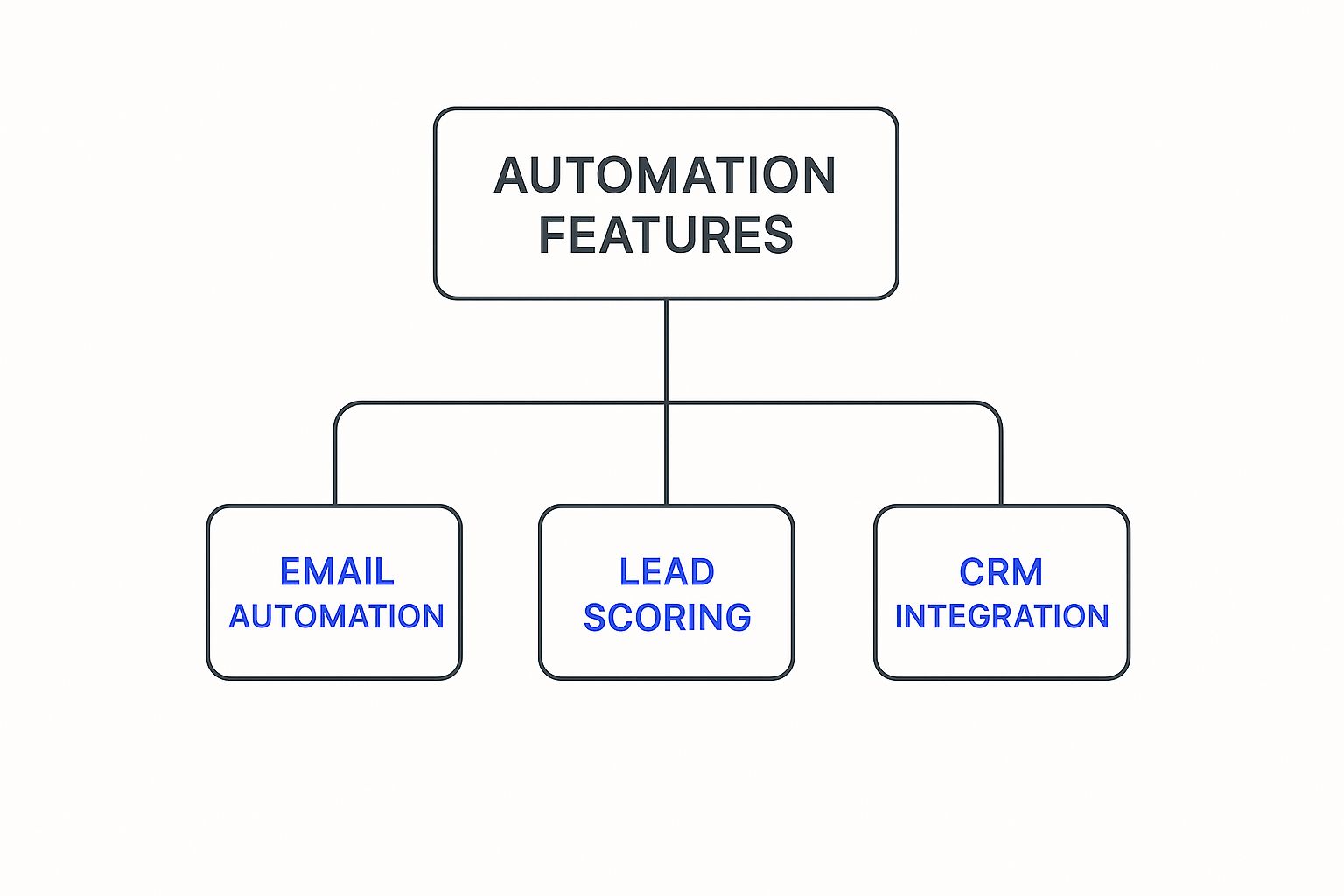
As you can see, things like email automation, lead scoring, and CRM integration aren't just standalone features—they're the bedrock of the entire system.
The Core Features You Can't Live Without
Let's break down what these features actually do in the real world.
1. Lead Capture: Your Digital Handshake
Lead Capture is all about turning anonymous website visitors into actual, identifiable contacts. Think of it as the digital version of a friendly greeting at your front door. It’s moved way beyond the basic "Contact Us" form.
- Smart Forms & Pop-ups: These aren't your annoying, generic pop-ups from the 90s. Modern tools can trigger a form based on what a user is doing. For example, an exit-intent pop-up offering a 10% discount can recover up to 15% of otherwise lost visitors. Did they just finish reading a long blog post? A pop-up can offer a related PDF guide in exchange for their email. It's all about timing and relevance.
- Chatbots: These AI assistants are your 24/7 receptionists. They can answer common questions, figure out if a visitor is a good fit for your business, and even book meetings on your sales team's calendar—all while you're asleep. In fact, businesses using chatbots have seen conversion rates increase by as much as 30%.
2. Lead Nurturing: Building the Relationship
Once you have a contact, Lead Nurturing kicks in. This is how you build trust with people who are interested but not quite ready to pull out their wallets. It’s a game-changer, too. Studies show that nurtured leads make 47% larger purchases than those who aren't nurtured.
Lead nurturing is the art of staying top-of-mind without being pushy. It’s about sending the right message at the right time, guiding prospects with helpful content until they're ready to talk business.
A classic example is a drip email campaign. Let's say someone downloads your guide to social media marketing. Your automation tool can automatically send them a series of follow-up emails over the next few weeks—first a related blog post, then a webinar invitation, and finally, a gentle nudge to schedule a consultation.
3. Lead Scoring: Finding the Hottest Leads
Finally, there’s Lead Scoring—the brains of the operation. This feature automatically ranks your leads so your sales team can stop guessing and start focusing on the people most likely to buy.
Here’s how it works: the system assigns points based on who a person is (their job title, industry, company size) and what they do (visit your pricing page, open five emails, request a demo). A CMO from a target company who just watched your product webinar gets a high score. A student who downloaded one whitepaper gets a low score. It’s that simple. This ensures your sales reps spend their valuable time on conversations that actually lead to revenue.
For a closer look at platforms that excel at these features, this roundup of the best B2B lead generation tools is a great place to start.
Comparison of Automation Tool Feature Tiers
As you shop around, you'll find that tools are often bundled into different tiers—usually based on price and functionality. Understanding what to expect at each level can help you find the right fit for your budget and business goals without overpaying for features you don't need yet.
| Feature Category | Entry-Level (Basic) | Mid-Tier (Professional) | Enterprise (Advanced) |
|---|---|---|---|
| Lead Capture | Basic static forms, simple pop-ups | Behavior-triggered pop-ups, basic chatbot functionality | Advanced chatbots with AI, dynamic forms, A/B testing |
| Lead Nurturing | Simple email drip campaigns, limited personalization | Multi-channel campaigns (email, SMS), segmentation | Predictive nurturing, full marketing automation workflows |
| Lead Scoring | Manual or very basic rule-based scoring | Automated behavioral and demographic scoring | Predictive lead scoring with AI, multi-model scoring |
| Integrations | Limited native integrations (e.g., email client, basic CRM) | Robust integrations with major CRMs, marketing tools | Custom API access, full platform integrations (BI, ERP) |
| Analytics | Basic email metrics (open/click rates) | Campaign-level reporting, conversion tracking | Full-funnel attribution, predictive analytics, custom dashboards |
Choosing the right tier isn't just about your current needs; it's also about where you're headed. An entry-level tool might be perfect for getting started, but if you plan to scale aggressively, a mid-tier solution could offer a much better long-term value.
The Growing Impact of AI in Lead Generation
If you think of standard automation as a well-oiled machine, then adding Artificial Intelligence (AI) is like giving that machine a brain. AI isn't some far-off concept anymore; it's the real-world advantage that top sales and marketing teams are using right now. It pushes lead generation automation tools beyond just completing tasks and into the realm of making smart decisions.
Instead of rigidly following the rules you program, AI digs into your data to learn, adapt, and even predict what will happen next. This helps you shift from a reactive strategy—waiting for leads to act—to a proactive one where you’re anticipating their needs before they even voice them.
How AI Elevates Standard Automation
The true magic of AI comes from its ability to chew through massive, complex data sets, going way beyond simple "if this, then that" commands. It adds a layer of intelligence that was, until recently, impossible to apply at any kind of scale.
Here are a few concrete examples of how AI is changing the game:
- Predictive Lead Scoring: Old-school lead scoring was a guessing game based on manual point assignments. AI is different. It sifts through thousands of data points from your past successes and failures to build a data-driven model of your ideal customer. It then scores new leads based on how well they fit that profile, pinpointing your next big customer with up to 95% accuracy.
- AI-Powered Chatbots: We've all dealt with those clunky, scripted chatbots. Modern AI chatbots are a world apart. They understand natural language, engage visitors in actual conversations, and can qualify leads around the clock. They can handle complex questions, book meetings directly on your calendar, and hand off hot prospects to your sales team without missing a beat.
- Hyper-Personalization at Scale: AI finally makes one-to-one communication with thousands of leads a reality. It can analyze past engagement to determine the perfect time to send an email to each individual recipient, write subject lines they’re more likely to open, and recommend personalized content based on a lead's specific browsing history.
AI transforms lead generation from a process of executing pre-set commands into a dynamic system that learns from every interaction. It’s the difference between a checklist and a strategy.
This smarter approach is already delivering big results. The market for AI in sales and marketing is booming, with a projected 120% year-over-year growth expected by 2025. Businesses putting money into AI are seeing their revenue jump by 3% to 15%, while their sales ROI improves by 10% to 20%. These aren't just vanity metrics; they point to a clear trend toward more intelligent, AI-powered growth. You can read the full research on lead generation trends to get a deeper look at the financial impact.
Choosing the Right Automation Tool for Your Business

With so many lead generation automation tools on the market, picking one can feel like a shot in the dark. But it doesn't have to be. The secret is to look past the flashy promises and focus on what your business actually needs to succeed.
It's tempting to jump right into scheduling demos, but the most important work happens before you ever speak to a salesperson. You need to look inward first. Think of it this way: you wouldn't shop for a new car without knowing if you need a two-seater or a minivan. The same logic applies here—the "best" tool isn't the one with the most features; it's the one that fits your workflow like a glove.
Assess Your Core Requirements
Before you get lost in feature lists, start by mapping out your non-negotiables. These are the fundamental, operational realities of your business. Getting these wrong is the fastest path to adopting a tool that ends up gathering digital dust.
Ask yourself a few straightforward questions to build your foundation:
- Team Size and Skill Level: Is your team full of marketing tech wizards, or do you need something with a drag-and-drop interface that's practically plug-and-play? Be honest about the technical skills you have on hand.
- Budgetary Constraints: What can you realistically spend each month or year? Remember to factor in potential setup fees and costs for additional contacts as you grow. Knowing your number up front saves you from falling in love with a platform you simply can't afford.
- CRM Integration: This is a big one. Does the tool play nicely with the CRM you already use every day? A clunky integration that requires manual workarounds defeats the entire purpose of automation. Ask for a live demonstration of how it syncs data.
Choosing an automation tool is less about finding the most powerful option and more about finding the most compatible one. A platform that aligns with your team's skills, budget, and existing tech stack will deliver a far greater return on investment.
Questions to Ask During a Demo
Once you've narrowed down your options to a shortlist, it's demo time. This is your opportunity to go beyond the slick sales pitch and see how the tool actually performs in the real world. For marketing firms, knowing how to apply these platforms is key, and you can get more ideas for agency-specific questions by understanding the nuances of lead generation for agencies.
Don't let the sales rep run the entire show. Come to the meeting with your own list of questions that get to the heart of your biggest challenges and goals.
Here are a few must-ask questions for any demo:
- Usability: "Can you walk me through building a simple workflow from scratch, right now? For example, a three-email nurture sequence for a new ebook download." Watching them do it live tells you everything you need to know about how intuitive the interface really is.
- Scalability: "How do your pricing and features grow with a business like ours? What are the contact or user limits on this plan, and what is the cost to upgrade?" You need a partner that can scale with you, not a tool you’ll outgrow in six months.
- Customer Support: "What does onboarding look like, and what kind of support is included with the plan we're discussing? Is it email only, or do we get a dedicated account manager?" Excellent support can be the difference between a smooth launch and a months-long headache.
Getting Your Implementation Right: Best Practices
Even the most powerful lead generation automation tools can't fix a broken strategy. A successful rollout hinges far more on your plan than on the software itself. Before you ever log into a new platform, you need to map out your entire lead management process, from the first click to the final sale.
Think of it like building a house. You wouldn't just start nailing boards together without a detailed blueprint. In the same way, you must define what a "lead" actually means to your team, what makes them "qualified," and precisely what should happen at every single stage of their journey. Getting this clarity upfront is the bedrock of effective automation.
Define Your Process First
One of the most common pitfalls is trying to automate a messy or nonexistent workflow. Automation is an amplifier—if your process is disorganized, you’ll just create chaos faster and on a much larger scale.
Before you build a single automated sequence, get your sales and marketing teams in the same room. Seriously. They absolutely have to agree on the fundamentals:
- Lead Handoff Criteria: What's the exact trigger that turns a marketing-qualified lead (MQL) into a sales-qualified lead (SQL)? Is it a lead score of 100? A demo request? Get specific and write it down.
- Service Level Agreements (SLAs): How quickly must a sales rep follow up on a lead once it lands in their queue? An hour? A day? Data shows following up within the first hour increases conversion rates by nearly 400%. Put a number on it.
- Data Hygiene Standards: Who owns keeping contact and company information clean and up-to-date? This prevents the "garbage in, garbage out" problem that plagues so many CRMs.
This alignment is non-negotiable. It stops leads from falling through the cracks and makes sure everyone is pulling in the same direction.
The point of automation isn't to replace a good process; it's to execute it flawlessly at scale. Define the human strategy first, then let the technology do the heavy lifting.
Start Small and Prove It Works
Don't try to boil the ocean with a massive, company-wide launch right out of the gate. Instead, start with a small pilot project. Pick a specific segment of your audience or a single marketing campaign to test out your new system. For example, automate the follow-up for attendees of your next webinar.
This approach gives you a controlled environment to work out the kinks, gather real-world feedback, and—most importantly—prove the tool's value with a tangible win. A successful pilot builds momentum and gets everyone excited.
The impact can be significant. Companies that get this right often see a 25% boost in sales productivity and a 15% increase in sales revenue. You can read the full research about sales outcomes and see for yourself. By starting small, you ensure your full-scale launch is built on a solid, proven foundation for success.
Got Questions About Lead Generation Automation?
Diving into any new technology brings up a few questions, and that's perfectly normal. Even with a solid plan, it helps to clear up some of the common points of confusion before you jump in. Let's tackle a few I hear all the time.
A big one is getting the terminology straight. People often throw around a couple of key phrases as if they mean the same thing, but they really don't.
Lead Generation Automation vs. Marketing Automation: What’s the Real Difference?
It’s easy to get these two mixed up, but they have very different jobs. Think of lead generation automation as a specialist—its sole focus is on the very top of your sales funnel. Its mission is to capture, qualify, and pass new leads to your sales team as efficiently as possible. It's all about filling the pipeline.
Marketing automation, on the other hand, is the general manager. It’s a much broader platform that oversees the entire customer journey. That includes nurturing those new leads, but it also handles things like customer onboarding, loyalty programs, and campaigns to keep existing customers happy.
So, you can think of lead generation automation as one powerful, specialized gear inside the much larger machine of your overall marketing automation strategy.
How Long Until I Actually See Results?
This is the million-dollar question, right? You want to know when your investment will start paying off.
You'll see some immediate wins pretty quickly. Within the first 30 days, you’ll notice things are just… easier. Your leads will be more organized, and you'll have reclaimed a ton of time you used to spend on manual tasks. For example, a sales team can save up to an hour per day per rep by automating data entry and follow-up reminders. That initial efficiency boost is the first sign it's working.
The more significant results—like a real jump in conversion rates and revenue—take a bit more time to show up. You can typically expect to see that kind of impact within 3 to 6 months. That gives your automated email sequences and follow-ups enough runway to actually warm up your leads and guide them through the entire buying process.
One of the biggest myths I hear is that automation is just for the big players. The truth is, it’s a massive equalizer. It gives smaller teams the power to operate with the kind of consistency and efficiency that was once only possible for large corporations.
And that brings up another common worry: "Is this for me?" If you're running a small business, the answer is an emphatic "yes." Automation is an absolute game-changer for smaller teams. It takes over the repetitive, time-sucking tasks and ensures every single lead gets a professional, prompt follow-up, helping you punch way above your weight.
Plenty of tools on the market are built specifically for small businesses—they’re affordable, they scale as you grow, and the return on investment can be huge.
Ready to connect with high-intent startups the moment they get funded? FundedIQ delivers hand-curated, verified lead lists directly to you, eliminating the guesswork and accelerating your sales pipeline. Discover your next best customers today.