

Lead Generation for Contractors: 8 Smart Tactics in 2025
- 1. Google Local Services Ads (LSA)
- 2. Google Ads Search Campaigns
- 3. Facebook and Instagram Advertising
- 4. SEO and Organic Search Optimization
- 5. Referral and Networking Programs
- 6. Content Marketing and Lead Magnets
- 7. Home Service Platforms and Marketplaces
- 8. Email Marketing and Newsletters
- 8-Channel Lead Generation Comparison for Contractors
- Choosing Your Best Tools for the Job
In the competitive world of contracting, a steady flow of high-quality leads isn't just a goal; it's the foundation of a thriving business. Yet, many contractors rely on outdated methods or struggle to navigate the complex marketing landscape, leaving potential projects and revenue on the table. This article cuts through the noise and provides a clear, actionable blueprint for growth.
We will break down eight powerful and practical strategies for lead generation for contractors, combining proven digital tactics with timeless offline methods. Forget generic advice; we're providing factual data, real-world examples, and step-by-step instructions you can implement immediately to fill your project pipeline. To build a robust lead pipeline, it's essential to start with a strong foundation; consult a comprehensive success guide on lead generation for contractors for a deeper dive into foundational principles.
This guide is designed for action. Whether you're a roofer, plumber, electrician, or general contractor, these strategies will equip you to attract more of the right customers. From leveraging Google's powerful ad platforms to building a referral engine that works for you, you'll learn how to secure a consistent stream of work and build a more sustainable, profitable business.
1. Google Local Services Ads (LSA)
Google Local Services Ads (LSA) are a game-changer for service-based businesses, representing one of the most direct forms of lead generation for contractors available today. These pay-per-lead ads appear at the very top of Google search results, even above traditional pay-per-click ads and organic listings. When a potential customer searches for a service like "plumber near me," they see a block of trusted, "Google Guaranteed" or "Google Screened" contractors, complete with photos, ratings, and a direct call button.
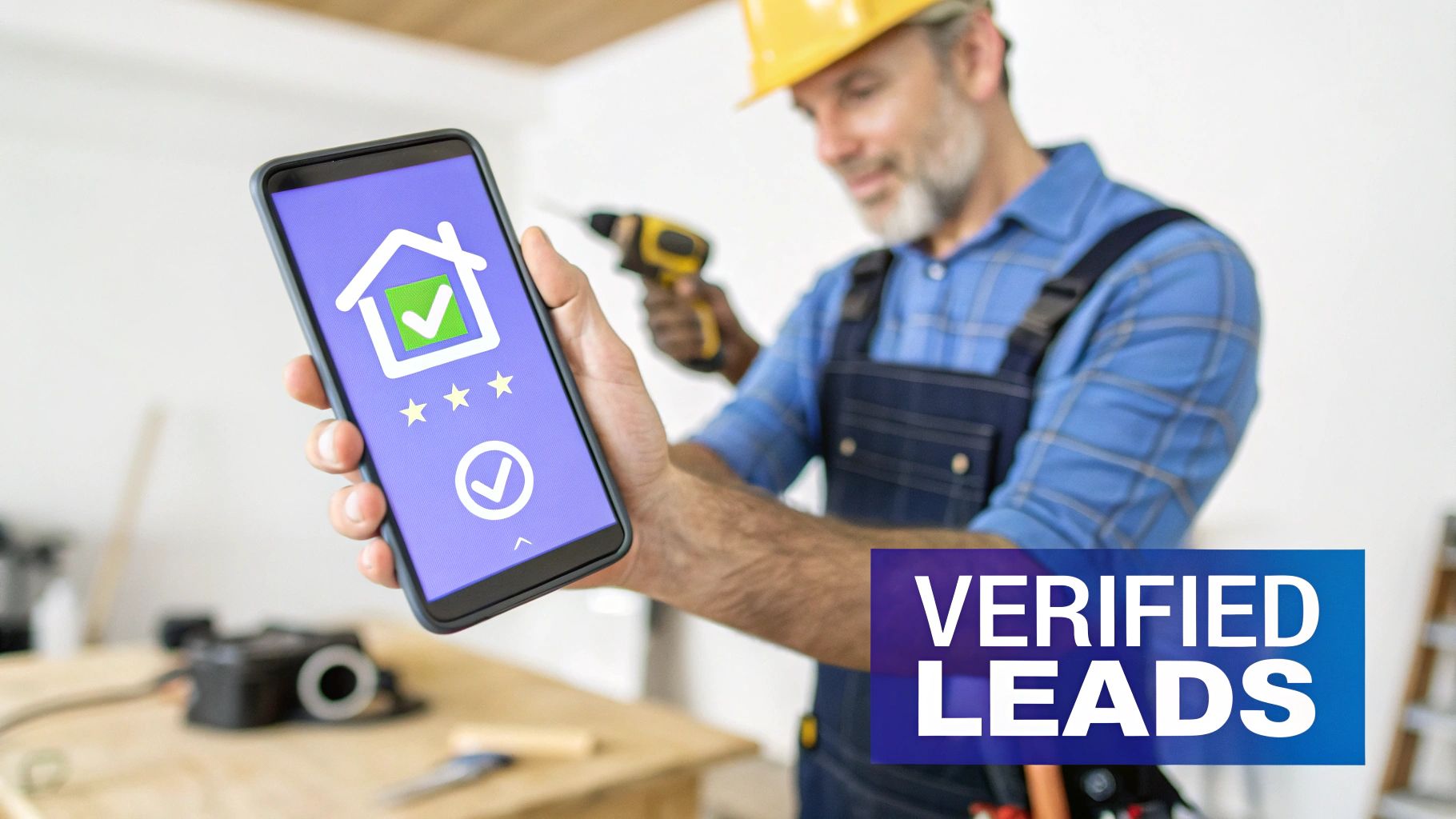
The key difference is the payment model: you only pay when a customer directly contacts you through the ad, not for a simple click. This pre-qualifies the intent, ensuring you are investing in potential customers who are ready to engage. For example, industry data shows the average cost per lead for an LSA can range from $20 to $50, which is often 30-50% cheaper than traditional search ads for the same service, making it a highly efficient marketing spend.
Key Insight: The "Google Guaranteed" badge is a powerful trust signal. It tells potential customers that Google has vetted your business for licenses and insurance, and it even backs your work with a satisfaction guarantee of up to $2,000. This badge can increase click-through rates by up to 15%.
How to Maximize Your LSA Performance
To get the most out of your LSA investment, focus on optimizing your profile and responsiveness. Your ad's rank is determined by factors like your review score, your response time to inquiries, and your proximity to the customer.
- Respond Immediately: Aim to answer calls and reply to messages within one to two minutes. Data from Google indicates that businesses answering calls in under 2 minutes see significantly higher lead conversion rates.
- Maintain a High Star Rating: Consistently solicit reviews from happy customers to keep your rating above 4.5 stars. Businesses with 10+ reviews on their LSA profile receive 50% more leads than those with fewer.
- Define Your Service Area: Set realistic service boundaries to avoid paying for leads from customers who are too far away. Strategically target high-demand zip codes where you are most profitable.
- Keep Documentation Current: Ensure your business license, insurance, and any trade-specific certifications are always up-to-date in your LSA profile to maintain your "Google Guaranteed" status.
2. Google Ads Search Campaigns
While LSAs are pay-per-lead, Google Ads Search Campaigns operate on a powerful pay-per-click (PPC) model, giving contractors unparalleled control over their advertising efforts. These text-based ads appear at the top and bottom of search results, allowing you to bid on specific keywords your potential customers are using. When a homeowner searches for "kitchen remodel contractor" or "emergency roof repair," your ad can be the first thing they see, driving highly motivated traffic directly to your website or phone line.
This method is a cornerstone of digital lead generation for contractors because it captures active demand. For instance, data shows that leads from search ads have a close rate of nearly 15%, significantly higher than outbound leads. A well-managed campaign for a local painter can generate leads for as low as $30 each, while a general contractor might see an average cost-per-lead of $100 for a high-value remodeling job. For a deeper dive into paid advertising, a comprehensive PPC advertising guide can help you master the intricacies of platforms like Google Ads.
Key Insight: The power of Google Search Ads lies in precision. You can target users by their exact search query, location, time of day, and even the device they are using. Over 60% of searches for local services now happen on mobile devices, making mobile-optimized ads and landing pages critical.
How to Maximize Your Search Campaign Performance
Success with Google Ads hinges on strategic campaign setup, continuous optimization, and accurate performance measurement. A "set it and forget it" approach rarely works; you must actively manage your campaigns to achieve the best ROI.
- Focus on High-Intent Keywords: Bid on phrases that signal a strong desire to hire, such as "hire general contractor" or "emergency plumber near me," instead of general research terms like "how to fix a leaky faucet." These "buyer-intent" keywords have higher conversion rates.
- Use Ad Extensions: Implement call, location, and sitelink extensions. Call extensions, which add a "click-to-call" button, can increase click-through rates by up to 8% as they make it seamless for mobile users to contact you.
- Create Service-Specific Campaigns: Separate your services (e.g., "Roof Repair" vs. "Roof Replacement") into different campaigns. This allows you to create highly relevant ads and landing pages, which can improve your Quality Score and lower your cost-per-click.
- Implement Conversion Tracking: This is non-negotiable. By tracking calls, form submissions, and quote requests, you can accurately measure your marketing ROI and optimize your campaigns based on what actually generates leads.
3. Facebook and Instagram Advertising
Facebook and Instagram advertising offers contractors a powerful way to reach potential customers with visually compelling content and hyper-specific targeting. Unlike search-based ads that capture existing demand, social media allows you to generate new demand by placing your services directly in front of homeowners based on their demographics, interests, behaviors, and location. With over 2.9 billion monthly active users on Facebook alone, this is a prime opportunity for visual storytelling and brand building.
The strength of these platforms lies in their sophisticated targeting engine. You can reach users who recently moved, showed interest in home improvement stores, or fit the profile of your ideal customer. For instance, a landscaping company can target homeowners in specific high-income zip codes with stunning video testimonials. An HVAC contractor might run a lead form ad campaign offering a "Free AC Tune-up Quote," generating qualified leads for as little as $15-$25 each.
Key Insight: The Facebook pixel is your most valuable tool for social media advertising. By installing it on your website, you can track visitor actions, optimize ads for conversions, and run highly effective retargeting campaigns. Retargeted visitors are 70% more likely to convert than cold traffic.
How to Maximize Your Social Media Ad Performance
To turn social media scrolling into a consistent stream of leads, focus on engaging visuals and precise audience segmentation. Your success depends on capturing attention quickly and making it easy for users to take the next step.
- Showcase Your Best Work: Use high-quality before-and-after photos and videos. Carousel ads are perfect for displaying the transformation of a renovation project. Video content on social media generates 1200% more shares than text and image content combined.
- Leverage Lead Form Ads: Minimize friction by using native lead forms. These pre-populate a user's contact information, making it incredibly simple for them to request a quote without ever leaving the platform, which can boost conversion rates by over 50%.
- Target with Precision: Create distinct ad sets for different audience segments. Target homeowners in a 15-mile radius, and then layer on interests like "home renovation" or "DIY." Also, create lookalike audiences from your past customer list to find new users with similar characteristics.
- A/B Test Creative Elements: Continuously test different images, headlines, and calls to action. A simple change, like swapping an image of a finished project for a video of your team at work, can decrease your cost per lead by 20-30%.
4. SEO and Organic Search Optimization
Search Engine Optimization (SEO) is the long-term strategy of optimizing your website to rank higher in Google’s organic (non-paid) search results. For contractors, this means when a homeowner searches "kitchen remodel in [your city]," your website appears on the first page. Considering that the first organic result on Google gets approximately 32% of all clicks, SEO is crucial for capturing highly qualified traffic for free. Unlike paid ads, SEO builds a sustainable asset that consistently generates leads over time.
The power of SEO lies in its authority and trust. A study by BrightLocal found that 87% of consumers used Google to find local businesses in the last year. By ranking high, you are essentially getting a free endorsement from the world's largest search engine. This digital real estate becomes a powerful engine for lead generation for contractors, positioning you as the go-to expert in your service area and driving inbound inquiries from customers actively seeking your skills.
Key Insight: Local SEO is your most critical focus. Optimizing your Google Business Profile (GBP) is the fastest way to appear in the "Local Pack" map results. This block of 3 businesses appears in 93% of local searches and captures a massive share of user clicks.
How to Maximize Your SEO Performance
A successful SEO strategy integrates on-page optimizations, local signals, and authoritative content. Focus on building a strong local foundation to attract the most relevant customers.
- Claim and Perfect Your GBP: Fully optimize your Google Business Profile. Upload at least 10 high-quality photos, list all your services with descriptions, and use the Q&A feature to answer common questions.
- Build Local Citations: Get your business name, address, and phone number (NAP) listed consistently across relevant directories like Yelp, Angi, and the BBB. NAP consistency is a key local ranking factor for Google.
- Create Location-Specific Pages: Develop dedicated pages on your website for each major city or neighborhood you serve (e.g., "HVAC Repair in Brooklyn"). This helps you rank for geographically specific searches like "plumber in Park Slope."
- Generate High-Quality Reviews: Actively request reviews from satisfied customers. Businesses with over 50 Google reviews and an average rating of 4.8 or higher see a significant boost in local pack visibility and conversion rates.
5. Referral and Networking Programs
Building a strong referral and networking program is one of the most effective and cost-efficient forms of lead generation for contractors. These leads are powerful because they come with pre-built trust. According to Nielsen, 92% of consumers trust referrals from people they know. When a satisfied customer or another trusted professional recommends your services, the lead is already warm and significantly more likely to convert into a paying job.
Unlike paid advertising, referral marketing capitalizes on genuine satisfaction and professional relationships. For instance, a local roofing company offering a simple $100 referral bonus for every signed contract can see a 10x return on that incentive. A general contractor who builds strong partnerships with real estate agents can become their go-to for pre-sale repairs and renovations, creating a consistent pipeline of high-value projects.
Key Insight: The highest converting leads often come from referrals because they bypass the initial trust barrier. The lifetime value of a referred customer is, on average, 16% higher than that of a non-referred customer.
How to Maximize Your Referral Program Performance
To transform casual word-of-mouth into a reliable lead machine, you need a structured and proactive approach. Your goal is to make it incredibly easy and rewarding for others to recommend your business.
- Formalize Your Program: Create clear, simple terms. For example: "Refer a friend who completes a project over $2,000, and you both get a $100 Visa gift card." A dedicated landing page can make it easy for people to submit referrals.
- Build Strategic Partnerships: Actively network with non-competing trades (plumbers, electricians, HVAC techs), real estate agents, and property managers. Offer a reciprocal relationship: "I'll send my plumbing jobs your way if you send electrical work mine."
- Make Referring Easy: Provide your partners and past clients with a few of your business cards or a simple link to a referral form. The easier you make it, the more likely they are to do it.
- Follow Up and Reward Promptly: When you receive a referral, contact the lead within 24 hours and mention who sent them. Once a job is complete, send the reward and a thank-you note to your referral source within 7 days to reinforce the behavior.
6. Content Marketing and Lead Magnets
Content marketing is a long-term strategy that positions you as a trusted expert, attracting customers by providing valuable information instead of just pitching your services. This approach to lead generation for contractors involves creating helpful content like blog posts, guides, and videos that answer your potential clients' most pressing questions. A study shows that businesses with blogs get 67% more leads than other companies. By offering a high-value resource, or "lead magnet," in exchange for their contact information, you build a pipeline of warm, educated leads.
This method builds brand authority and generates leads organically. For example, a roofing company could create an "Ultimate Roof Inspection Checklist" downloadable PDF. A homeowner planning a renovation might download a general contractor’s "Home Renovation Budgeting Template" in exchange for their email. These assets work for you 24/7, capturing prospects who are in the early stages of their decision-making process.
Key Insight: Unlike paid ads, content assets have a long shelf life. A single, well-crafted guide can attract and convert leads for years. For example, a blog post about "cost to finish a basement" can rank on Google for years, consistently bringing in traffic and leads with no additional ad spend.
How to Maximize Your Content Marketing Performance
Success in content marketing hinges on creating resources that directly address your ideal customer's pain points and promoting them effectively. The goal is to become the go-to resource in your specific trade and local market.
- Create Hyper-Specific Lead Magnets: Develop resources tailored to your customer's journey. An HVAC company's "Seasonal Maintenance Checklist" or an electrician's "Home Electrical Safety Guide" are far more effective than generic offers.
- Promote Across Channels: Don’t just let your content sit on your website. Promote your lead magnets on social media, in your email signature, and even through targeted ads to a custom audience of website visitors.
- Build a Nurture Sequence: Once you capture a lead, use a 3-5 part automated email sequence to build a relationship. Share more helpful tips, showcase case studies of past projects, and include a clear call-to-action to schedule a consultation.
- Focus on High-Intent Keywords: Base your content topics on what potential customers are searching for. Use keyword research tools to find phrases like "how much to remodel a bathroom" or "signs I need a new roof." If you're new to the topic, learning more about content marketing for startups can provide a foundational understanding.
7. Home Service Platforms and Marketplaces
Home service platforms like Thumbtack, HomeAdvisor, and Angi (formerly Angie's List) act as digital marketplaces connecting contractors directly with homeowners actively seeking services. These platforms handle the initial marketing and customer acquisition, delivering a steady stream of project requests and quote opportunities directly to your inbox. This model offers a powerful method of lead generation for contractors looking to fill their pipeline without a massive upfront marketing investment.
The core function is simple: customers submit project details, and the platform matches them with qualified local pros. You typically pay on a per-lead basis, meaning you only invest when a potential customer shows direct interest. For example, a new painter might use Thumbtack to secure their first 5-10 jobs to build a portfolio. Many contractors report that while lead quality can be mixed, these platforms provide a high volume of opportunities that can be profitable if managed carefully.
Key Insight: These platforms are not just lead sources; they are reputation-building tools. A well-managed profile with at least 10-15 high-quality reviews, professional photos, and detailed service descriptions acts as a powerful digital brochure that builds trust and helps you win more bids.
How to Maximize Your Marketplace Performance
Success on these platforms hinges on speed, reputation, and strategic profile management. You are often competing with several other contractors for the same job, so optimizing your approach is critical to winning bids and achieving a strong return on investment.
- Respond Within the Hour: The first contractor to respond often wins the job. Data from these platforms shows response times under 60 minutes can double your chances of securing the project.
- Maintain a 4.5+ Star Rating: Excellent service is your best marketing tool. Actively solicit reviews after every completed job to build social proof and improve your visibility in search results.
- Showcase Your Best Work: Upload high-quality, well-lit photos of your completed projects. A strong visual portfolio demonstrates your expertise and helps you stand out from the competition.
- Track Your ROI: Monitor your spend vs. closed-job revenue for each platform. If you spend $500 on leads and only close $1,000 in work, it may not be a good fit. Aim for at least a 3:1 return on your ad spend.
8. Email Marketing and Newsletters
Building and nurturing an email list is a powerful, low-cost strategy for consistent lead generation for contractors. With an average ROI of $36 for every $1 spent, email marketing outperforms most other digital channels. Unlike paid ads, this allows you to directly communicate with past clients and warm prospects who have already shown interest in your services. This direct line of communication keeps your business top-of-mind, fostering loyalty and driving significant repeat business and referrals.
The primary goal is to provide value, not just to sell. By sending out seasonal maintenance reminders, home care tips, and exclusive offers, you position yourself as a trusted advisor. For instance, a roofing contractor sending a spring "Gutter Cleaning Checklist" can generate dozens of high-intent service calls. A plumber sending a "Winter Pipe-Freezing Prevention" email can book an extra $5,000 in preventative services before the first frost hits.
Key Insight: Your email list is a business asset you own completely. It is not subject to algorithm changes like social media or search engines, giving you a reliable and direct channel to generate revenue from your most engaged audience: past and potential customers.
How to Maximize Your Email Marketing Performance
An effective email strategy is built on relevance and consistency. Segmenting your audience and tailoring your message ensures your emails are welcomed rather than ignored.
- Segment Your List: Separate your contacts into groups like "past roofing clients," "recent quote requests," and "newsletter subscribers." This allows you to send highly relevant content, which can increase open rates by over 14%.
- Provide Value First: Lead with helpful content. Share DIY tips, seasonal maintenance schedules, or how-to guides before you ask for a sale. This builds trust and keeps subscribers engaged.
- Use Seasonal Triggers: Time your emails around predictable needs. Send HVAC tune-up reminders in March, deck-staining offers in May, and furnace inspection specials in September.
- Focus on the Subject Line: Your subject line determines if your email gets opened. Personalizing the subject line with the recipient's name can increase open rates by 26%. Experiment with formats like asking a question ("Is your AC ready for summer?") or creating urgency ("Last chance for 20% off winterization!").
8-Channel Lead Generation Comparison for Contractors
| Channel | Complexity (🔄 Implementation complexity) | Resources (⚡ Time & budget) | Expected outcomes (📊 + ⭐ Quality) | Ideal use cases (💡) | Key advantages (⭐) |
|---|---|---|---|---|---|
| Google Local Services Ads (LSA) | Low 🔄: simple setup but requires background/license verification | Moderate ⚡: pay‑per‑lead; minimal day‑to‑day management | High 📊⭐: qualified, high‑conversion leads; reliable for urgent requests | Emergency/urgent local services; plumbers, electricians, HVAC in supported regions | Only pay per contact; Google verification badge; top‑of‑search placement |
| Google Ads Search Campaigns | High 🔄: complex setup, tracking and continuous optimization | High ⚡: ongoing PPC budget; landing page and analytics investment | Immediate 📊: fast lead flow; measurable ROI; CPL varies by competition | High‑intent searches; businesses needing immediate volume | Granular targeting; full budget/control; quick scaling |
| Facebook & Instagram Advertising | Medium 🔄: audience setup + creative production and testing | Medium ⚡: modest budgets possible; need quality visuals/video and pixel | Moderate 📊⭐: strong awareness and engagement; lower lead qualification vs search | Visual portfolios, retargeting warm visitors, brand building | Detailed demographic targeting; cost‑effective awareness; strong creative formats |
| SEO & Organic Search Optimization | High 🔄: ongoing technical, content and link work; slow ramp | Moderate ⚡: low ad spend but high time/expertise investment | High long‑term 📊⭐: compounding organic traffic; best ROI over 12+ months | Long‑term local dominance; sustained lead flow for service areas | Sustainable leads; high credibility; no per‑click fees |
| Referral & Networking Programs | Low‑Medium 🔄: systems for tracking and partner management | Low ⚡: modest incentive costs; significant time to nurture relationships | Very high 📊⭐: highest conversion rates and customer lifetime value | Established businesses with satisfied customers and partner networks | Lowest CAC for quality leads; strong trust and long‑term relationships |
| Content Marketing & Lead Magnets | Medium‑High 🔄: strategy, content production and nurture workflows | Moderate ⚡: upfront content/time costs; marketing automation needed | High long‑term 📊⭐: attracts qualified prospects; supports SEO and sales funnels | Educating buyers, capturing emails, long sales cycles and higher‑value jobs | Builds authority; captures warm leads; improves organic visibility |
| Home Service Platforms & Marketplaces | Low 🔄: easy profile setup; manage multiple leads across platforms | High ⚡: pay‑per‑lead and platform fees; minimal marketing effort | Moderate 📊: consistent volume but often higher CPL and mixed quality | New contractors needing immediate volume; supplemental lead source | Fast lead volume; built‑in review/trust systems; low setup effort |
| Email Marketing & Newsletters | Medium 🔄: list building, segmentation and automation setup | Low ⚡: low ongoing cost; time for content and deliverability management | High 📊⭐: excellent ROI; drives repeat business and referrals | Retention, seasonal promotions, past customers and upsells | High ROI; direct channel to warm audience; measurable outcomes |
Choosing Your Best Tools for the Job
Building a robust lead generation engine is not about chasing every new trend or spreading your resources thin across a dozen different platforms. As we've explored, effective lead generation for contractors is about strategic selection and flawless execution. Think of it like assembling a toolkit; you don't need every tool ever made, but you do need the right ones for the specific job of growing your business. The most successful contractors build a resilient system by combining short-term wins with long-term asset creation.
The strategies detailed in this article, from Google Local Services Ads to hyper-local SEO and powerful referral programs, are the professional-grade tools at your disposal. Your task now is to select the 2-3 that best align with your business goals, budget, and ideal customer profile. Don't try to master all eight at once. Instead, focus your energy on becoming an expert in a few chosen channels.
Your Actionable Blueprint for Growth
To move from reading to doing, here is a practical starting sequence we recommend for most contractors looking to build a predictable pipeline:
- Fortify Your Foundation: Before spending a single dollar on ads, ensure your Google Business Profile is fully optimized and you have a system in place to consistently request and manage reviews. Simultaneously, formalize your referral program. These foundational elements act as a force multiplier for every other marketing effort you undertake.
- Secure Quick Wins: Launch a Google Local Services Ads campaign. This is often the fastest path to getting your phone to ring with high-intent leads, providing immediate ROI and valuable data on what customers in your area are searching for.
- Invest in Long-Term Assets: While your LSAs are running, begin your investment in SEO and content marketing. This is the long game. Building your organic search authority and creating valuable lead magnets like project cost estimators will pay dividends for years to come, reducing your reliance on paid advertising over time.
The ultimate key to mastering lead generation for contractors is a commitment to data. Consistently track your cost per lead and return on investment for each channel. If a Facebook Ads campaign isn't delivering, reallocate that budget to what is, whether that's more investment in SEO or doubling down on your LSA budget. This data-driven approach transforms your marketing from an expense into a predictable, scalable engine for growth, ensuring you stop chasing jobs and start building a profitable, in-demand contracting business.
Ready to fuel your growth with the right resources? Many of the most successful agencies and contractors scale by securing funding to expand their marketing efforts and teams. Discover your next opportunity with FundedIQ, the leading platform for connecting with recently funded companies that are actively hiring and investing in growth. Explore job openings and partnership possibilities at FundedIQ today.