

Outsourcing inside sales: Scale Revenue with Smart Partnerships
Outsourcing your inside sales means bringing in a specialized external partner to handle core functions like lead generation, qualifying prospects, and setting appointments. It’s a strategic play many companies use to instantly plug into trained talent, ramp up revenue efforts fast, and break into new markets without the massive overhead of building a team from the ground up. For example, a B2B SaaS company can leverage outsourcing to test a new industry vertical in 90 days, a fraction of the time it would take to hire and train a new in-house team.
Why Smart Companies Are Outsourcing Inside Sales
More and more, fast-growing companies are moving away from the traditional in-house sales model. This isn’t just about trimming the budget; it's a calculated decision to embed speed and deep expertise directly into their revenue engine. The biggest drivers are the need for speed, access to specialized talent, and the ability to scale on a dime. A recent industry report highlights that 78% of businesses who outsource feel positive about their relationship with their provider, citing expertise and efficiency as top benefits.
You can see this shift playing out in the market’s growth. The global outsourced sales services market is pegged at around USD 2.71 billion in 2024 and is expected to hit USD 4.21 billion by 2034. That kind of jump shows a real change in how businesses think about building their sales pipeline. You can find more insights on these global trends over at ActivatedScale.com.
Gain Instant Access to Expertise
Let's be honest, building a solid inside sales team from scratch takes months. According to research from The Bridge Group, the average ramp-up time for a new Sales Development Representative (SDR) is over 3 months. When you outsource, you tap into a team of pros who are ready to go on day one.
These teams hit the ground running because they already have:
- Proven Processes: They aren't guessing. They come with refined scripts, outreach cadences, and qualification frameworks that work. For instance, a good partner will have a multi-touch cadence combining email, calls, and LinkedIn that's been optimized across hundreds of campaigns.
- Industry Knowledge: The best providers specialize in certain verticals, so they bring a deep understanding of your market with them. A partner focused on FinTech will already know the key regulations, buyer personas, and competitive landscape.
- Tech Proficiency: They’re already masters of the essential tools—CRMs like Salesforce, sales engagement platforms like Outreach or Salesloft, and data enrichment tools like ZoomInfo.
A Real-World Scenario
Picture a SaaS startup trying to make a name for itself in a crowded space. Building their own team would burn through a huge chunk of their funding and take the better part of a year. Instead, they decide to partner with an outsourced sales provider.
Suddenly, they have a team of five experienced reps targeting key accounts. This outsourced sales team starts booking qualified demos in a matter of weeks, not quarters. That early momentum is exactly what they need to gain a foothold against bigger, more established competitors. They simply couldn't have moved that fast on their own.
By bringing in external experts, the startup turned a long-term capital sinkhole into a predictable, scalable operational cost—one that’s tied directly to bringing in more revenue.
Unlock Scalability and Market Agility
Outsourcing gives you a flexible lever for growth. Want to test the waters in a new European market or roll out a new product line for a different customer segment? You can spin up a dedicated team in weeks without the long-term commitment and risk of full-time hires. It’s all about maximizing speed while minimizing exposure.
Plus, these teams often come armed with advanced tools and data-driven methods. If you want to get a better sense of the strategies they use to find and qualify leads, you might find our guide on what is sales intelligence helpful.
The Big Question: Build Your Own Team or Buy the Expertise?
So, you're at a crossroads. Do you build an in-house sales team from the ground up, or do you bring in an outside partner? This is one of those fundamental decisions that will absolutely define your company's growth path. It’s not just a simple calculation of salaries versus agency fees; this choice ripples through everything from how fast you can build a pipeline to how nimble your operations can be. Get it wrong, and you could be stuck with a high-cost, slow-moving team or, even worse, a partnership that just doesn't deliver.
At the heart of it, you need to understand the true cost of ownership. Building an in-house team is so much more than an SDR's salary. Sure, the average base for an SDR sits between $60,000 and $70,000, but that's just the tip of the iceberg. Once you factor in recruiting fees (often 20% of first-year salary), benefits, management overhead, and pricey software licenses (which can run $1,500+ per rep per year), the real, all-in cost for a single in-house SDR can easily blast past $100,000 a year.
This decision tree gives you a visual on the two main paths you can take to grow your sales function: building it yourself or outsourcing to a team that lives and breathes this stuff.
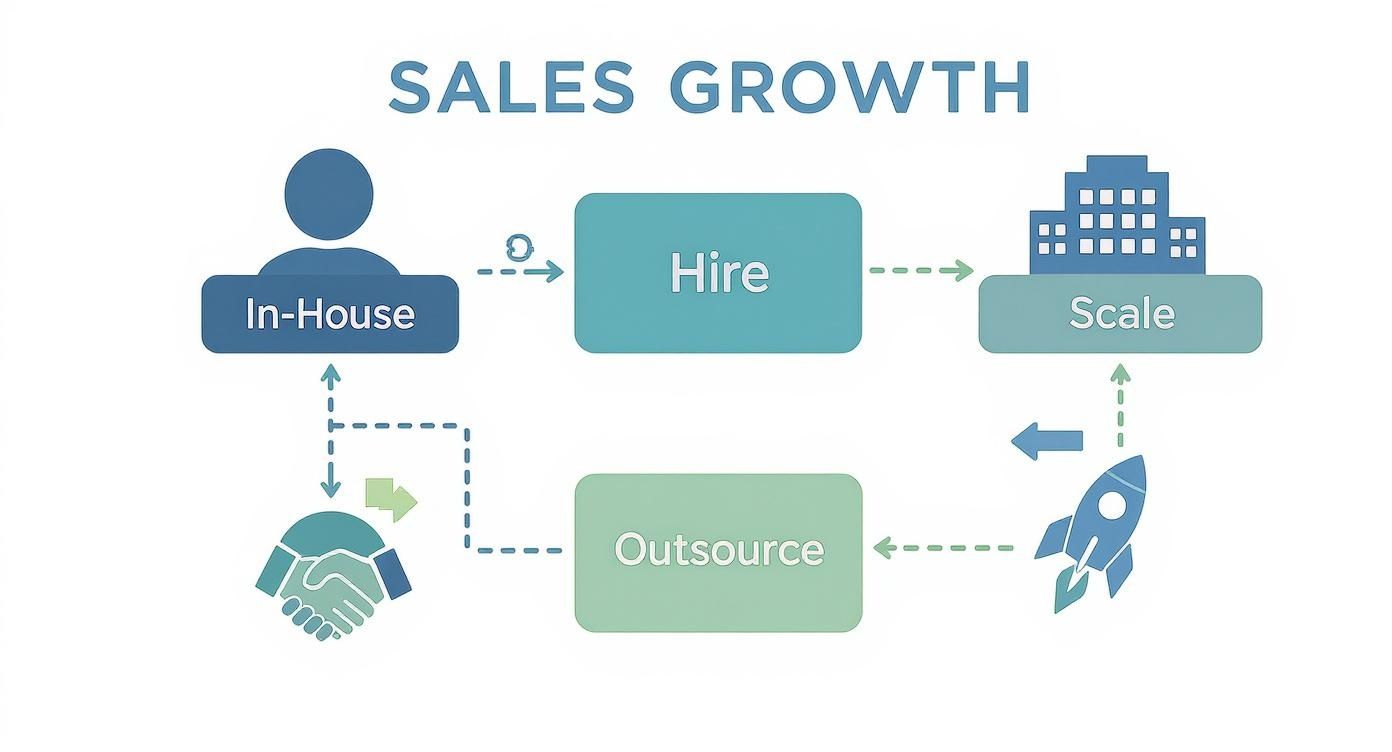
As the graphic shows, both routes point toward growth. But the outsourcing path is really designed to put you on the fast track to scale.
Breaking Down the Real Costs and Timelines
When you decide to "build," you're shouldering all the risk and the operational headache that comes with it. The hiring process alone can drag on for months. Then comes the ramp-up period, where your new hires are just trying to get their heads around your product, your market, and your sales process. That hidden cost—all the time they spend not generating revenue—is something most people forget to account for.
Outsourcing, on the other hand, gives you a predictable, fixed cost right out of the gate. A good managed service bundles the people, the tech stack, and the management into one monthly retainer, so you're not getting hit with surprise expenses. For a venture-backed tech company, this is huge—it turns a major capital investment into a manageable operational expense.
It's not just about "What does it cost?" The real question is, "How fast can we get a qualified pipeline, and how much of my team's focus will this eat up?" A slow, expensive ramp-up can be a killer for a startup that needs traction now.
To really understand the trade-offs, let's compare the two approaches side-by-side. The table below breaks down the major differences in cost, effort, and strategic focus.
In-House vs Outsourced Inside Sales: A Cost and Effort Comparison
| Factor | Building In-House Team | Outsourcing to a Partner |
|---|---|---|
| Upfront Costs | High. Recruiting fees (~20% of salary), hardware, software licenses. | Low to none. Typically just the first month's retainer. |
| Time to First Meeting | 3-6 months. Sourcing, interviewing, hiring, onboarding, and ramp-up. | 2-4 weeks. The team is already trained and ready to launch campaigns. |
| Ongoing Costs | Variable & High. Salaries, benefits, taxes, bonuses, management overhead. | Predictable & Fixed. A set monthly retainer covers everything. |
| Management Burden | High. You are responsible for hiring, training, coaching, and performance management. | Low. The partner manages their team, you just manage the relationship. |
| Tech Stack Costs | High. You purchase and manage CRM, outreach tools, data providers, etc. | Included. The partner brings their own optimized and paid-for tech stack. |
| Risk | High. The cost of a bad hire, high turnover, and slow ramp-up falls on you. | Low. The partner is responsible for performance and replacing underperformers. |
| Expertise & Process | Developed internally over time through trial and error. | Instant access to proven playbooks, scripts, and industry best practices. |
This comparison makes it clear: building in-house gives you total control but demands significant investment in time, money, and management. Outsourcing accelerates your path to pipeline and shifts the operational burden to a specialized expert.
A Tale of Two Companies
Let's put this into a real-world context. Picture a Series A SaaS company. They've got the capital to absorb the high initial costs and decide to build their team from scratch, thinking it gives them more control. The problem? They burn their first six months just finding, hiring, and training people instead of booking meetings. Their competitors, meanwhile, are already capturing market share.
Now, think about a bootstrapped agency that needs to generate leads without a massive upfront investment. They go with outsourcing inside sales to a managed provider. Within a few weeks, a professional team is already running outreach campaigns for them. This frees up the founders to do what they do best: close deals and serve clients, not babysit a team of SDRs. This nimble approach is a cornerstone of many successful strategies for outsourced B2B lead generation, where speed and expertise are everything.
Key Factors to Steer Your Decision
Your choice here needs to be based on a brutally honest look at where your company is today and where you need to be tomorrow. Don't just default to the "we should hire someone" path because it feels familiar.
Ask yourself these questions:
- How fast do we need pipeline? If you need qualified meetings on the calendar ASAP, outsourcing gets you there in weeks, not months. The ramp-up time is drastically shorter.
- Do we need niche expertise? If your product is highly technical or serves a very specific industry, finding and training in-house reps who get it can be a nightmare. A specialized agency might already have that expertise on tap.
- What's our tolerance for risk? Are you ready to eat the costs of a bad hire or deal with high employee turnover? The average turnover for sales roles is nearly 35%, significantly higher than other professions. Outsourcing pushes a lot of that performance risk onto your partner.
- Do we have the management bandwidth? Does your leadership team truly have the time and experience to recruit, train, coach, and manage an inside sales team? A managed service takes all of that off your plate, letting your team focus on their core jobs.
How to Pick the Right Sales Partner
Let's be clear: choosing an outsourced sales partner isn't like hiring a vendor. It's like recruiting a specialized extension of your own team. Your entire success hinges on this one decision. Get it right, and it’ll feel like your best sales reps are sitting in the next room, crushing their quotas. Get it wrong, and you'll burn through cash and maybe even tarnish your brand's reputation.

The selection process has to be deliberate. You can't get distracted by a slick website or a smooth sales pitch. You’re hunting for proof, not just promises. The right partner needs to show you a clear track record of success, preferably in your industry or with companies at a similar stage of growth.
Look for Proven Expertise in Your Niche
A generalist sales agency might seem like a safe bet, but the real wins come from deep, specialized knowledge. A team that has already sold into your market gets it. They know the lingo, they understand the customer’s pain points, and they probably already have a list of key players to contact. That kind of experience slashes the ramp-up time.
When you’re vetting potential partners, push for specifics. Ask them for case studies with hard data: "Show me a campaign where you increased qualified meetings by 25% for a company like mine." Don’t let them get away with vague success stories; you want to see the numbers and the strategy that got them there.
Think about it this way: if you sell marketing automation to e-commerce brands, a partner whose main experience is in healthcare IT will be starting from scratch. But an agency that has already helped three other e-commerce SaaS companies grow? They’re going to get you results, fast.
Scrutinize Their Process and Tech Stack
The best partners I've worked with operate like a well-oiled machine. They have a defined, repeatable process for everything. They should be able to walk you through their entire playbook, from how they build lists and qualify leads to their outreach cadences and how they hand off a hot lead to your team. If their process feels murky or improvised, that's a huge red flag.
Their tech stack is equally important. You have to be sure their tools will play nice with yours. I always ask these questions:
- CRM Integration: How will they log activities in our CRM? Do they have direct experience with our platform, whether it’s Salesforce, HubSpot, or something else? A practical example is asking if they can automatically update lead statuses and log call notes, which saves your internal team manual data entry.
- Outreach Tools: What sales engagement platforms are they using for calls and emails? How do they ensure their outreach is effective and, just as importantly, compliant with regulations like GDPR or CCPA?
- Data Sources: Where are they getting their contact data? How do they keep it accurate so your team isn't wasting cycles on bounced emails and disconnected numbers? Data decays at a rate of over 20% per year, so a partner with a strong data hygiene process is crucial.
It's also worth digging into their technical know-how. For instance, strong email deliverability best practices are non-negotiable to ensure your messages actually land in front of prospects.
Don’t just take their word for it. Ask for a live demo of their process or a walkthrough of their reporting dashboard. A transparent partner will have no problem showing you exactly how they operate.
Vet Their People and Communication Style
At the end of the day, you’re partnering with people, not just a logo. You have to feel confident in the team that will be speaking on behalf of your brand. Insist on meeting the actual sales reps and the account manager who will be on your project, not just the agency’s slick new business team.
In those conversations, pay close attention to their communication style. Do they listen more than they talk? Are they asking smart, probing questions about your business? A great partner acts like a consultant, digging deep to understand your goals before ever mentioning their solutions. This is critical—these people are the first impression many of your future customers will have of your company. You need a team that reflects your culture in every single interaction.
Watch Out for These Red Flags
As you move through the vetting process, keep your antenna up for warning signs. I've learned to treat these as serious indicators to either slow down or walk away entirely.
- Vague Reporting and KPIs: If they can’t clearly define how they measure success, you’ll be flying blind. Ask for a sample report to see exactly what you'll get each week.
- Inflexible, Long-Term Contracts: A partner who believes in their ability to deliver will be fine with a shorter pilot program—say, 90 days—to prove their value before locking you into a year-long deal.
- "Secret Sauce" Mentality: Be wary of any agency that’s overly secretive about their methods. True partners are open and collaborative.
- Overly Aggressive Sales Tactics: If their own sales process feels pushy or unprofessional, just imagine how they’ll represent you to your prospects.
- One-Size-Fits-All Approach: Your business is unique. A partner offering a cookie-cutter solution without trying to understand your specific needs isn’t invested in your success.
Choosing the right partner is the single most important part of your outsourcing inside sales journey. Taking the time to do your homework here will pay off immensely, setting you up for a scalable and profitable partnership.
Getting Your New Sales Team Up to Speed
Signing the contract with your new sales partner isn’t the finish line—it’s the starting block. I’ve seen more of these partnerships fizzle out because of a sloppy, rushed onboarding than for any other reason. If you want this investment to pay off, you have to treat your new team like an extension of your own, not just another vendor. And that all starts with a world-class onboarding experience.

This isn't just about handing over logins and a few product sheets. It’s a full-on transfer of knowledge, culture, and process. The goal is to get your outsourced reps so dialed in that they feel, think, and sell just like your top in-house performers from day one.
The Sales Playbook: Your Team's Bible
First things first: you need a rock-solid sales playbook. This isn't a quick one-pager; it’s the master document, the blueprint that turns your company’s sales DNA into a repeatable process anyone can follow. Think of it as the ultimate cheat sheet—no more guesswork.
Your playbook absolutely must include:
- Ideal Customer Profile (ICP) & Buyer Personas: Get granular. Who do you sell to? Define their industry, company size, and the specific pain points you solve. For example, an ICP might be "US-based SaaS companies with 50-200 employees using HubSpot." Then, build out detailed personas for the decision-makers, covering their roles, daily frustrations, and what motivates them to buy.
- Competitive Battle Cards: You need to arm your reps for a fight. For every major competitor, map out their strengths, weaknesses, and the common angles their reps use. Give your team sharp talking points that drive home your unique value and set you apart.
- Objection Handling Scripts: Don't let your team get caught flat-footed. Document every common objection you can think of—"it's too expensive," "we're happy with what we have," "call me next quarter." Then, provide them with proven, field-tested responses.
Your playbook's job is to eliminate friction so reps can act with conviction. A well-equipped team is a confident team, and confidence is what closes deals.
Tech Integration and Tool Access
With the strategy locked down, it's time for the tech. A clunky, disorganized tech setup is a momentum killer right out of the gate. You’re aiming for a secure, seamless integration that makes them feel like they’re sitting in the office next to you.
Create a simple checklist to make sure nothing gets missed. This should cover secure, role-based access to your core systems. For instance, set up a dedicated view for them in your CRM so they can log calls and track leads without tripping over sensitive company-wide data.
Get them into your daily communication flow, too. Add your outsourced account manager and key reps to a dedicated Slack or Teams channel. It’s a small step, but it fosters the real-time collaboration that makes them feel like part of the crew. They can ask quick questions, share wins, and stay in the loop. For a deeper dive into structuring this process, you can find great info on client onboarding best practices.
This disciplined approach is critical in the rapidly expanding global outsourcing market. The market is projected to swell to USD 577 billion by 2025, a huge jump from USD 490 billion in 2020. Customer experience (CX) outsourcing, a close relative to inside sales, is valued at around USD 110 billion for the same year, largely because over 60% of businesses now see customer satisfaction as a primary revenue driver. You can dig into more of these market potential statistics on Stealthagents.com.
Measuring the True ROI of Your Partnership
https://www.youtube.com/embed/Rv_SwTq68Ck
Once your outsourced team is up and running and the first campaigns are out the door, the real work begins. How can you be sure this whole thing is actually paying off? It's way too easy to get lost in a sea of vanity metrics—things like call volume or email open rates. While interesting, they don't tell you if you're making more money.
To get a real, honest picture of performance, you have to focus on the key performance indicators (KPIs) that are directly tied to revenue. This means shifting your focus from activity to outcomes.
Defining Your Core Sales KPIs
Your performance dashboard shouldn't be a cluttered mess. It needs to tell a simple, clear story about progress—one you can easily walk your leadership team through. Forget tracking dozens of metrics. Just concentrate on the vital few that really move the needle.
These are the essentials you absolutely have to track:
- Qualified Meetings Set: This is the bread and butter of any good inside sales effort. A practical example of a qualification framework is BANT (Budget, Authority, Need, Timeline). Ensure both teams agree on what constitutes a "qualified" lead.
- Pipeline Generated: This is the total dollar value of all the opportunities that came from meetings your outsourced team booked. It’s a direct measure of their impact on your future revenue.
- Meeting-to-Opportunity Conversion Rate: Of all the meetings they book, what percentage actually become qualified sales opportunities in your CRM? A healthy benchmark for this metric in B2B tech is often between 50-75%. This one tells you a lot about the quality of their work.
- Customer Acquisition Cost (CAC): How much are you spending to land each new customer through this channel? This is the ultimate gut check on whether the program is financially efficient.
The best partnerships I've ever seen were built on a foundation of shared goals and transparent data. If your partner isn't obsessed with the same bottom-line metrics you are, the relationship is probably doomed from the start.
Calculating the Real ROI
With these KPIs in hand, you can finally figure out your true return on investment. The math is pretty simple, but it depends on you knowing another key number for your business: your Customer Lifetime Value (LTV).
Here’s a straightforward way to break down the ROI calculation:
- Calculate Total Investment: Add up everything you’ve paid your sales partner over a set period, like a quarter. Let's say you spent $24,000 over three months.
- Determine New Revenue Generated: Track the deals that have closed from the leads your outsourced team brought in. If they helped you close $100,000 in new contracts during that same quarter, that’s your revenue figure.
- Apply the Formula: The classic ROI formula is (New Revenue – Total Investment) / Total Investment. Using our example, that’s ($100,000 – $24,000) / $24,000, which gives you a 333% ROI.
This gives you a clear, defensible number you can confidently take to your board to prove the program's value.
Factoring in Speed and Efficiency
Don't forget that outsourcing brings more to the table than just direct revenue. The efficiency gains can be massive. We've seen data showing that businesses using outsourced SDRs can ramp up their sales operations about 40% faster than building a team from scratch.
On top of that, these companies often cut their sales acquisition costs by up to 30%. The combination of speed and savings can lead to a 50% increase in qualified leads and a 25% faster conversion rate. When you look at it that way, strategic outsourcing becomes a powerful lever for growth. You can dig deeper into the impact of these B2B sales strategies to see more examples.
By tracking the right KPIs and regularly calculating your ROI, you change the entire conversation. It’s no longer about "How much is this costing us?" but "How much faster are we growing?" This data-driven mindset is the key to building a profitable, long-term partnership with your outsourced inside sales team.
Got Questions About Outsourcing Sales? You're Not Alone.
Even with a rock-solid plan, deciding to outsource your inside sales function brings up a lot of questions. It’s a huge move, so it's only natural to have some concerns about everything from costs and control to whether it will actually work.
Let's walk through some of the most common questions I hear from leaders who are weighing this decision. Getting straight answers is the only way to feel confident you're making the right call for your company's growth.
What's the Typical Cost Structure?
When you start talking to agencies, you'll quickly find they usually work off one of three main pricing models. Knowing how they operate is the first step to matching your budget with your goals.
-
The Fixed Retainer: This is as straightforward as it gets. You pay a set monthly fee, often ranging from $5,000 to $15,000, for a dedicated team or a certain amount of work. It’s great for predictability and makes financial planning a breeze.
-
Pay-Per-Performance: Here, you’re only on the hook for specific results—think qualified meetings booked or solid opportunities handed over. This model is fantastic for aligning incentives because the agency only makes money when you do. Just be aware that the cost-per-result can be higher to balance out the agency's risk.
-
The Hybrid Model: This is the one you’ll see most often. It’s a blend of a smaller monthly retainer (e.g., $3,000/mo) plus performance bonuses for hitting key targets (e.g., $250 per qualified meeting). It gives the agency some stability while keeping them hungry to deliver what matters most to you.
The right model really depends on your risk tolerance, your budget, and how dialed-in your sales process already is.
The real question isn't just "What's the monthly fee?" It's "Which model gives us the most predictable path to a positive ROI?" A slightly higher upfront cost with a performance guarantee can often be a smarter long-term investment than the cheapest available option.
How Do I Protect My Data and Brand?
Handing over the keys to part of your sales engine feels like a big leap of faith, but protecting your brand and data is completely doable with the right guardrails in place. Frankly, it’s non-negotiable.
It all starts with a solid legal framework. Your contract needs a detailed non-disclosure agreement (NDA) and specific clauses that spell out data ownership and security protocols. When you're vetting potential partners, ask practical questions: "Do you have SOC 2 compliance?" or "How do you manage password security and user permissions?"
To keep your brand's voice consistent, you have to provide an incredibly detailed brand guide and insist on rigorous, scenario-based onboarding. A great way to test the waters is by launching a small pilot program. This lets you listen in on their first few calls and review their emails, ensuring they sound like you before you scale things up.
What Are the Biggest Pitfalls to Avoid?
I’ve seen this go wrong, and the biggest mistakes are almost always avoidable with a bit of foresight.
The absolute number one pitfall is setting fuzzy expectations. You and your partner need a crystal-clear, mutually agreed-upon definition of a "qualified lead." If your definitions don't match, you're just setting everyone up for frustration.
Another classic mistake is poor communication. Don't treat your outsourced team like some far-off vendor you just send a check to. Integrate them. A practical way to do this is to schedule a 30-minute weekly sync call to review performance, discuss challenges, and plan the week ahead. Put their account manager in your company's Slack channel. Invite them to your sales meetings. Make them feel like part of the team, because they are.
Finally, don't skimp on onboarding. You can't just toss a contact list over the fence and expect magic to happen. You have to invest real time training them on your product, your market, and the unique pains your ideal customer feels. A rushed onboarding always, always leads to mediocre results.
How Long Until I Actually See Results?
Look, you’ll see activity—calls being made, emails going out—almost immediately. But it’s crucial to be realistic about how long it takes to build a consistent, predictable pipeline. The standard ramp-up period is about 90 days.
- Month 1: This is all about learning and calibration. The team is absorbing your value prop and testing their initial messaging. It's a lot of trial and error. You should expect them to conduct A/B tests on email subject lines and call scripts.
- Month 2: They should start booking their first real, qualified meetings. They're taking what they learned in month one and refining their approach based on actual conversations.
- Month 3: By now, the machine should be humming. The team should be hitting their initial KPI targets and generating a steady flow of opportunities you can count on.
You have to be patient during this initial phase. Think of it as a critical investment in building a revenue engine that will pay dividends for a long, long time.
Ready to accelerate your growth by targeting the most promising, high-intent startups? FundedIQ delivers hand-curated lists of recently funded companies, complete with verified decision-maker contacts and critical buying signals. Stop guessing and start engaging with prospects at the perfect moment. Explore our lead generation solution today.