


Top real estate startups to watch in 2025

- 1. Crunchbase
- 2. PitchBook
- 3. AngelList (Venture)
- 4. G2 – Real Estate Software Marketplace
- 5. Product Hunt – Real Estate Category
- 6. Y Combinator Startup Directory – Housing & Real Estate
- 7. Snowflake Marketplace (Data and Apps for Real Estate)
- Top 7 Real Estate Startup Platforms Comparison
- Your Next Move in the Evolving Real Estate Landscape
The real estate industry is undergoing a seismic shift, powered by a new wave of technology-driven innovators. These real estate startups, often called 'proptech' companies, are redefining everything from property management and financing to construction and data analytics. For investors, agencies, and job seekers, identifying the most promising players is crucial but challenging. The market, valued at over $23.7 billion in 2023 and projected to grow, is fragmented, and signals of growth can be hard to spot.
This guide cuts through the noise. We will provide a curated roundup of seven essential platforms that offer the data, insights, and direct access needed to navigate this dynamic ecosystem. Each entry includes a concise profile, recent funding signals, ideal outreach hooks, and analysis of why they matter. To truly unlock the proptech frontier and understand innovative solutions, it's beneficial to explore resources covering the best AI tools for real estate STR professionals, which highlight emerging technologies transforming the sector.
Our goal is to equip you with actionable intelligence. You'll learn how to use each platform to:
- Identify recently funded startups and high-growth companies. For example, pinpointing a startup that just closed a $10M Series A round.
- Analyze their technology stacks and hiring trends to find opportunities. For instance, noticing a company is hiring for AWS and Python developers signals a tech expansion.
- Craft effective outreach strategies for sales, partnerships, or job applications. A practical hook could be referencing their recent funding as a trigger for needing new marketing services.
We've included screenshots and direct links to help you get started immediately. Whether you're sourcing deals, hunting for clients, or seeking your next career move, this is your playbook for staying ahead of the curve in 2025.
1. Crunchbase
Crunchbase stands as a cornerstone platform for anyone serious about navigating the landscape of real estate startups. It's not a real estate company itself, but rather a comprehensive database that provides the critical intelligence needed to discover, track, and engage with emerging proptech ventures. For investors, agencies, and job seekers, it’s the definitive starting point for market research, deal sourcing, and competitive analysis. The platform's power lies in its structured data on over 1 million private and public companies, including detailed funding histories, key personnel, investor profiles, and recent news signals.

This depth of information allows users to move beyond simple searches and build highly targeted outreach lists. For example, a marketing agency could identify all proptech startups that raised between $5M and $20M in the last 12 months, as this is a prime trigger for expanding marketing budgets.
Key Features and Use Cases
Crunchbase’s utility extends across various professional needs, making it a versatile tool for anyone targeting the startup ecosystem.
- Advanced Search & Filtering: The Pro tier unlocks powerful search capabilities. You can filter for real estate startups by location, funding stage (e.g., Series A, Seed), total funding amount, employee count, and specific industry tags like "PropTech" or "Commercial Real Estate." This is crucial for creating hyper-specific prospect lists, such as "all seed-stage proptech companies in California with fewer than 50 employees."
- AI-Powered Insights: Crunchbase Scout uses AI to summarize company profiles and recent news, saving hours of manual research. For example, it can condense a company’s last five press releases into a few bullet points, helping you quickly grasp their trajectory and identify relevant talking points for outreach.
- Data Export & Alerts: Pro users can export search results to a CSV file for easy integration into a CRM or outreach tool. You can also set up alerts to be notified when a target company receives new funding—a key trigger for sales and recruitment outreach.
- Contact Data: While the core platform focuses on company data, add-on credits are available to access verified contact information for key decision-makers, streamlining the process from discovery to direct engagement.
Practical Tips for Effective Use
To maximize your results on Crunchbase, focus on creating saved searches. For example, a recruitment agency could create a search for "PropTech companies in New York that raised a Series B in the last 6 months." Setting an alert on this search will deliver new, relevant leads directly to your inbox. This proactive approach turns the database into an automated deal-sourcing engine. If you're exploring alternatives or want a deeper dive, you can find a useful comparison of startup company databases here.
Why It Makes the List
While some core features are behind a paywall (Pro plans start at $49/user/month), the free version still offers valuable surface-level data. Its true strength is the structured, actionable intelligence it provides. For anyone looking to systematically identify and engage with high-growth real estate startups, Crunchbase is an indispensable resource for building a data-driven strategy.
Website: https://www.crunchbase.com
2. PitchBook
PitchBook offers institutional-grade intelligence on the private markets, making it an essential platform for deep-dive analysis of real estate startups. Where other databases provide a surface-level view, PitchBook delivers analyst-curated data on over 450,000 deal transactions annually, designed for serious due diligence and advanced market research. For venture capitalists, private equity firms, and corporate development teams, it provides the granular detail needed to evaluate valuations, track investor relationships, and identify high-potential proptech ventures with confidence.
The platform’s strength lies in its comprehensive datasets that link companies, deals, investors (both LPs and GPs), and key personnel. This interconnected data allows users to map out entire ecosystems, understand investment patterns, and uncover non-obvious relationships within the real estate technology sector. For example, a user could see which venture funds have made the most follow-on investments in their proptech portfolio companies.
Key Features and Use Cases
PitchBook is built for professionals who require meticulous data for strategic decision-making, far beyond simple lead generation.
- Comprehensive Private Market Data: Gain access to exhaustive information on VC, PE, and M&A deals. Users can track funding rounds, pre-money valuations, and cap tables for real estate startups, providing a complete financial picture of a target company.
- Analyst-Curated Research: Unlike purely algorithm-driven platforms, PitchBook employs a team of over 1,000 analysts to verify and enrich its data. This human oversight ensures higher accuracy for critical metrics like valuations and comparable deal analysis, which is vital for investment decisions.
- Advanced Search & Comparables: The platform allows for the creation of precise comparable analyses (comps). An investor could, for example, build a list of all Series A proptech companies in the U.S. that were acquired in the last 24 months, and then analyze their valuation multiples (e.g., 5x ARR).
- Integrations & AI Features: PitchBook offers robust integrations with Excel and other tools, along with optional AI features like PitchBook Navigator for enhanced data discovery. For a comprehensive overview of its capabilities, you can find a useful analysis within this comparison of startup funding databases.
Practical Tips for Effective Use
To leverage PitchBook effectively, go beyond company searches and focus on building market maps. For instance, a VC firm can map out the entire competitive landscape for a specific sub-sector, like "construction tech," by identifying all funded companies, their lead investors, and board members. This provides a strategic overview of market saturation and potential investment gaps, turning raw data into actionable intelligence.
Why It Makes the List
PitchBook's primary drawback is its enterprise-level pricing, which is customized and can be a significant investment (often starting in the five-figure range annually), making it less accessible for smaller firms or individual users. However, for those who need unparalleled depth and verified accuracy for high-stakes decisions, it is the gold standard. Its analyst-backed data and powerful workflow tools make it an indispensable resource for anyone conducting serious due diligence or competitive analysis on real estate startups.
Website: https://pitchbook.com
3. AngelList (Venture)
AngelList (Venture) is a critical platform for direct investment into the startup ecosystem, including the burgeoning real estate startups sector. Unlike a research database, AngelList is a marketplace where accredited investors can gain access to early-stage deals, and founders can connect with capital. Since its inception, the platform has facilitated billions in investments. For those looking to invest directly in proptech or for founders seeking seed funding, it provides the infrastructure to discover opportunities and manage investments through syndicates and venture funds.

The platform’s core value lies in its network and operational efficiency. It enables individual investors (Limited Partners or LPs) to co-invest alongside experienced venture capitalists (General Partners or GPs) in specific deals or funds. This model opens up a previously opaque asset class, allowing qualified individuals to build a diverse portfolio of startup investments, including promising real estate startups that are transforming the property market.
Key Features and Use Cases
AngelList Venture is designed to facilitate investment and fundraising with a suite of specialized tools. Its utility is most pronounced for accredited investors and startup founders.
- Access to Syndicates & Funds: The platform allows accredited investors to browse and invest in syndicates (deal-by-deal investments led by an experienced investor) and rolling funds. You can filter by industry, such as "Real Estate" or "PropTech," to find specialists backing the next generation of property technology companies.
- Transparent Investment Structure: AngelList provides a standardized framework for investments, clearly outlining minimum check sizes (often starting at $1,000), management fees, and carried interest (carry) for each deal. This transparency helps investors make informed decisions and understand the cost structure upfront.
- Fundraising & Back-Office Support: For startup founders, it's a direct channel to a large network of active angel investors and VCs. For fund managers, AngelList provides a comprehensive "fund-in-a-box" solution, handling the legal, operational, and financial back-office tasks required to run a venture fund or syndicate.
- Deal Flow Discovery: Investors can follow specific GPs or funds known for their expertise in proptech. This allows them to see curated deal flow and receive notifications when new investment opportunities in the real estate startups space become available. For example, following a GP who specializes in construction tech can give you first access to their deals.
Practical Tips for Effective Use
For investors, success on AngelList involves identifying and building relationships with syndicate leads who have a proven track record in proptech. Review a lead's past investments and portfolio performance before committing capital. For founders, a well-crafted profile that clearly articulates your value proposition, market traction (e.g., "$10k MRR"), and team is essential to attract investor attention. If you're looking for a broader overview of similar investment platforms, you can find more information in this guide to venture capital databases.
Why It Makes the List
AngelList's primary limitation is that participation is generally restricted to accredited investors under U.S. securities laws (e.g., individuals with a net worth over $1M or income over $200k). However, it earns its spot for providing unparalleled, direct access to investment opportunities in private real estate startups. While platforms like Crunchbase help you research the market, AngelList is where you can actively participate in it. It has fundamentally changed the landscape of early-stage venture capital.
Website: https://www.angellist.com
4. G2 – Real Estate Software Marketplace
G2 serves as the definitive buyer’s marketplace for evaluating the software tools that power modern real estate startups and established operators. Instead of focusing on the startups themselves, G2 provides a transparent look into the technology they use, from property management and CRMs to virtual tour and title software, backed by over 2 million verified user reviews. For agencies, investors, and job seekers, this platform offers a unique angle: understanding a company by analyzing its tech stack and operational efficiency. It's an essential resource for benchmarking the tools that enable growth in the proptech sector.
The platform’s strength lies in its crowd-sourced credibility. By aggregating reviews from actual users, G2 helps professionals cut through marketing hype and make informed decisions about the software they adopt. This is invaluable for new ventures aiming to build a scalable tech foundation or for established firms looking to upgrade their systems.
Key Features and Use Cases
G2’s utility is centered on its structured, review-driven approach to software discovery and comparison.
- Verified User Reviews: The platform’s core value comes from authentic, detailed reviews that cover ease of use, quality of support, and implementation specifics. Users can filter reviews by company size and role, providing contextually relevant feedback. For instance, a small real estate agency can see what other small agencies think of a specific CRM.
- Granular Software Categories: G2 organizes software into dozens of specific real estate categories, including Property Management, Real Estate CRM, IWMS (Integrated Workplace Management System), and Commercial Real Estate Management. This makes it easy to find and compare direct competitors for a particular function.
- Comparison Grids & Reports: The platform generates side-by-side comparison grids that visually map out features, satisfaction ratings, and market presence for shortlisted tools. This data is critical for making a business case for a new software purchase, like showing that "Software A" has a 95% satisfaction rating for ease of use compared to "Software B's" 75%. When exploring options, it's also beneficial to review resources directly comparing real estate investment software like Homebase and InvestNext.
- "Best Of" Lists & Awards: G2 publishes annual "Best Real Estate Software" lists based on user satisfaction and market presence, which serve as a reliable starting point for identifying industry-leading solutions.
Practical Tips for Effective Use
To get the most out of G2, use its category pages as a primary research tool. If you're a startup evaluating property management systems, don't just look at the overall leader. Filter by "Small Business" to see which platforms are best suited for emerging companies. Pay close attention to reviews that mention integration capabilities, as a well-integrated tech stack is crucial for scaling operations. For example, a review stating "seamlessly integrates with QuickBooks and Stripe" is a strong positive signal.
Why It Makes the List
G2 is free to browse, offering immense value without a subscription. While pricing details are often on vendor sites and some reviews can be incentivized, the sheer volume of data provides an unparalleled view of the proptech software landscape. It empowers real estate startups to build their operational toolkit with confidence and allows observers to gauge which technologies are gaining traction. For anyone involved in the operational side of real estate, G2 is an indispensable guide.
Website: https://www.g2.com/categories/real-estate
5. Product Hunt – Real Estate Category
Product Hunt is the daily pulse of the tech world, and its Real Estate Category serves as a vital discovery hub for the absolute newest real estate startups and tools. Unlike established databases, this platform showcases products on their launch day, offering a ground-floor view of emerging proptech. For agencies, investors, and tech enthusiasts, it's the place to spot innovative AI listing tools, niche investor dashboards, and experimental lead generation platforms before they gain mainstream traction or even secure their first round of funding.
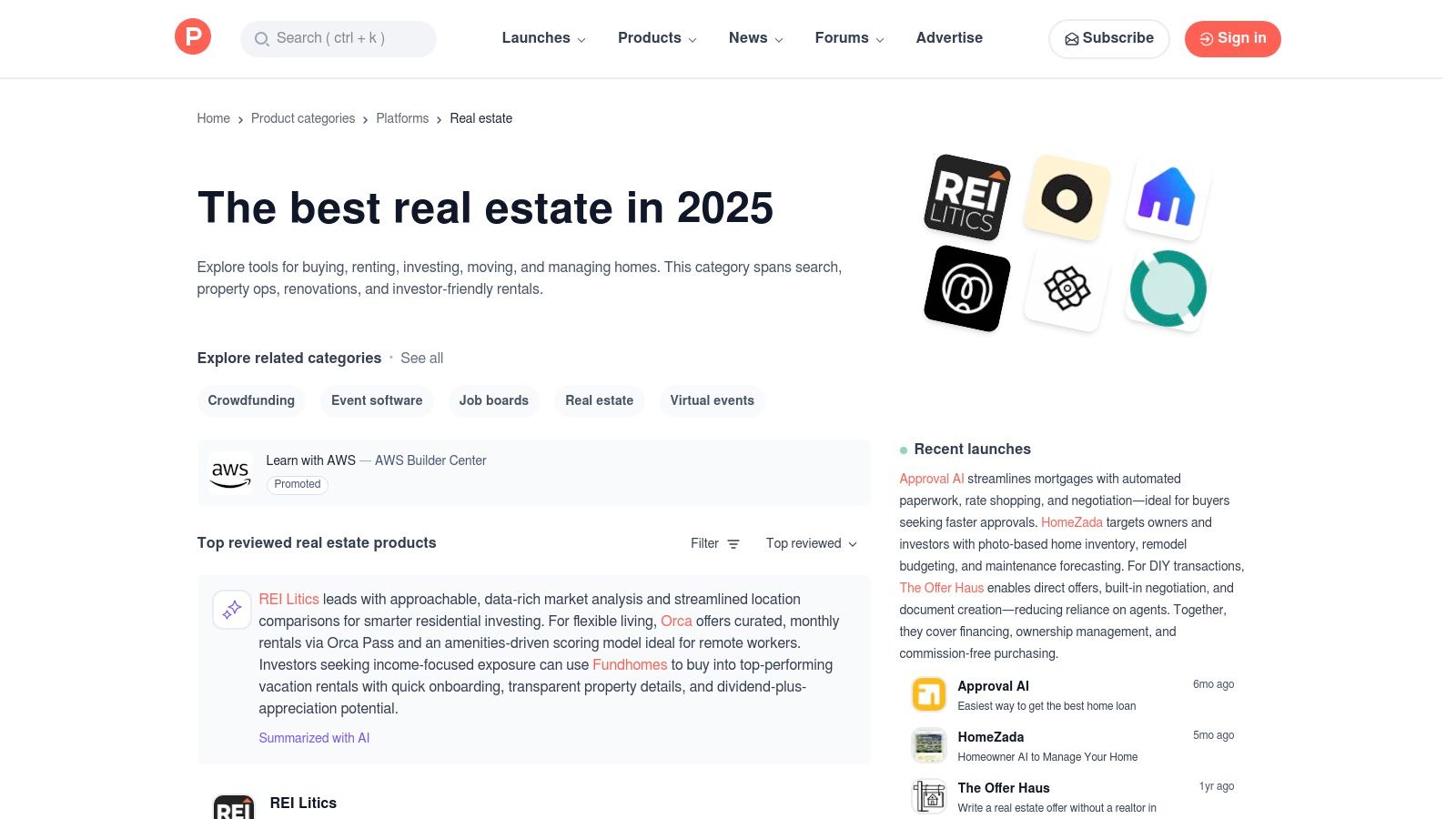
The platform’s value lies in its rawness and community-driven curation. Users upvote and comment on launches, providing immediate social proof and unfiltered feedback. A product that reaches the top 5 for the day, for instance, might receive over 500 upvotes and dozens of comments, indicating strong initial interest. This dynamic environment allows you to gauge market reception for a new concept in real-time.
Key Features and Use Cases
Product Hunt’s real estate section is a goldmine for early adopters and those hunting for hyper-niche solutions that larger platforms might miss.
- Early-Stage Discovery: This is the primary use case. You can find pre-seed or bootstrapped real estate startups that haven't appeared on Crunchbase or AngelList yet. This is ideal for angel investors looking for undiscovered gems or agencies wanting to partner with founders from day one.
- Direct Access to Founders: The launch day discussion threads are a unique feature. Founders are almost always active, answering questions and engaging with early users. This presents a perfect opportunity for recruiters, marketers, or potential partners to build a direct relationship. For example, asking "How do you plan to differentiate from Zillow?" can reveal key strategic insights.
- Community Reviews and Feedback: Each product page aggregates comments and reviews from a tech-savvy community. This feedback can be invaluable for assessing a product's potential, understanding its core value proposition, and identifying potential flaws or market gaps.
- Free Trials and Launch-Day Deals: Many startups launching on Product Hunt offer special deals, such as a "50% off for life" plan, to attract their first wave of users. This makes it a cost-effective way to test-drive new proptech tools.
Practical Tips for Effective Use
To leverage Product Hunt effectively, subscribe specifically to the "Real Estate" topic to get notified of new launches. Check the platform daily or weekly to stay ahead of trends. When you find a promising startup, don’t just look at the product page; dive into the comments. The questions asked and the founder’s responses often reveal more about the company's vision and traction than the marketing copy itself.
Why It Makes the List
Product Hunt is completely free to use, offering unparalleled access to the bleeding edge of the proptech scene. While the quality of launches can vary, and some projects may be experimental, its ability to surface brand-new, innovative real estate startups is unmatched. It’s an essential daily or weekly check-in for anyone who wants to see the future of real estate technology as it’s being built, providing a direct channel to the innovators behind it.
Website: https://www.producthunt.com/categories/real-estate
6. Y Combinator Startup Directory – Housing & Real Estate
The Y Combinator (YC) Startup Directory is an exceptionally high-signal resource for discovering promising real estate startups. Unlike broad databases, this is a curated list of ventures that have successfully passed YC's rigorous selection process, which has an acceptance rate of less than 3%. This immediately signals a certain level of quality, innovation, and founder ambition. For agencies, investors, or job seekers looking to connect with the next wave of proptech leaders, the YC directory serves as a pre-vetted launchpad, filtering out noise and focusing on companies with significant growth potential.
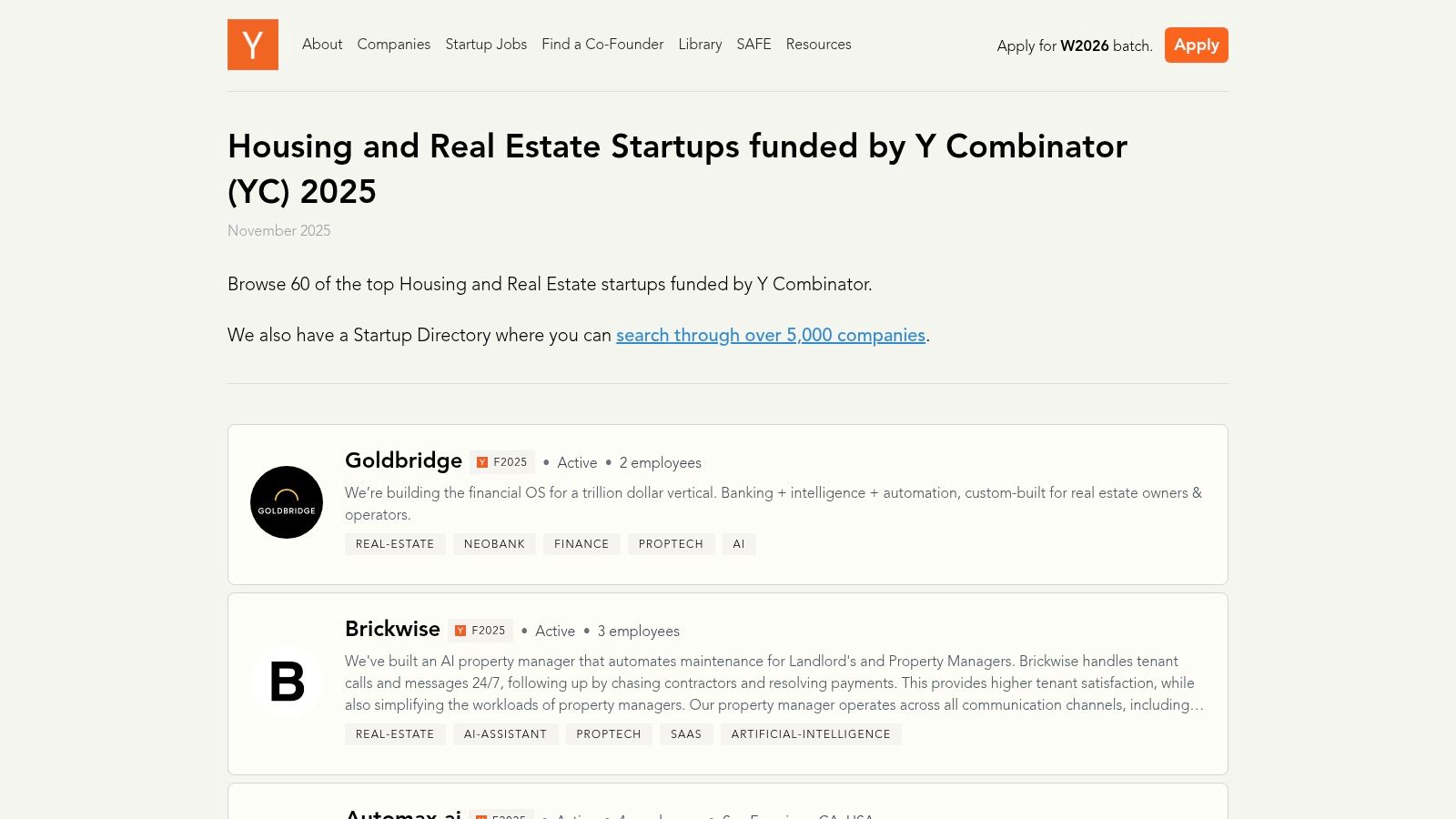
This directory provides a direct line of sight into the companies emerging from one of the world's top accelerators. It offers brief, high-level snapshots of each startup, what they do, and a link to their website, making it an efficient tool for initial research. While it lacks the deep financial data of platforms like Crunchbase, its value lies in the curation and the inherent prestige of the YC brand. Famous proptech alumni include companies like Airbnb and Opendoor.
Key Features and Use Cases
The directory is intentionally simple, designed for efficient discovery rather than deep-dive analysis. Its primary strength is in its curated nature.
- Curated, Vetted Listings: Every company featured has been accepted into a YC batch, a powerful signal of quality. This saves you time by presenting a list of startups that have already met a high bar for innovation and market potential.
- Targeted Industry Filters: Users can easily navigate to the "Housing & Real Estate" category, with related tags like "Proptech" and "Construction Tech" offering further specialized lists. This allows for focused prospecting within specific niches.
- Batch and Status Filtering: You can filter companies by their YC batch (e.g., S23, W24) to identify the newest ventures or by status (Active, Acquired, Inactive) to track outcomes. For example, filtering for "Active" and "W24" will show you the most recent crop of proptech startups from the last winter batch.
- Direct Company Access: Each listing includes a direct link to the startup’s website, providing a seamless transition from discovery to direct evaluation. This is ideal for quickly assessing a company's product, messaging, and potential fit for partnership or investment.
Practical Tips for Effective Use
To leverage the YC directory effectively, use it as a starting point for your research. Identify a handful of relevant companies from a recent batch within the "Housing & Real Estate" filter. Visit their websites, then cross-reference them on LinkedIn to find key personnel and on Crunchbase to check for recent funding news. This multi-platform approach combines YC's high-quality curation with deeper operational and financial data.
Why It Makes the List
The Y Combinator Directory is completely free to access, offering unparalleled value. Its main drawback is that its scope is limited to YC-backed companies, meaning you won't find every proptech startup here. However, for those seeking early-stage, high-potential real estate startups that have already received a significant stamp of approval, this directory is an essential and highly efficient sourcing tool. It cuts through the clutter to highlight ventures that are already on a promising trajectory.
Website: https://www.ycombinator.com/companies/industry/housing-and-real-estate
7. Snowflake Marketplace (Data and Apps for Real Estate)
Snowflake Marketplace has emerged as a critical data infrastructure layer for real estate startups looking to build data-driven products. Rather than being a proptech company itself, it is a centralized hub where data teams can discover and instantly deploy third-party real estate datasets and applications directly within their Snowflake environment. For startups in valuation, investment analysis, or market intelligence, this eliminates the cumbersome process of building and maintaining data ingestion pipelines, accelerating the path from concept to product by months.
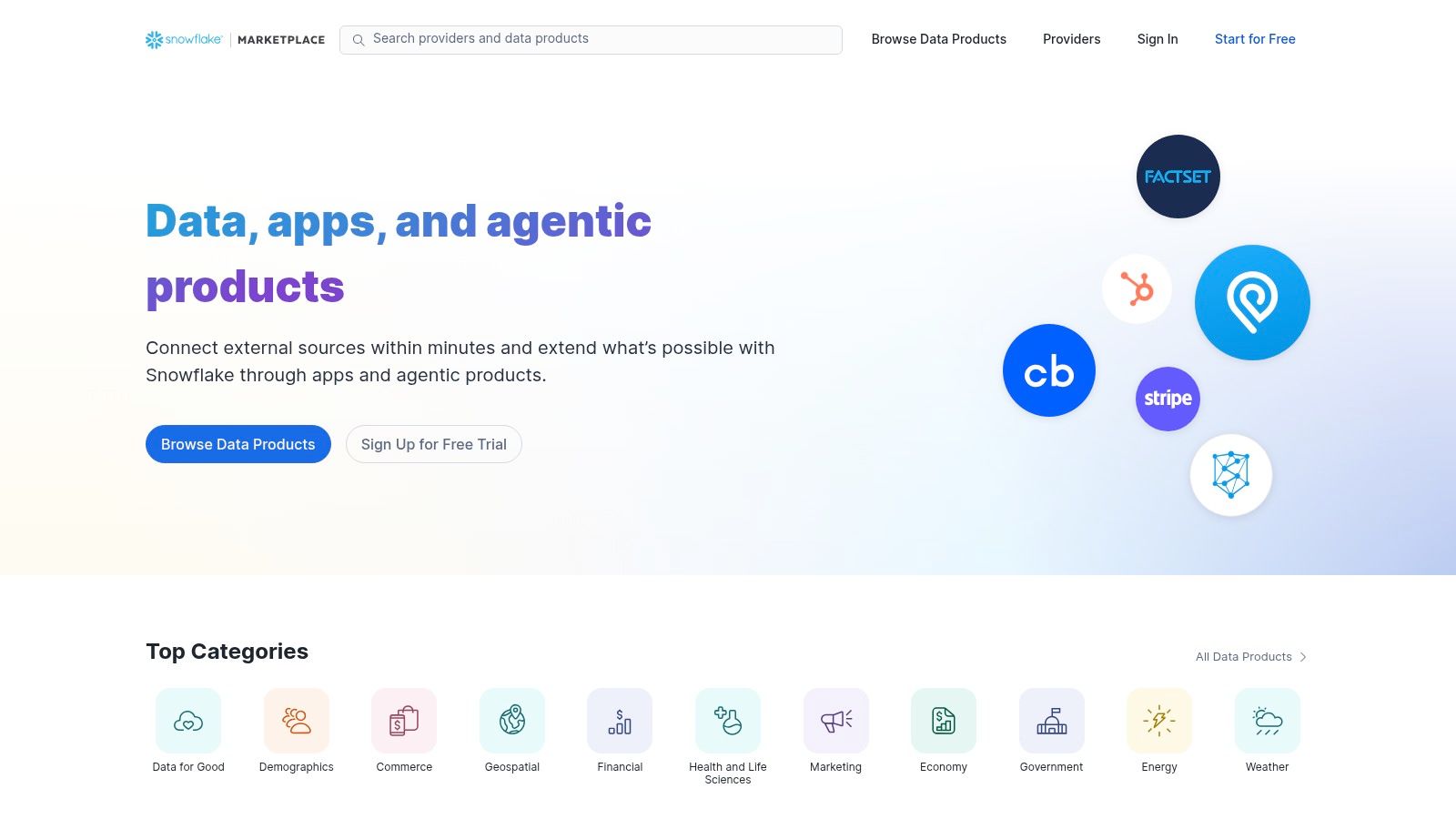
The platform's core advantage is its "zero-copy" data sharing architecture. This means when a startup licenses a dataset, like property intelligence from ATTOM Data Solutions or point-of-interest data from SafeGraph, they are not receiving a static file. Instead, they get live, direct access to the provider's data, which is always up-to-date. This is a game-changer for startups that rely on fresh, accurate data to power their services.
Key Features and Use Cases
Snowflake Marketplace offers powerful tools that allow real estate startups to integrate high-quality data and applications with minimal engineering overhead.
- Turnkey Access to Datasets: The marketplace provides immediate access to a vast catalog of real estate-centric data, including property records, valuation models, address verification, and demographic information. This is ideal for building predictive models or enriching internal data. For example, a fintech startup could license mortgage lien data to enhance their underwriting models.
- Ready-to-Query Data: Because the data lives within Snowflake, it's immediately available for querying with standard SQL. This cuts the time-to-value from weeks or months down to minutes, allowing data scientists to focus on generating insights rather than data wrangling.
- Native Analytics Apps: Beyond raw data, the marketplace hosts native applications that run securely inside a company's Snowflake account. These can perform tasks like property valuation or risk analysis without data ever leaving the environment, ensuring security and governance.
- Integrated Billing & Free Trials: Many listings offer free trials, allowing teams to test data quality and compatibility before committing. Billing is integrated directly into a company's Snowflake account, simplifying procurement.
Practical Tips for Effective Use
To get the most out of the Marketplace, start by clearly defining your data needs. For instance, a residential tech startup could search for "property transaction history" or "school district boundaries" and use the free trial listings to run sample queries against their own data. This allows for a direct evaluation of a dataset's value before purchase. Also, pay close attention to the data provider's documentation and update frequency (e.g., "updated daily") to ensure it meets your product's requirements.
Why It Makes the List
While access requires an existing Snowflake account and premium datasets can be a significant investment (ranging from thousands to hundreds of thousands of dollars per year), the platform's value proposition is undeniable. It dramatically lowers the barrier to entry for building sophisticated, data-intensive real estate applications. By providing instant, live access to curated datasets, Snowflake Marketplace empowers even small real estate startups to compete on analytics and product features that were once only achievable by large enterprises.
Website: https://app.snowflake.com/marketplace
Top 7 Real Estate Startup Platforms Comparison
| Tool | 🔄 Implementation complexity | ⚡ Resource requirements | 📊 Expected outcomes | Ideal use cases | ⭐ Key advantages |
|---|---|---|---|---|---|
| Crunchbase | Low–Medium — straightforward UI; Pro features add workflow steps | Paid subscription + optional contact credits; moderate cost | Strong deal‑sourcing, monitoring and outreach lists | Deal sourcing, competitor scans, build outreach lists | Broad private-company coverage, advanced filters & exports |
| PitchBook | High — analyst‑driven workflows and steeper learning curve | Enterprise pricing; high budget and analyst time | Deep diligence, valuations, comparables and investor maps | Institutional benchmarking, advanced private‑markets research | Very deep curated datasets and integrations |
| AngelList (Venture) | Low — simple platform flows for investors and syndicates | Free to join; deal fees, SPV costs and carry for participants | Direct access to startup allocations and syndicates | Accredited investors sourcing deal flow; founders raising early rounds | Direct deal access and mature SPV/fund back‑office |
| G2 – Real Estate Software Marketplace | Very Low — browse and filter with review pages | Free to use; vendor pricing external | Rapid shortlisting and vendor reputation signals | Shortlisting software before trials/purchase | Verified user reviews and category rankings |
| Product Hunt – Real Estate Category | Very Low — discover new launches via list pages | Free discovery; variable trial availability | Early visibility into niche and experimental tools | Finding cutting‑edge or early‑stage proptech | Surfaces new, experimental products quickly |
| Y Combinator Startup Directory – Housing & Real Estate | Low — curated directory with simple filters | Free; limited to YC‑backed companies | High‑signal list of vetted startups | Sourcing vetted vendors, partners or early investments | YC‑vetted quality and easy company snapshots |
| Snowflake Marketplace (Data & Apps) | Medium — requires Snowflake setup and permissions | Snowflake account required; dataset costs vary (can be high) | Instant access to ready‑to‑query datasets and native apps | Data teams, analytics, product dev needing turnkey data | Turnkey datasets/apps within Snowflake; reduces ingestion overhead |
Your Next Move in the Evolving Real Estate Landscape
The landscape of real estate is no longer defined solely by physical properties and traditional transactions. It's a dynamic ecosystem powered by data, innovation, and the ambitious real estate startups driving the proptech revolution forward. The platforms we've explored are not just directories. They are the essential maps and compasses for navigating this new terrain.
By dissecting each tool, a clear pattern emerges: success in this space is less about finding a single "best" startup and more about understanding the interconnected signals of market momentum. A Series B funding announcement on Crunchbase, a surge in G2 reviews, a new real estate dataset appearing on the Snowflake Marketplace-these are not isolated events. They are critical data points that, when combined, paint a vivid picture of a startup's trajectory and the sub-sector's health.
From Data Overload to Actionable Intelligence
The challenge, however, lies in moving from passive observation to strategic action. It's easy to get lost in the sheer volume of information. The key is to refine your approach based on your specific objectives.
-
For Investors & Venture Capitalists: Your focus should be on triangulation. Cross-reference PitchBook's valuation data ($50M pre-money) with Crunchbase's funding history (led by a reputable firm) and the founding team's experience on LinkedIn (ex-Zillow, ex-Google). This multi-platform diligence separates a good bet from a great one.
-
For Agencies (Growth, Creative, Recruitment): Actionability is paramount. A startup that just closed a $15M round is a prime candidate for a growth agency. One that's rapidly hiring for 10+ engineering roles is a target for recruiters. A company launching a new feature on Product Hunt needs creative and PR support. The data tells you when to act.
-
For Job Seekers & Tech Professionals: Look beyond the job description. A company's presence in the YC directory signals a certain pedigree and network. Their tech stack, revealed through job postings (e.g., "React, Node.js, PostgreSQL"), tells you about their engineering culture. Use these tools to build a narrative about your potential employer before you even apply.
Implementing Your Strategy: A Practical Checklist
As you integrate these platforms into your workflow, consider the following factors to maximize your return on investment, whether that's time or subscription fees:
- Define Your Ideal Profile: Before you even log in, clearly define your target. Are you looking for early-stage B2B SaaS real estate startups in the commercial sector, or late-stage consumer-facing proptech companies? This focus will prevent wasted time.
- Establish Cadence: Information becomes stale quickly. Schedule regular check-ins. For instance, a weekly review of new real estate startups on Product Hunt or a monthly export of newly funded companies from Crunchbase can keep your pipeline fresh.
- Integrate and Automate: Don't let this data live in a silo. Explore how these platforms can integrate with your existing CRM or workflow tools. Can you set up automated alerts for when a company on your watchlist receives new funding or hits a hiring milestone?
- Qualify, Don't Just Collect: A list of 1,000 startups is useless. A qualified list of 50 is invaluable. Use the data points-funding stage, employee growth, recent news, tech stack-to score and prioritize your outreach efforts.
The proptech sector's rapid evolution is not slowing down. The most successful players will be those who can synthesize information into a coherent strategy and execute with precision. The future of real estate is being built by the companies on these lists, and with the right tools, you have a direct line to its architects. Your next great opportunity is waiting in the data; it's time to make your move.
Tired of manually sifting through data to find your next client or investment? FundedIQ accelerates your process by delivering curated, actionable intelligence on recently funded real estate startups and other high-growth companies directly to you. Visit FundedIQ to spend less time researching and more time closing deals.