


list of leads: 7 Powerful Sources for High-Intent Prospects

In the competitive 2025 business landscape, relying on generic, bulk-scraped lead lists is a direct path to failure. Low response rates, outdated contact information, and wasted resources have become the standard for sales and marketing teams using these outdated methods. For instance, industry reports suggest that B2B data decays at a rate of over 30% per year, meaning nearly a third of your list could be useless within 12 months. The real competitive advantage is no longer found in the quantity of leads but in their quality and timing.
High-intent prospects, those actively signaling a need for your specific solution, are the key to unlocking predictable revenue and sustainable growth. This means strategically targeting companies that have just secured a funding round, are rapidly expanding key departments, or have recently adopted technologies that create a perfect entry point for your offerings. These signals indicate not just a potential need but also the budget and urgency to act. For example, a company that just raised a Series B is 70% more likely to invest in scaling solutions like new marketing automation or CRM software within the next six months.
This article moves beyond surface-level advice to provide a curated, comprehensive list of leads sources and platforms designed to identify these high-intent signals. We will dive deep into seven powerful tools, offering a detailed breakdown of their unique strengths and ideal use cases.
Inside, you will find:
- Actionable insights on how to leverage each platform effectively.
- Direct links and screenshots to guide your evaluation process.
- Practical examples demonstrating how to pinpoint specific buying triggers.
Forget the numbers game. This guide is your blueprint for building a high-quality list of leads that actually converts, saving you valuable time and dramatically improving the ROI of your outreach efforts. Prepare to transform your prospecting strategy from random cold outreach into a precision-driven growth engine.
1. FundedIQ
For agencies and service providers targeting high-growth startups, timing is everything. FundedIQ has carved out a powerful niche by focusing exclusively on this critical moment, delivering a hand-curated list of leads sourced from startups that have just secured new funding. This platform is built on the premise that a fresh capital injection is one of the strongest buying signals a company can emit, making it an ideal time to pitch services that accelerate growth, from marketing and recruitment to tech development.
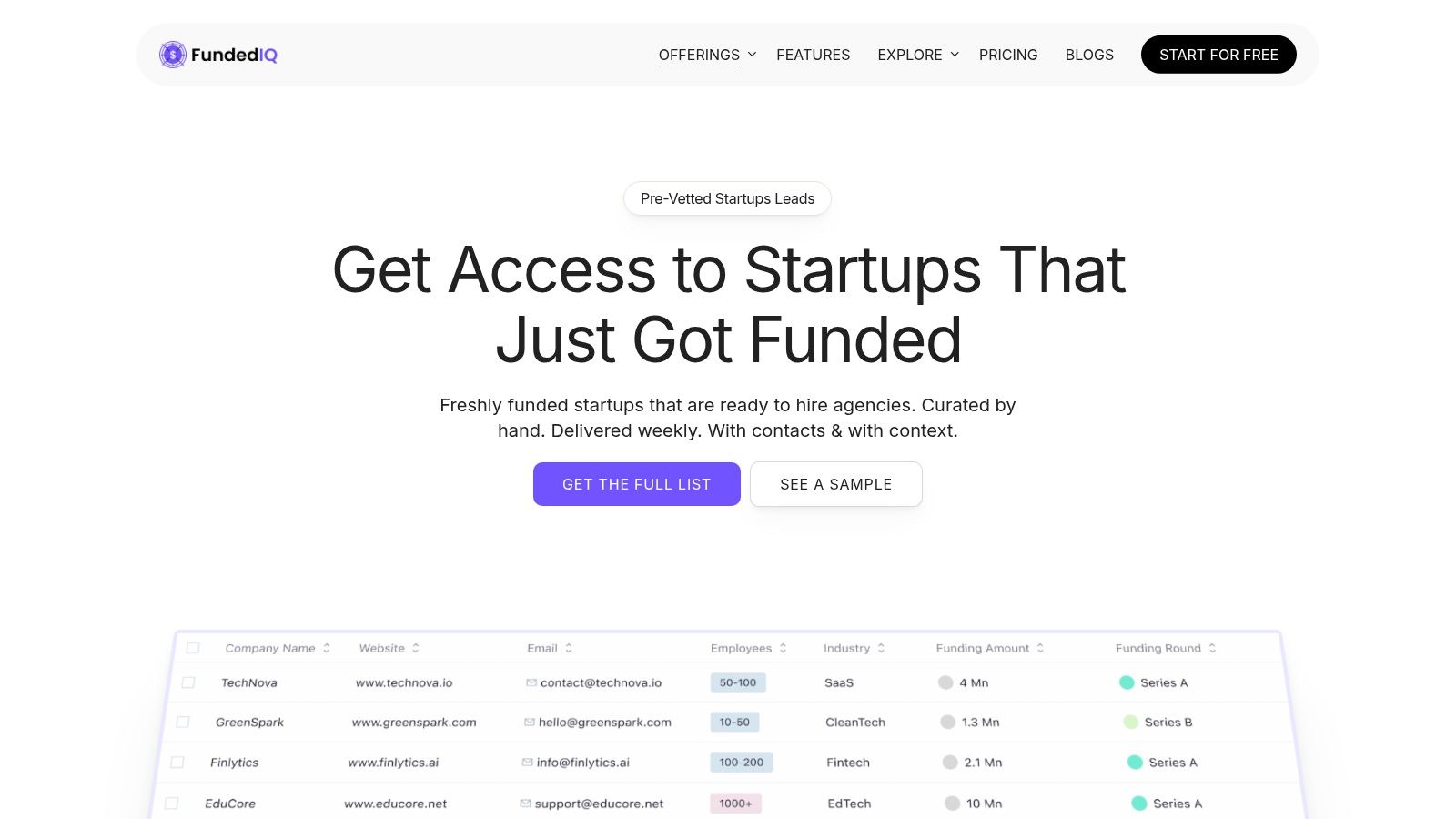
Unlike mass-scraped databases that often yield stale or inaccurate information, FundedIQ’s core differentiator is its human-centric approach. Every lead is manually researched, verified, and enriched, ensuring the data is not just fresh but also contextually relevant and immediately actionable. This focus on quality over sheer quantity makes it a formidable tool for teams that prioritize personalized, high-conversion outreach over a "spray and pray" strategy.
In-Depth Feature Analysis: What Sets FundedIQ Apart
FundedIQ’s strength lies in its meticulously layered data, which provides a 360-degree view of each prospect. Subscribers receive a weekly list packed with crucial intelligence designed to inform and personalize their sales process.
Key Data Points Provided:
- Verified Decision-Maker Contacts: Each entry includes direct email addresses, LinkedIn profiles, and X (formerly Twitter) handles for founders and key executives, validated to maximize deliverability.
- Comprehensive Company & Funding Data: Users get insights into the funding round size, lead investors, industry, employee count, and a concise company description. For example, knowing a company raised a $15M Series A from a top-tier VC like Andreessen Horowitz signals a high-growth trajectory.
- Actionable Buying Signals: The platform goes beyond funding announcements by including real-time indicators of spending intent, such as:
- Hiring Surges: Identifying which roles a startup is actively recruiting for helps tailor your pitch. For example, an agency seeing a surge in marketing roles can offer specialized services like "demand generation for Series A companies."
- Ad Spend Activity: Knowledge of a company's advertising activity on platforms like Facebook or Google Ads signals their investment in growth channels.
- Tech-Stack Signals: Understanding a prospect’s current technology stack allows for highly relevant pitches, such as offering an integration or a superior alternative.
- Web Traffic Trends: A sudden increase in site traffic can indicate readiness for conversion rate optimization or scaling infrastructure.
This rich data transforms a simple list into a strategic asset. You can explore a startup funding database on their website to understand the depth of information provided.
The Human Curation Advantage
The platform’s commitment to manual verification is a significant advantage. While automated scrapers often pull outdated or generic contact info (like [email protected]), FundedIQ’s team validates each contact and enriches profiles using over 15 premium data vendors.
Key Insight: This enrichment process reportedly yields up to 40% more reachable, direct emails than standard scraping methods. It also ensures all data is sourced in compliance with GDPR and CAN-SPAM regulations, mitigating legal risks for your outreach campaigns.
Practical Application & Reported Outcomes
The real-world results highlighted by FundedIQ users demonstrate its effectiveness. Testimonials report tangible ROI, from booking calls within 24 hours of receiving a list to closing substantial deals. Notable examples include a $42,000 project and a $28,000 monthly retainer, with some agencies claiming to have built pipelines worth over $300,000 ARR in under six months.
How to Use FundedIQ Effectively:
- Segment the List: Don't treat the list as a monolithic block. Filter by industry (e.g., FinTech), funding size (e.g., over $5M), or specific hiring signals to identify your ideal customer profile.
- Personalize Outreach: Use the provided buying signals as conversation starters. Reference their recent funding, a new key hire, or their tech stack to show you’ve done your homework. A sample opening could be: "Saw you just closed your Series A and are hiring for SDRs—we specialize in building sales playbooks for companies at your exact stage."
- Act Quickly: Recently funded companies move fast. Engage with new leads within the first week of receiving the list to capitalize on their immediate need to deploy capital.
Access and Pricing
FundedIQ operates on a simple, transparent subscription model. Access is provided for a flat monthly fee of $47 per month, with no long-term contracts. This low-commitment structure, combined with a 60-day money-back guarantee, makes it an accessible option for agencies of all sizes to test and validate.
| Feature | Description |
|---|---|
| Lead Type | Recently funded startups |
| Delivery | Weekly curated lists sent directly to your inbox |
| Data Quality | Human-curated, manually verified, and enriched from 15+ premium sources |
| Key Signals | Funding details, hiring surges, ad activity, tech stack, traffic trends |
| Pricing | Flat $47/month subscription |
| Commitment | No long-term contract; cancel anytime |
| Guarantee | 60-day money-back guarantee |
Pros:
- Extremely high-intent leads triggered by a major funding event.
- Superior data accuracy and contact reachability due to human verification.
- Rich contextual signals (hiring, tech stack) for hyper-personalized outreach.
- Simple, affordable pricing with a strong money-back guarantee.
Cons:
- Highly specialized; only provides leads for recently funded startups.
- Success is still contingent on the quality of your own sales and outreach process.
- Subscribers may be targeting the same pool of leads, increasing competition.
Website: https://fundediq.co
2. ZoomInfo (SalesOS)
ZoomInfo is a titan in the B2B data space, offering a comprehensive sales intelligence platform designed for teams that need to generate a high-quality list of leads at scale. Unlike manually curated lists, ZoomInfo's SalesOS provides a massive, dynamic database of companies and contacts that can be filtered with exceptional granularity. This platform is ideal for mid-market and enterprise organizations that require deep data insights and seamless integration with their existing sales and marketing stacks.
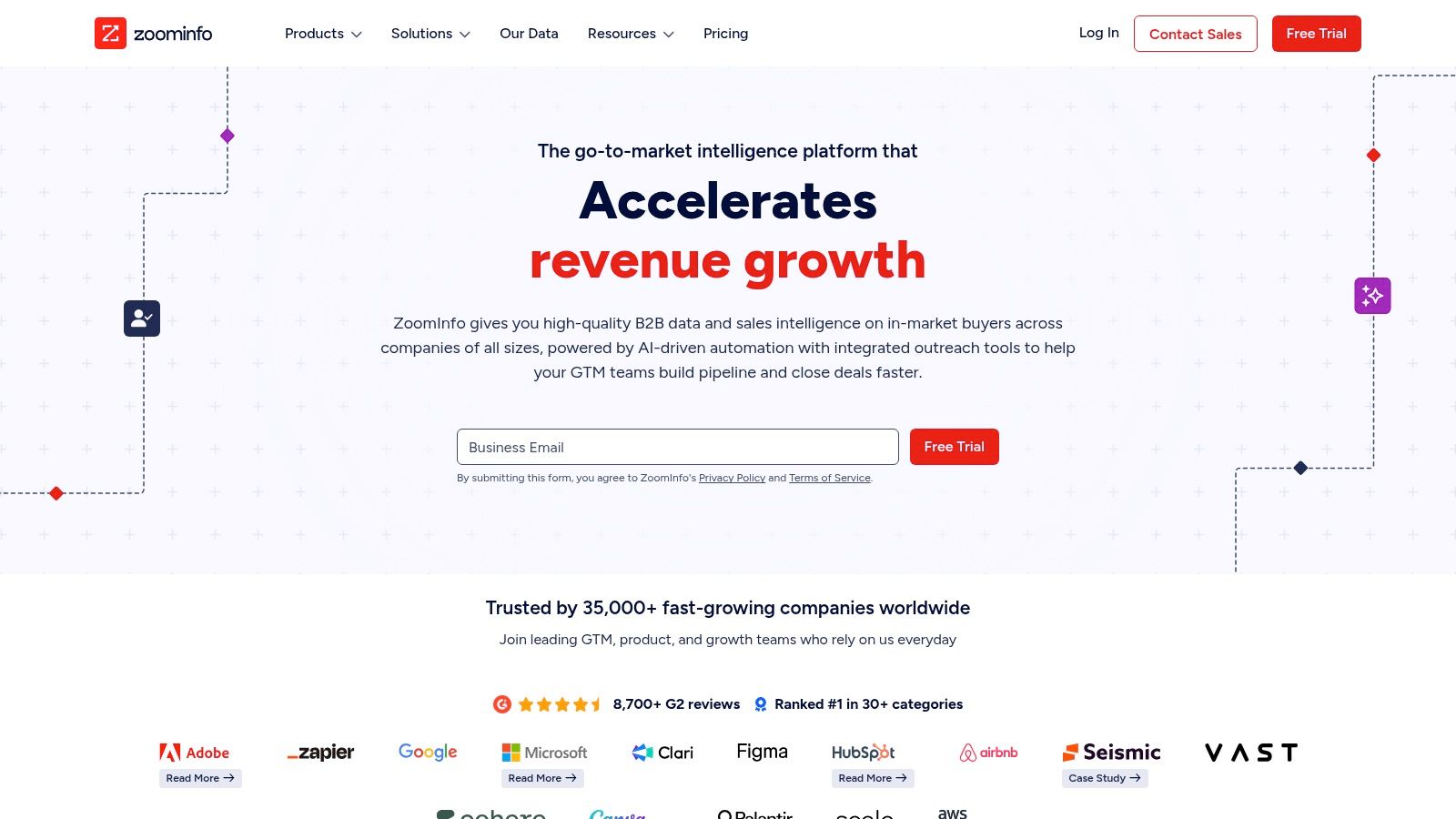
What truly sets ZoomInfo apart is its multi-layered approach to lead identification, which goes far beyond basic firmographics. Its system is built on a foundation of sophisticated data signals, reportedly processing over 38 billion data points daily, allowing users to pinpoint companies that are not just a good fit, but are also ready to buy.
How to Build a High-Intent Lead List with ZoomInfo
ZoomInfo’s power lies in combining its vast database with advanced filtering capabilities. Instead of just pulling a list of VPs of Marketing in the SaaS industry, you can create a highly targeted segment based on buying intent and technology usage.
A practical workflow might look like this:
- Define Technographics: Start by filtering for companies that use a specific technology stack. For example, a marketing agency could search for companies using HubSpot Marketing Hub but not Salesforce, identifying a potential integration opportunity.
- Layer on Intent Data: Next, apply "Intent" signals. ZoomInfo tracks online research activities across millions of domains, flagging companies that are actively searching for topics relevant to your solution. You could filter for companies researching "demand generation strategies" or "account-based marketing platforms" in the last 30 days.
- Identify Key Personas: Use the advanced search to pinpoint exact job titles or departmental functions within those target accounts. The platform's org charts are particularly useful for understanding reporting structures and identifying the ultimate decision-makers.
- Enrich and Export: Once your list is built, you can enrich the data with verified contact information (direct-dial phone numbers and email addresses) and export it directly into your CRM, like Salesforce or HubSpot, to trigger automated sales sequences.
Pro Tip: Use ZoomInfo's "Scoops" feature to find insider information like recent funding rounds, leadership changes, or upcoming projects. These timely insights provide powerful conversation starters and help you personalize your outreach. For example, a "Project Scoop" might reveal a company's plan to open a new headquarters in Q4, creating a perfect opportunity for local service providers.
Platform Breakdown
| Feature | Description | Best For |
|---|---|---|
| Contact & Company Data | Massive database of B2B contacts and companies with advanced filters. | Building foundational lead lists for large-scale outreach. |
| Intent Data | Tracks online research behavior to identify accounts with buying intent. | Prioritizing accounts that are actively in a buying cycle. |
| Technographics | Identifies the technology stacks used by companies. | Sales teams selling complementary or competitive software. |
| CRM Integration | Deep, native integrations with platforms like Salesforce and HubSpot. | Automating lead enrichment and streamlining sales workflows. |
While ZoomInfo’s platform is incredibly powerful, access comes at a premium. Pricing is not public, and contracts are typically customized for larger teams based on data credits and user seats, which can be prohibitive for startups or small businesses. Some users have also noted aggressive renewal terms. However, for organizations that can leverage its full suite of tools, the ROI from building a precise and actionable list of leads is often substantial. This platform truly embodies the core principles of sales intelligence. To better understand this field, you can learn more about what sales intelligence is and how it works.
Website: https://www.zoominfo.com
3. LinkedIn Sales Navigator
LinkedIn Sales Navigator leverages the world's largest professional network, transforming it into a dynamic platform for sales teams to build a highly contextual list of leads. Unlike static databases, it provides real-time access to member-updated profiles and relationship signals, making it an indispensable tool for targeted, relationship-driven prospecting. It is particularly effective for teams focused on named-account strategies and those who value up-to-the-minute insights on job changes, company growth, and buyer activity.
What sets Sales Navigator apart is its ability to blend advanced search filters with organic network activity. This allows salespeople to move beyond cold outreach by identifying warm pathways through shared connections, common groups, or recent company engagement, turning a simple lead list into a strategic map of potential relationships.
How to Build a High-Intent Lead List with Sales Navigator
The true power of Sales Navigator is unlocked by using its advanced filters to identify active and relevant prospects. Instead of simply searching for job titles, you can pinpoint individuals who are more likely to be receptive to your outreach based on their recent behavior and career movements.
A practical workflow might look like this:
- Define Advanced Lead Filters: Start with the "Advanced Search for Leads." Filter by key firmographics like industry, company size, and geography. Then, layer on more specific criteria such as "Years in current position" (e.g., less than 1 year to find new decision-makers) or "Groups" to find prospects in relevant industry circles.
- Leverage "Posted on LinkedIn" Signal: Filter for leads who have "Posted on LinkedIn in the past 30 days." This is a powerful indicator of an active, engaged user who is more likely to see and respond to InMail or connection requests. Studies show that active LinkedIn users are 50% more likely to engage with outreach.
- Identify Key Accounts with "TeamLink": Use the "TeamLink" filter to surface leads at target companies where your colleagues already have a 1st-degree connection. This provides an immediate warm introduction pathway, dramatically increasing response rates.
- Save and Monitor Leads: Once you have a refined search, save the leads to a custom list. Sales Navigator will then send you real-time alerts about their activity, such as job changes, company news, and recent posts, providing timely triggers for personalized outreach.
Pro Tip: Use the "Viewed your profile" filter in your Saved Leads list. This identifies prospects who have shown reciprocal interest, making them high-priority targets for immediate follow-up. This simple step can significantly shorten the sales cycle.
Platform Breakdown
| Feature | Description | Best For |
|---|---|---|
| Advanced Lead & Company Search | Granular filters including seniority, function, company growth rate, and recent activity. | Building hyper-targeted lead lists for named-account selling. |
| Buyer Activity Insights & Alerts | Real-time notifications on job changes, company news, and content shares. | Maintaining up-to-date relationship signals and timely outreach. |
| InMail Messages | Direct messaging credits for reaching prospects outside your network. | Contacting key decision-makers who are otherwise hard to reach. |
| Native CRM Integrations | Syncs lead and account data with major CRMs like Salesforce and HubSpot. | Streamlining workflows and keeping prospect data current. |
LinkedIn Sales Navigator offers clear, self-serve plans with monthly or annual billing, making it accessible for individuals and small teams. However, some users find the native CSV export limitations challenging, often relying on third-party tools to extract data. Higher tiers like Advanced Plus, which offer deeper CRM integration, require enterprise quoting. While LinkedIn Sales Navigator offers powerful lead identification, leveraging complementary tools can further enhance your outreach. For instance, you might explore comparisons of LinkedIn growth platforms like tools like Supergrow to optimize your presence and engagement. As one of the premier B2B platforms, it's a cornerstone among the top sales prospecting tools available today.
Website: https://www.linkedin.com/sales
4. Apollo.io
Apollo.io has emerged as a powerful, all-in-one sales intelligence and engagement platform, particularly favored by SMBs and startups. It uniquely combines a massive B2B database with a built-in suite of outreach tools, allowing users to build a list of leads and immediately act on it without switching applications. This integrated approach streamlines the entire top-of-funnel process, from prospecting to initial contact, making it an incredibly efficient solution for lean sales and marketing teams.
What sets Apollo.io apart is its accessibility and the consolidation of tools. While other platforms focus solely on providing data, Apollo empowers you to find prospects, verify their contact information, enroll them in email sequences, and even call them directly from the same interface. This removes the friction and cost associated with stitching together separate tools for data, enrichment, and sales engagement.
How to Build and Engage a Lead List with Apollo.io
Apollo.io's strength is its seamless workflow that takes you from search to outreach in minutes. Instead of exporting a static list, you can build dynamic segments and engage them immediately.
A practical workflow might look like this:
- Define Your Persona: Use the robust filtering options to hone in on your ideal customer profile. You can filter by job title, company size, industry, location, and even technologies used (technographics). For instance, a recruitment agency could search for "Heads of Talent" at tech companies with 50-200 employees that are currently hiring for engineering roles.
- Uncover Buying Intent: Layer on Apollo’s Buying Intent filters to prioritize prospects. You can target companies actively researching keywords related to your service, like "employee onboarding software" or "B2B lead generation services," ensuring you reach out when they are most receptive.
- Build and Enrich the List: Select the most relevant contacts from the search results and save them to a list. Apollo provides verified email addresses and, in many cases, direct-dial phone numbers. The platform uses a credit system for revealing and exporting this contact data.
- Launch an Outreach Sequence: Directly from your newly created list, select your prospects and enroll them in a pre-built or custom multi-step sequence. This can include a mix of automated emails, manual email steps, and call tasks, all managed within the Apollo platform.
Pro Tip: Use Apollo's Chrome Extension to prospect directly from LinkedIn. When you're viewing a profile on LinkedIn, the extension can reveal and save that person's contact information to your Apollo lists with one click, dramatically speeding up your prospecting efforts. This can increase prospecting efficiency by over 40% compared to manual data entry.
Platform Breakdown
| Feature | Description | Best For |
|---|---|---|
| Prospecting Database | A large B2B database with dozens of filters, including technographics. | Building highly targeted lead lists for outbound campaigns. |
| Engagement Suite | Built-in email sequencer, dialer, and task manager for outreach. | Teams wanting an all-in-one platform for prospecting and engagement. |
| Data Enrichment | Enriches existing records in your CRM or from LinkedIn with verified data. | Maintaining a clean and up-to-date contact database. |
| Transparent Pricing | Offers a free tier and clear, per-user pricing plans with credits. | Startups, SMBs, and teams that require predictable costs. |
Apollo.io's value proposition is compelling, especially given its transparent pricing and free entry-level plan, which makes it accessible to almost any business. While some users note that phone number accuracy can be variable and the interface can feel complex at first, the platform's power is undeniable. For teams that need to efficiently build a list of leads and immediately begin outreach, Apollo.io offers a unified and cost-effective solution that reduces tool sprawl and accelerates the sales cycle.
Website: https://www.apollo.io
5. UpLead
UpLead offers a streamlined and highly accurate approach to building a B2B list of leads, positioning itself as a powerful yet accessible alternative to more complex enterprise platforms. It prioritizes data quality above all else, boasting a 95% accuracy guarantee on its contacts, which are verified in real-time at the point of download. This focus makes it an ideal choice for small to mid-sized businesses (SMBs) and sales teams that need reliable data without a massive budget or extensive training.
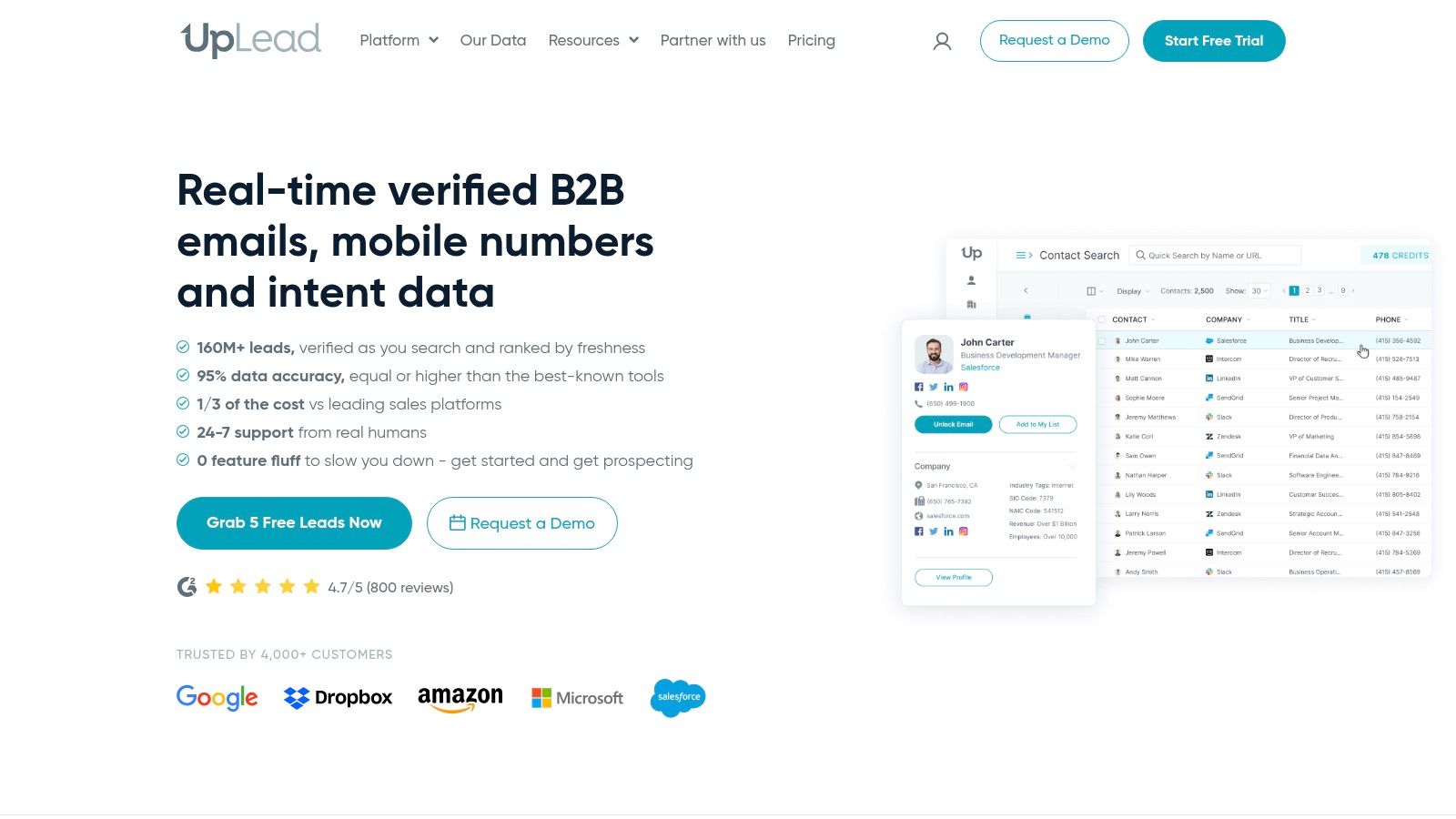
What makes UpLead stand out is its transparent, credit-based model combined with its real-time verification process. Users know exactly what they are getting and paying for. This transparent system eliminates the budget uncertainty often associated with other data providers and empowers teams to build a predictable and scalable lead generation engine.
How to Build a High-Intent Lead List with UpLead
UpLead’s strength lies in its user-friendly interface that simplifies the process of creating a targeted lead list without sacrificing filtering depth. It combines robust search criteria with a simple workflow, making it easy to go from broad market to specific prospects quickly.
A practical workflow might look like this:
- Establish Core Firmographics: Begin by defining your ideal customer profile using over 50 search filters. You can segment by industry, company size, revenue, location, and specific keywords in the company description.
- Apply Technographic Filters: Layer on technology data to find companies using specific software. For example, a cybersecurity firm could search for companies using AWS but not using a known security information and event management (SIEM) tool, signaling a potential gap.
- Pinpoint Key Contacts: Use the contact filters to identify the right decision-makers. You can search by job title, management level (e.g., C-Level, VP), or specific job functions to ensure your message reaches the right person.
- Verify and Export: Before downloading, UpLead verifies emails in real-time to ensure deliverability. Once your list is refined, you can unlock contacts using your credits and export them directly to your CRM or sales engagement platform, like Salesforce, HubSpot, or Outreach, to launch your campaigns.
Pro Tip: Use UpLead’s suppression list feature to upload a list of your existing customers or competitors. This ensures you don't waste credits on contacts you already have or accounts you don't want to target, keeping your outreach focused and efficient. For instance, uploading a CSV of your 500 current customers prevents you from re-prospecting them.
Platform Breakdown
| Feature | Description | Best For |
|---|---|---|
| Real-Time Verification | 95% data accuracy guarantee with on-demand email verification. | Teams prioritizing deliverability and reducing bounce rates. |
| Credit-Based Model | Transparent pricing where one credit unlocks one verified contact. | SMBs and teams that require predictable cost-per-lead acquisition. |
| Technographics | Database of technologies used by millions of companies worldwide. | Selling complementary tech products or targeting competitors' users. |
| CRM Integrations | Native connections to popular CRMs and sales tools, plus a Chrome extension. | Streamlining the process of moving leads from discovery to outreach. |
While UpLead’s engagement features are lighter than all-in-one sales intelligence suites, its transparent pricing and high-quality data make it a compelling choice. The costs are predictable, and a free trial makes it easy to get started. High-volume teams may find they need to purchase higher-tier plans or additional credits. However, for organizations that need a reliable and straightforward way to build an actionable list of leads, UpLead provides exceptional value and accuracy.
Website: https://www.uplead.com
6. Lusha
Lusha is a highly accessible contact enrichment tool designed for speed and simplicity. It’s particularly effective for individuals, sales development representatives (SDRs), and small teams who need to quickly find accurate contact information (emails and direct-dial phone numbers) for specific prospects. Instead of offering a massive, searchable database like some larger platforms, Lusha excels at on-demand data retrieval, making it perfect for building a targeted list of leads directly from sources like LinkedIn or company websites.
What sets Lusha apart is its low-friction, credit-based model and its powerful browser extension. This combination empowers users to enrich contacts one by one as they prospect, seamlessly integrating data acquisition into their daily workflow without the complexity or cost of an enterprise-level sales intelligence platform. It prioritizes ease of use and immediate value, allowing users to get started in minutes.
How to Build a Targeted Lead List with Lusha
Lusha's strength lies in its real-time enrichment capabilities, which are best leveraged through its Chrome extension. The workflow is designed for efficiency, turning prospecting on platforms like LinkedIn into a direct data-gathering exercise.
A practical workflow might look like this:
- Identify Prospects on LinkedIn: Use LinkedIn's native search or Sales Navigator to identify ideal prospects. For instance, a recruiter might build a list of "Senior Software Engineers" at a specific tech company.
- Activate the Lusha Extension: On a prospect's LinkedIn profile, click the Lusha extension icon in your browser. Lusha will then search its database for verified contact details associated with that individual.
- Reveal and Save Contacts: With a single click, you can use a credit to reveal the prospect's email address and direct phone number. Lusha allows you to save this contact directly to a list within its web app. According to Lusha, their data accuracy for direct dials is among the highest in the industry, often cited at over 80%.
- Export to Your CRM: Once you have compiled a sufficient number of contacts in your Lusha list, you can export the entire list as a CSV file or push it directly into your connected CRM (like HubSpot or Salesforce) to begin your outreach campaigns.
Pro Tip: Use Lusha's list-building feature within its web app. Before exporting, you can create separate, organized lists for different campaigns or client projects. This keeps your data clean and ensures your outreach is segmented and relevant.
Platform Breakdown
| Feature | Description | Best For |
|---|---|---|
| Credit-Based Model | Users purchase credits to reveal contact information (email/phone). | Teams that need predictable costs and want to pay only for the data they use. |
| Browser Extension | Enables one-click contact enrichment on LinkedIn and company websites. | Individuals and SDRs who do most of their prospecting directly on social platforms. |
| CRM Integration | Pushes enriched contact data directly into major CRM platforms. | Streamlining the handoff from prospecting to sales engagement. |
| API Access | Allows for programmatic data enrichment for more advanced workflows. | Tech-savvy teams looking to automate data enrichment at scale. |
Lusha offers a straightforward pricing structure, including a free plan with a small number of monthly credits, making it an excellent entry point for those new to sales tools. Paid plans are affordable for individuals and small teams, with options for pooled team credits. The primary limitation is its credit-based nature; high-volume users may find the cost per lead higher than bulk data providers. However, for those focused on building a high-quality, targeted list of leads with verified contact data, Lusha provides an exceptionally efficient and user-friendly solution.
Website: https://www.lusha.com
7. D&B Hoovers (Dun & Bradstreet)
D&B Hoovers is a sales acceleration platform from the legacy data powerhouse Dun & Bradstreet, designed for creating a meticulously structured list of leads. Leveraging D&B's extensive commercial Data Cloud and its proprietary D-U-N-S Number system, Hoovers excels at providing deep firmographic data, complex corporate family trees, and financial risk signals. This makes it an ideal choice for sales and marketing teams engaged in strategic account-based marketing (ABM) and enterprise-level targeting where understanding organizational structure is critical.
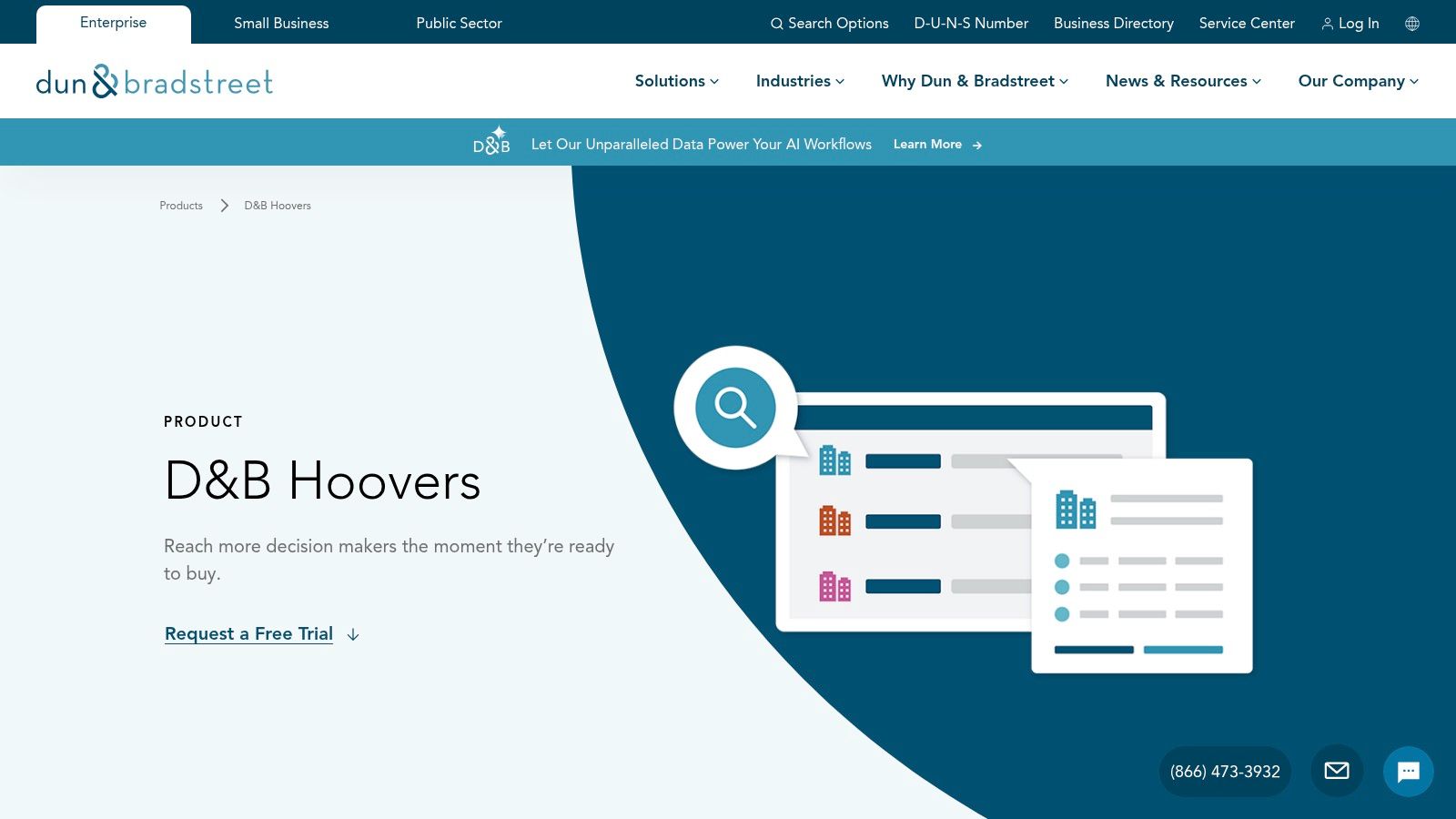
What sets D&B Hoovers apart is its foundation in Dun & Bradstreet’s long-standing, verified business data. While other platforms focus heavily on intent signals, Hoovers provides an unparalleled view of company hierarchies, creditworthiness, and official business registrations, allowing users to qualify accounts based on financial stability and corporate relationships, not just online behavior.
How to Build a High-Intent Lead List with D&B Hoovers
D&B Hoovers shines when building a lead list that requires deep corporate intelligence and precise segmentation. Instead of just identifying companies of a certain size, you can map out entire corporate families and pinpoint decision-makers within specific subsidiaries.
A practical workflow might look like this:
- Establish a Foundational List: Begin by using advanced firmographic filters such as industry (SIC/NAICS codes), annual revenue, employee count, and geographic location to create a broad list of target companies.
- Map Corporate Hierarchies: Use the "Corporate Family Tree" feature to expand your list. If your target is a large enterprise like a Fortune 500 company, you can identify all its parent companies, subsidiaries, and branches across the globe. This is crucial for "land and expand" sales strategies.
- Apply SmartLists & Triggers: Convert your search into a "SmartList" to receive real-time alerts. Set up triggers for key business events like executive changes, M&A activity, or negative financial news. These triggers provide timely reasons to initiate outreach.
- Identify and Refine Contacts: Within your target accounts, use the contact search to find individuals by job title, function, or seniority level. You can then enrich these contacts with verified business information before exporting the list to your CRM for targeted engagement.
Pro Tip: Leverage the D-U-N-S Number to de-duplicate and clean your existing CRM data. By matching your records against D&B’s master database, which covers hundreds of millions of business records, you can eliminate outdated information and build a single source of truth for your accounts.
Platform Breakdown
| Feature | Description | Best For |
|---|---|---|
| D-U-N-S® Number System | A unique nine-digit identifier for businesses, ensuring data accuracy and de-duplication. | Creating a clean, single source of truth for account data in a CRM. |
| Corporate Family Trees | Visualizes complex company hierarchies, including parent companies and subsidiaries. | Enterprise sales teams using account-based marketing (ABM) strategies. |
| Risk & Financial Signals | Provides insights into a company's financial stability and credit risk. | Qualifying leads based on financial health and procurement viability. |
| Trigger Alerts | Real-time notifications for key business events within target accounts. | Timely and context-aware sales outreach and engagement. |
Access to D&B Hoovers typically requires contacting their sales team, as pricing is customized based on team size, data needs, and integration requirements. The platform and associated data credits can be a significant investment, often positioning it for mid-market and enterprise clients. While it may not offer the same level of real-time intent data as some competitors, its strength in verified firmographics and corporate structure makes the list of leads you build exceptionally reliable for strategic, high-value outreach.
Website: https://www.dnb.com/en-us/products/dnb-hoovers.html
Top 7 Lead Platforms Comparison
| Product | Implementation complexity 🔄 | Resource requirements ⚡ | Expected outcomes 📊⭐ | Ideal use cases 💡 |
|---|---|---|---|---|
| FundedIQ | Low — subscription, minimal setup and weekly delivery 🔄 | Low monthly fee ($47 listed); needs outreach capacity ⚡ | High-intent, time-sensitive leads; rapid bookings and pipeline growth reported ⭐⭐⭐ | Agencies targeting recently funded startups and time-sensitive outreach |
| ZoomInfo (SalesOS) | Medium–High — enterprise setup, CRM integrations and config 🔄 | High cost and contract complexity; dedicated admin resources ⚡ | Scalable coverage, robust enrichment and intent signals for large pipelines ⭐⭐⭐⭐ | Mid-market and enterprise teams needing scale, automation, and reporting |
| LinkedIn Sales Navigator | Low–Medium — self-serve but advanced search/configuration 🔄 | Per-seat subscriptions; requires user time for relationship outreach ⚡ | Up-to-date professional signals and relationship context; strong for ABM ⭐⭐⭐ | Named-account prospecting, relationship-driven outreach and recruiting |
| Apollo.io | Medium — combined database + outreach setup (sequences, dialer) 🔄 | Transparent per-user pricing; credits for exports may be needed ⚡ | Streamlined prospect-to-outreach workflow; good engagement-to-conversion potential ⭐⭐⭐ | SMBs and scale-ups wanting an integrated prospecting + engagement tool |
| UpLead | Low — straightforward list-building with credit unlocks 🔄 | Predictable credit-based costs; scales with purchased credits ⚡ | High email verification accuracy; predictable contact acquisition outcomes ⭐⭐⭐ | SMBs needing verified contacts and predictable cost-per-contact |
| Lusha | Very Low — quick browser extension lookups and simple UI 🔄 | Low-cost, credit-limited model for individuals/small teams ⚡ | Fast, small-list contact reveals; limited scalability by credits ⭐⭐ | Individuals and small teams needing rapid contact reveals from web/LinkedIn |
| D&B Hoovers (Dun & Bradstreet) | High — enterprise onboarding, D‑U‑N‑S mapping and integrations 🔄 | High enterprise pricing; sales-led access and integration effort ⚡ | Strong firmographics, company hierarchies and risk/financial insights; ideal for complex accounts ⭐⭐⭐⭐ | Enterprise ABM, procurement, risk assessment, and data-enrichment programs |
Transform Your Pipeline with the Right Lead Generation Strategy
The journey to building a predictable, high-growth sales pipeline no longer relies on casting a wide net. As we've explored, the modern landscape is about precision, timing, and leveraging the right signals. A generic list of leads is a relic of the past; today's success is built on a foundation of high-intent, context-rich data that tells you not just who to contact, but why and when.
From the comprehensive data universes of ZoomInfo and D&B Hoovers to the all-in-one prospecting powerhouses like Apollo.io and UpLead, the tools available are more sophisticated than ever. Platforms like LinkedIn Sales Navigator offer unparalleled social insights, while Lusha excels at delivering direct contact information with surgical accuracy. Each of these solutions addresses a specific need in the vast B2B marketplace, empowering teams to move beyond cold, uninformed outreach.
Key Takeaways for Strategic Lead Generation
The central theme connecting these powerful platforms is the shift from quantity to quality. Simply having access to millions of contacts is no longer a competitive advantage. The real value lies in filtering that data through the lens of buying intent.
Here are the most critical takeaways to implement:
- Prioritize Intent Signals: Don't just look for companies that fit your Ideal Customer Profile (ICP). Look for those actively signaling a need. Key signals include recent funding rounds, new executive hires, significant hiring surges in specific departments, and technology stack changes.
- Context is King: A name and an email address are not enough. The most effective outreach is personalized with relevant context. Knowing a company just raised a Series A for market expansion allows you to tailor your pitch to solve their specific, immediate growth challenges.
- Tool Stack Alignment: No single tool is a silver bullet. Your choice should directly align with your target market and sales motion. An enterprise sales team targeting Fortune 500 companies will have different needs than a creative agency looking to partner with high-growth startups.
Choosing Your Platform: A Needs-Based Approach
Selecting the right tool from this list of leads providers requires a clear understanding of your business objectives. If your goal is broad market coverage with deep firmographic data, enterprise solutions like ZoomInfo or D&B Hoovers provide immense value. If you need an integrated solution for prospecting, sequencing, and enriching data all in one place, Apollo.io is a strong contender.
However, if your target audience is the dynamic, fast-moving world of recently funded startups, a specialized tool offers a distinct advantage. Platforms like FundedIQ are built on the most powerful buying signal of all: a fresh injection of capital. This signal indicates not just the ability to buy but an urgent mandate to invest in growth, making these companies prime targets for agencies, consultants, and service providers. Choosing a niche tool provides focus and eliminates the noise inherent in larger, more generalized databases.
Final Thoughts: From Data to Deals
Ultimately, the tools discussed in this article are just the starting point. They provide the raw material, but your strategy transforms that data into revenue. To ensure your efforts are aligned with the most effective methods for attracting and converting prospects, delve into the 10 Proven Lead Generation Best Practices for a deeper strategic framework.
The future of sales belongs to those who can act on high-intent signals faster and more effectively than their competitors. By thoughtfully selecting your tools, focusing on the context behind each lead, and executing a well-timed, personalized outreach strategy, you can move beyond simply filling a pipeline. You can begin to architect a predictable and scalable engine for growth.
Ready to stop chasing cold leads and start engaging companies with a clear intent to buy? FundedIQ delivers a hand-curated list of leads from recently funded startups directly to your inbox, complete with verified contacts and the context you need to close. Explore FundedIQ today and access the highest-intent leads in the market.