Your Guide to Startups Funding Rounds
·
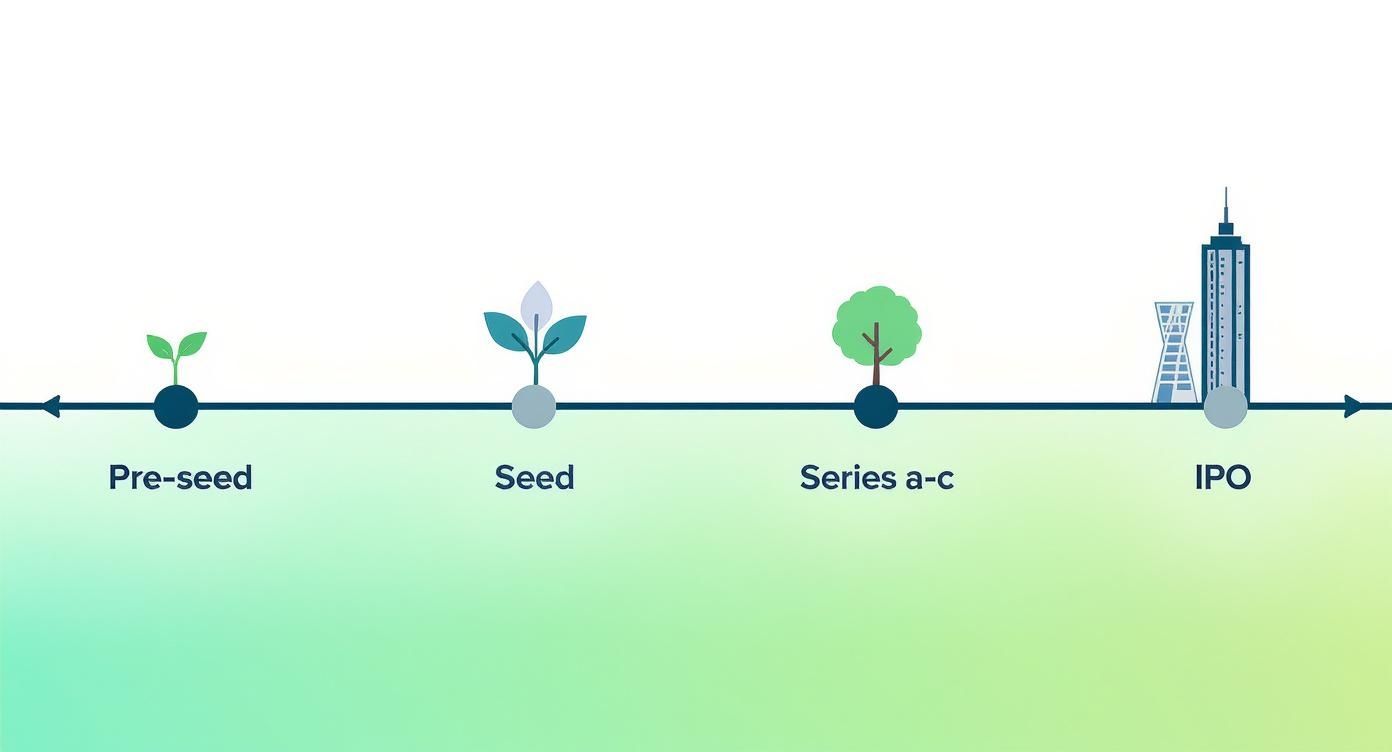
Think of startup funding as building a skyscraper. You don’t build all 100 floors at once. You start with a solid foundation (the Seed round) and then add more levels (Series A, B, C, and so on). Each round of funding provides the materials and manpower needed to reach the next stage of construction. For example, Airbnb raised a modest $600k Seed round to prove its model before raising a $7.2 million Series A to expand.
Your First Look at Startup Funding Rounds
Building a startup is a game of calculated growth, and capital is the fuel. Without it, even the most brilliant ideas fizzle out before they ever get off the ground. This is precisely why startup funding rounds exist—to provide a structured way for founders to get the resources they need to go from a sketch on a napkin to a global force.
Each funding round is a major milestone. It brings new investors into the fold, each with higher expectations for what the company can achieve. This step-by-step approach lets founders raise just enough money for the current phase, which helps them avoid giving away too much of their company (dilution) while they prove their business model. In the early days, it’s all about survival and finding that perfect product-market fit. Later on, the game shifts to aggressive growth and conquering the market.
The Lifecycle of Startup Investment
The path through different funding rounds mirrors a company’s journey from a raw idea to a mature business. It starts with small, early-stage investments to see if an idea has legs and gradually moves toward massive capital injections designed to scale a proven operation.
This market is always in flux, often reflecting bigger economic shifts. For instance, global venture funding saw a significant rebound in Q2 2024, reaching $94 billion, a 19% increase from the previous quarter. This indicates that while investors remain selective, capital is actively being deployed for promising ventures. You can dig into more of these venture funding trends from Crunchbase.
The core idea is simple: raise enough capital to hit the next set of goals that prove your company is worth more. This creates a cycle of building momentum that attracts the next, bigger round of investment.
To give you a clearer picture, here’s a quick overview of how these stages typically break down.
Overview of Startup Funding Stages
This table summarizes the key characteristics of each major funding round, from the initial idea to a company preparing for an IPO.
| Funding Round | Primary Goal | Typical Amount | Company Stage |
|---|---|---|---|
| Pre-Seed | Validate the core idea and build a prototype | $10k – $500k | Ideation / Concept |
| Seed | Find product-market fit and build an early team | $500k – $3M | Early-Stage / Launch |
| Series A | Optimize the business model and start scaling | $3M – $15M | Growth Stage |
| Series B | Aggressively expand and build market share | $15M – $50M | Expansion Stage |
| Series C+ | Dominate the market and prepare for an exit (IPO) | $50M+ | Late-Stage / Pre-IPO |
Each of these stages represents a new level of maturity and requires a different approach from founders and their teams. The infographic below visualizes this journey perfectly.
As you can see, the scale and complexity ramp up significantly at each step. It’s a progression from nurturing a tiny seed of an idea to building a market-leading skyscraper.
Planting the Seed: Pre-Seed and Seed Rounds
Every great company starts with a powerful idea. But an idea alone doesn’t build a business—it needs capital to get off the ground. This is where the earliest stages of funding come in, beginning with the Pre-Seed and Seed rounds. Think of these stages as turning a blueprint into a real, working product.

The Pre-Seed stage is often called the “friends and family” round, and for good reason. The first checks usually come from the founders themselves, their close contacts, or early believers who are betting on the team just as much as the idea. The goal here isn’t about making a profit; it’s about survival and proving the concept can work. This initial cash is almost always used to build a Minimum Viable Product (MVP)—the simplest version of the product you can get into users’ hands for feedback. A classic example is Dropbox, whose famous MVP was just a video demonstrating the product’s functionality, which drove hundreds of thousands of signups.
From Blueprint to Business Validation
Once the MVP is built and shows some early signs of life, the startup is ready for its first official funding stage: the Seed round. This is when the circle widens to include outside investors like angel investors and micro-Venture Capital (VC) firms. They aren’t just writing checks; they’re making a calculated bet that this small startup has the potential to grow into something huge.
At this point, investors are hunting for specific signals that point toward future success:
- A Passionate Founding Team: They want to see founders who live and breathe their industry and have an unwavering commitment to their mission.
- A Massive Market Opportunity: The idea needs to solve a real problem for a lot of people in a market that’s big enough to matter. For instance, a SaaS tool for a niche industry should target a Total Addressable Market (TAM) of at least $1 billion.
- Early Traction: This doesn’t have to be revenue. It could be a growing waitlist, impressive user engagement metrics (like high daily active users), or other signs that customers genuinely want what you’re building.
This initial capital is the lifeblood for a young startup. It’s used to make crucial first hires, refine the product based on user feedback, and begin the critical search for product-market fit—the point where the product and its customers are in perfect sync.
The focus shifts from simply building something to building something people will pay for and recommend. Many founders are navigating this for the first time, which is why understanding the expectations for pre-seed startups is so crucial.
Setting the Stage for Unicorns
While most startups won’t become billion-dollar “unicorns,” this is where every one of them begins. The sheer potential for explosive growth is what attracts early investors, even when the risks are at their absolute highest.
Globally, there are over 1,500 verified unicorns as of mid-2024. After a venture capital boom in 2021 that minted new unicorns at a record pace, the market has settled into a more sustainable rhythm, with investors focusing more on profitability and fundamentals. You can explore more detailed global startup data from Dealroom.co. This initial seed funding is the foundation these giants are built on, paving the way for the bigger funding rounds to come.
Building Momentum with Series A Funding
If the Seed round is about finding a spark, the Series A round is about pouring gasoline on it to build a real fire. This is a massive leap in the life of a startup, moving past the “great idea” phase and into the “proven business” phase. The conversation completely changes from “we think this could work” to “we have the data to prove this works, and now we’re ready to scale.”

Investor expectations get a lot more serious here. Seed investors often bet on a great team and a compelling vision. But Series A investors, who are usually traditional Venture Capital (VC) firms, are betting on hard data. They need to see evidence—cold, hard numbers—that show a clear path to profitability and a business model that’s ready for a major cash injection.
The Metrics That Matter Most
To even get a meeting for a Series A, founders need to show up with strong performance metrics. VCs will put the company’s numbers under a microscope, searching for signs of a healthy, growing business that isn’t just a one-hit wonder. A common benchmark for a SaaS company raising a Series A is reaching $1 million in Annual Recurring Revenue (ARR).
Key performance indicators (KPIs) become the main language of every conversation. While the specifics can vary by industry, a few metrics are almost always front and center:
- Monthly Recurring Revenue (MRR): For any subscription business, this is everything. It shows a stable, predictable income stream that’s on the upswing.
- Customer Acquisition Cost (CAC): How much does it cost to get a new paying customer? A low, efficient CAC proves the company has a solid marketing and sales engine.
- Lifetime Value (LTV): How much revenue will a single customer generate over their entire relationship with the company? A high LTV means customers are valuable and, more importantly, they stick around.
The golden ticket for a Series A round is often a healthy LTV-to-CAC ratio, ideally 3:1 or higher. This simple ratio tells investors that for every dollar spent to get a customer, the business makes at least three dollars back over time. That’s a recipe for profitable growth.
Think about it this way: a SaaS startup that spends $500 to land a new client, who then goes on to generate $2,000 in revenue, has a powerful story to tell. It’s no longer a hopeful guess; it’s a proven economic model ready for fuel.
With a typical Series A round raising between $3 million and $15 million, this money is earmarked for building the core functions of the business. The funds go directly into hiring a dedicated sales team, scaling up marketing campaigns, and beefing up the company’s operational backbone. It’s all about putting the infrastructure in place to handle rapid growth and start grabbing significant market share.
Scaling Aggressively with Series B and C Rounds
Once a startup has nailed its business model and closed a Series A round, the game changes. The focus shifts from fine-tuning the engine to hitting the accelerator. This is where Series B and Series C funding come in—these rounds are all about aggressive, high-speed growth. It’s the phase where a promising company uses major capital injections to become a true force in its market.
The Series B round is really the “market expansion” stage. You’ve proven the product works and that people will pay for it. Now, the goal is to grow, grow, grow. The capital raised here—typically somewhere between $15 million to $50 million—is put to work taking the business to a whole new level. We’re talking about launching in new cities or countries, grabbing a much bigger slice of the market, and sometimes even acquiring smaller competitors to strengthen your position. A great example is Stripe, which used its Series B to expand internationally and launch in the U.K.
The Shift to Market Expansion
Investors jumping in at Series B need to see more than just a good formula. They’re looking for solid proof that the company can actually pull off a massive expansion. The conversation moves past simple growth metrics and into the nitty-gritty of market penetration, how you stack up against the competition, and whether your operations can handle the pressure of scale. Founders have to walk in with a crystal-clear strategy for becoming a dominant player.
If you’re a founder gearing up for this stage, this no-fluff guide for Series B funding is a fantastic resource for understanding what investors are really looking for. Closing a Series B round sends a powerful signal to the market: this isn’t just a startup anymore, it’s a serious contender. For a deeper look, don’t miss our guide on what is series b financing/.
At this point, the cast of investors starts to change. While some of your Series A backers might double down, new faces appear. You’ll see late-stage VCs and growth equity firms entering the picture, and they bring more than just money—they bring experience in scaling companies to a global level.
The current market shows just where the big money is heading. In Q2 2024, late-stage funding accounted for over half of all venture capital dollars invested, highlighting a trend of capital consolidating around established companies ready to scale.
Cementing Dominance with Series C and Beyond
If Series B is about capturing the market, Series C is about locking it down. By now, the company is likely a well-known name in its industry. It’s pulling in serious revenue and has the financial performance to prove it. The objective now is to solidify that number one spot, maybe start gearing up for an IPO, or fund a big new product initiative to keep competitors at bay. For example, a company might raise a Series C to acquire a key technology or a competitor, as Facebook did with Instagram before its IPO.
These two later-stage rounds have very different goals, and it’s important to understand the distinction.
Comparing Series B and Series C Funding Rounds
This table breaks down the key differences between Series B and C, highlighting how a company’s focus and investor expectations evolve as it matures.
| Metric | Series B Focus | Series C Focus |
|---|---|---|
| Primary Goal | Market Expansion & Scaling Operations | Market Dominance & Profitability |
| Company Focus | Growing market share and building the team | Achieving profitability and preparing for exit |
| Investor Type | Late-Stage VCs, Growth Equity | Private Equity, Hedge Funds, Investment Banks |
| Key Metrics | Revenue Growth, Market Penetration | EBITDA, Profit Margins, Market Share |
As you can see, these later rounds are much less about “what if” and much more about “what is.” Investors are poring over detailed financial models, and they expect to see a clear, data-driven path to profitability. Ultimately, they’re looking for a major return on their investment, whether that comes from an acquisition or a successful public offering.
What Investors Look For at Every Funding Stage
Raising capital for a startup isn’t just about having a brilliant idea. It’s about telling the right story to the right people at the right time. What an investor needs to see changes dramatically as a company grows, and if you don’t get this, you’ll struggle to navigate the different startups funding rounds. The pitch that absolutely nails a Seed round will get you laughed out of a Series C meeting.

Think of it like getting a job at different stages of your career. An internship (your Seed round) is all about passion, raw talent, and potential. But when you’re going for that senior executive role (Series C), the board wants to see a proven track record of delivering results, period.
Early-Stage Expectations: It’s All About Vision and Validation
In the early Pre-Seed and Seed days, investors are betting on the jockey, not just the horse. They’re smart enough to know the product will probably change, but they need to believe the founding team can handle whatever comes their way. They’re looking at qualitative signals.
- The Team: Do the founders have a unique, almost unfair, insight into the problem they’re solving? Can they take a punch and get back up? Resilience is everything. A great example is the team behind Slack, which pivoted from a failed gaming company into a communication giant.
- The Vision: How big can this get? Investors are hunting for a 10x return, so the idea needs to be massive enough to make that a possibility.
- Early Traction: Don’t confuse this with revenue. It’s about proof. Proof that a specific group of people is desperate for what you’re building, whether that’s shown through obsessive user engagement or a waitlist that’s growing like a weed.
At this stage, a powerful story is your greatest asset. Investors have to believe in your vision and your ability to pull it off long before the spreadsheets look pretty.
For any stage, investors rely on a clear rationale for their decisions, which is often structured by building a strong investment thesis. This framework is how they keep their evaluations consistent and aligned with their fund’s strategy.
Later-Stage Expectations: Show Me the Metrics and Predictability
Once you start knocking on the door for a Series A and beyond, the conversation flips. It goes from storytelling to spreadsheets. Investors now need to see a business model that is repeatable, scalable, and backed by cold, hard data. The vision still matters, of course, but it has to be grounded in proven metrics.
Due diligence also gets way more intense. Investors will pour over every detail of your business, from your financial statements down to the fine print in your customer contracts. Having a clean, well-organized data room and a solid grasp of your numbers is crucial for getting the deal done without major headaches.
Here’s what they’ll be demanding:
- Solid Financials: This is non-negotiable. They want to see consistent revenue growth, healthy margins, and a sales funnel you can rely on.
- Market Leadership: You need to prove you’re carving out a significant piece of the market and have a moat that protects you from competitors.
- A Clear Path to Exit: Late-stage investors are thinking about their payday. They need to see a realistic path to an IPO or a major acquisition within a 5-7 year horizon.
Common Questions About Startup Funding
Diving into the world of startup funding rounds always brings up a ton of questions. As a founder, getting your head around the details can be the difference between landing the capital you need and hitting a wall. Let’s tackle some of the most common questions that pop up on the fundraising trail.
How Long Does Each Funding Round Take?
This is the big one everyone asks. While there’s no magic number, you should budget for three to six months from the moment you start pitching to when the cash actually lands in your bank account. It’s a marathon, not a sprint. A practical tip: start fundraising when you still have at least six months of runway to avoid negotiating from a position of desperation.
The whole process has a few key stages. First, there’s the prep work—polishing your pitch deck until it shines and building a financial model that can stand up to scrutiny. Then comes the outreach and the endless coffee meetings. If you hook an investor’s interest, they’ll kick off due diligence, which is where they dig into every corner of your business. Only then do you get to a term sheet and the final legal paperwork.
Keep in mind, the market has a huge say in this timeline. When capital is flowing freely, rounds can close surprisingly fast. But when the economy gets shaky, investors get more cautious, and the whole process can really drag out.
What Are the Alternatives to Venture Capital?
Venture capital gets all the headlines, but it’s definitely not the only game in town. In fact, plenty of amazing companies have been built without taking a single dollar from a VC. Mailchimp, for example, bootstrapped its way to a $12 billion acquisition.
Here are a few other paths you can take:
- Bootstrapping: This is where you fund the business yourself, either with your own savings or, ideally, by using the revenue it generates. The upside? You keep 100% ownership and complete control.
- Crowdfunding: If you have a consumer product, platforms like Kickstarter or Indiegogo can be a game-changer. You raise money from the very people who will become your customers, which is a fantastic way to validate your idea.
- Angel Investors: These are wealthy individuals who invest their personal funds into young companies. Angels often bring valuable experience and mentorship to the table and tend to be a bit more flexible than big VC firms.
- Small Business Loans: Good old-fashioned debt. A loan from a bank or a government-backed program lets you keep all your equity, though you will have to pay it back with interest.
- Revenue-Based Financing: This is a neat hybrid option. An investor gives you cash in exchange for a slice of your monthly revenue until a certain amount is repaid. It’s a solid choice for businesses with predictable income who don’t want to give up equity.
The right funding strategy really boils down to your business model, your growth plans, and how much control you’re willing to give up. VC money is rocket fuel, designed for high-risk companies chasing a massive exit.
What Percentage of Startups Raise a Series A?
Making the jump from a Seed round to Series A is one of the toughest challenges a startup will face. There’s a reason people call it the “Series A crunch.”
The numbers tell a pretty sobering story. Historically, only about 20% to 30% of startups that raise a Seed round ever successfully close a Series A. That steep drop-off shows you just how much the expectations ramp up between stages.
To clear that hurdle, you have to prove you’ve found genuine product-market fit. It’s not about the idea anymore; it’s about the execution. Investors want to see a scalable business with solid, repeatable growth in key areas like revenue and user acquisition. They’re looking for a well-oiled machine, not just a promising blueprint.
Are you an agency ready to connect with the next wave of high-growth startups? FundedIQ delivers a curated list of recently funded companies right to your inbox every month. We provide the detailed data and verified contacts you need to stop prospecting and start closing deals. Get your first list of high-intent leads today.