


What Is Ops Technology and How Does It Power Modern Business
"Ops technology" is the backbone of any modern business. It’s the combination of software, tools, and smart processes that a company uses to manage, automate, and fine-tune its internal operations. Think of it as the central nervous system keeping everything from software development to the sales pipeline running without a hitch. For example, when a customer signs up online, ops technology is what automatically creates their account, adds them to the marketing email list, and notifies the sales team for a follow-up—all without manual intervention.
In today's fast-paced market, this kind of integrated system isn't just a "nice-to-have"—it's an absolute must for any company looking to scale efficiently and outmaneuver the competition.
Getting to the Core of Ops Technology
Imagine a growing company as a complex machine. It has dozens, maybe hundreds, of moving parts. Without a way to coordinate them, departments turn into isolated silos, processes start to fail, and critical data gets lost in the shuffle. A practical example is a marketing team generating 500 leads, but only 200 make it to the sales team's CRM due to a manual handoff process, losing potential revenue. Ops technology is the framework that connects all those pieces, making the entire organization work better together.
But it’s not just about buying a bunch of software and calling it a day. It’s a genuine strategic shift. The whole point is to bring together specialized teams, arm them with the right tools, and empower them to solve specific business problems. Their mission is to eliminate friction, automate tasks that no one should be doing manually, and deliver clear data that leads to better decisions.
The Different Flavors of Ops
Operations technology isn't a single, monolithic thing. It shows up in different forms across a business, each one specialized for a particular domain. These functions are absolutely vital for making sure the company's technical efforts and its commercial goals are pulling in the same direction.
- Technical Ops (DevOps, SRE): These are the folks who focus on the systems that build, ship, and maintain the company's products. Their world revolves around speed, reliability, and security. They use technology to reduce the software release cycle from months to mere hours.
- Business Ops (BizOps, RevOps): These teams connect the company's technology directly to revenue and high-level strategy. They're obsessed with optimizing the entire customer journey, from the first marketing touchpoint all the way through to renewal. A RevOps team, for instance, might discover that customers who engage with support within their first 30 days have a 40% higher retention rate.
- People Ops (HR Ops): This area uses tech to make the employee experience smoother. They handle everything from recruiting and onboarding to payroll and performance reviews, aiming to reduce employee churn and improve productivity.
The core idea is simple: use technology to create standardized, repeatable, and scalable processes. When operations are smooth, the business can focus on innovation and growth instead of constantly fighting internal fires.
To give you a clearer picture, let's break down how these functions work in practice.
Core Functions of Modern Ops Technology
| Core Function | Primary Goal | Practical Example |
|---|---|---|
| Automation | Eliminate repetitive manual tasks and reduce human error. | Automating the deployment of new software updates, reducing a 4-hour manual process to a 10-minute automated one. |
| Monitoring & Alerting | Maintain system health and identify issues before they impact users. | Setting up an alert for when a website's page load time exceeds 3 seconds, allowing engineers to fix it before users notice. |
| Data Management | Ensure data is accessible, accurate, and secure across all systems. | Creating a centralized customer data platform (CDP) that gives marketing, sales, and support a single, unified view of every customer. |
| Process Optimization | Improve efficiency and reduce friction in internal workflows. | Streamlining the sales lead handoff from marketing to sales, cutting the average response time to a new lead from 24 hours to 5 minutes. |
| System Integration | Connect disparate tools and platforms to create a unified ecosystem. | Integrating a CRM with an email marketing tool to automatically sync contacts and track campaign engagement. |
Ultimately, each of these functions contributes to a more resilient and efficient organization.
Why It Matters Right Now
In such a competitive market, efficiency is everything. Companies that get ops technology right can simply move faster, make smarter choices, and give their customers a better experience. This operational foundation is what allows a business to scale—it ensures that as you grow, your internal processes don’t crumble under the pressure. For example, a business that automates its order fulfillment can process 1,000 orders per day with the same staff that previously handled 100.
To really get what Ops Technology is all about, it helps to understand its roots, and a big part of that is learning what is DevOps methodology, as it’s a foundational piece of the puzzle. Plus, the insights you get from well-run operations are the bedrock of good strategy. You can dive deeper into that topic in our guide on what is data-driven decision-making. At the end of the day, mastering ops technology is how you build a smarter, more agile, and more profitable company.
The Technical Pillars of Ops Technology

To really get what ops technology is all about, you have to look under the hood at a company's technical teams. This is where the magic happens—where teams work together to make sure products are built, shipped, and run without a hitch. These groups are the bedrock for delivering stable, scalable services that customers rely on.
Let's use an analogy. Think of your company's digital products as a complex, bustling superhighway system. Each of these technical disciplines plays a distinct, yet interconnected, role in keeping the traffic moving.
DevOps: The Highway Architects and Builders
In our analogy, DevOps is the team of architects and construction crews. They’re the ones designing the interchanges and building the roads. Historically, software development (Dev) and IT operations (Ops) were siloed, leading to friction and delays. DevOps tears down that wall, creating a smooth, fast lane from a line of code all the way to a live customer release. The whole point is to move faster and adapt quickly. A practical insight is that elite DevOps teams can deploy code over 200 times more frequently than low-performing teams.
The DevOps mindset revolves around a few core ideas:
- Continuous Integration/Continuous Delivery (CI/CD): This is the automated assembly line for software. Developers merge their code changes frequently, and an automated system takes over to build, test, and prepare the code for release. No more "big bang" deployments.
- Automation: DevOps teams automate just about everything they can, from running tests to spinning up new servers. This slashes manual errors and frees up talented engineers to solve bigger problems.
- Collaboration: More than anything, DevOps is a cultural shift. It’s about shared ownership and open communication, getting everyone to work together toward the same goal instead of pointing fingers.
IT Ops: Paving and Maintaining the Road
If DevOps builds the highway, IT Operations (IT Ops) is the crew that paves the asphalt, paints the lines, and installs the guardrails. They're also on call for ongoing maintenance. Their world is all about the stability, security, and availability of the foundational infrastructure that everything else runs on. For example, they manage network firewalls, perform data backups, and ensure the company's cloud spending doesn't spiral out of control.
IT Ops takes care of the essentials that keep the lights on—from physical servers and cloud instances to networks and security rules. While DevOps is obsessed with the speed of delivery, IT Ops is laser-focused on the reliability of the core systems.
SRE: The Traffic Control System
Finally, we have Site Reliability Engineering (SRE). Think of SRE as the sophisticated, real-time traffic management system for our digital highway. This discipline, born at Google, essentially treats operations as a software problem. The ultimate goal? To engineer software systems that are incredibly reliable and can scale massively.
SREs are the guardians of performance and uptime. They constantly monitor traffic flow, anticipate bottlenecks, and prevent digital traffic jams and crashes, making sure the user experience stays fast and smooth, even on Black Friday. A practical example is an SRE team at an e-commerce site setting a goal for 99.99% uptime, which translates to no more than 52 minutes of downtime per year.
SRE teams live and breathe data and automation to hit their targets. A huge part of this is ensuring the data they rely on is trustworthy, which is where practices like data observability come in. This gives them the visibility to spot potential problems early and stick to their Service Level Objectives (SLOs)—the promises they make about system reliability.
This focus on reliability highlights the importance of the broader operational technology space. In fact, the global Operational Technology (OT) market was valued at $167.4 billion in 2023 and is projected to reach $318.5 billion by 2030, showcasing its rapid growth and importance in the modern economy.
How Ops Technology Drives Revenue and Growth

While the technical side of ops keeps the lights on, the business-focused side is where you see the direct impact on the bottom line. This is where operations move out of the server room and into the boardroom, turning internal processes into powerful tools for boosting revenue.
It's here that disciplines like Business Operations (BizOps), Revenue Operations (RevOps), and People Operations (People Ops) take center stage. Each one uses specialized technology and data to fine-tune a different part of the business, proving that "ops" is absolutely essential in every department.
The Strategic Role of Business Operations
Think of Business Operations, or BizOps, as your company's internal strategy team, but one that lives and breathes data. They’re the ones tackling the big, complex business problems—from figuring out which new market to enter to deciding if a new product is viable. They are the company's navigators, using dashboards and analytics to chart the most profitable path forward.
For example, a BizOps team at a SaaS company might analyze usage data and discover that only 15% of users are engaging with a key feature. They can then build a data-backed case for leadership to either improve the feature's marketing or redesign it, directly impacting customer retention and revenue.
Aligning the Entire Funnel with RevOps
Revenue Operations, or RevOps, is all about knocking down the walls that traditionally separate marketing, sales, and customer success. The objective is to build one smooth, continuous revenue engine that manages the entire customer lifecycle, from their first contact with your brand to their long-term renewal. Companies with a mature RevOps function have been shown to experience 71% higher stock performance than their peers.
A RevOps team does this by unifying the tech stack. They might connect a marketing automation platform like HubSpot with a CRM like Salesforce, creating a single, comprehensive view of every customer's journey. This visibility helps them spot bottlenecks in the sales process, shorten sales cycles, and ultimately increase customer lifetime value. Finding the best CRM for agencies is often the first critical piece of this puzzle.
RevOps isn't just about connecting tools; it's about aligning people, processes, and data around a single goal—maximizing revenue. It treats the revenue funnel as one cohesive system, not a series of disconnected handoffs.
Driving Value Through People Ops
Finally, People Ops uses technology to improve the entire employee experience. By automating the tedious administrative work and using data to boost employee satisfaction, People Ops plays a key role in reducing turnover and building a more engaged, productive team. Platforms like Workday or Lattice help manage everything from onboarding to performance reviews, which frees up HR professionals to focus on more strategic work, like developing talent. A practical insight is that a strong onboarding process can improve new hire retention by 82%, a process often managed and optimized by People Ops technology.
While these ops principles apply everywhere, certain industries are investing more heavily. Research from Future Market Insights shows that sectors like manufacturing, energy, and utilities are the biggest adopters of operational technology, with the United States, China, and Germany leading the way.
A Look Inside the Modern Ops Tech Stack
The theory behind operations really comes alive when you look at the specific software that powers it—what we call the Ops Tech Stack. This isn't just a grab-bag of apps. It's a carefully chosen, interconnected system of tools built to automate, monitor, and fine-tune every part of a business. To truly get a feel for what ops technology is, you have to understand the tools in the toolbox.
The easiest way to make sense of the stack is to group the tools by what they actually do. You start to see how different platforms slot together to build one big, well-oiled operational machine. Each category solves a very specific set of problems for the teams on the ground.
Infrastructure and Monitoring Platforms
At the absolute core of any digital business are the tools that keep the lights on. Think of this category as the digital equivalent of a building's power grid, plumbing, and security system—absolutely essential for your applications to run.
- Infrastructure as a Service (IaaS): This is your raw computing power on demand. Platforms like Amazon Web Services (AWS), Google Cloud Platform (GCP), and Microsoft Azure provide the virtual servers, storage, and networking that modern apps are built on. They let companies spin up or shut down resources in minutes, not weeks.
- Monitoring and Observability: You can't fix what you can't see. Tools like Datadog, New Relic, and Splunk give technical teams x-ray vision into system performance. They track everything from server CPU usage to specific application errors, giving engineers the crucial data they need to keep services up and running.
CI/CD and Automation Engines
This next group of tools acts as the automated assembly line for building software. The whole point is to get new code from a developer's laptop to a live customer as quickly and safely as humanly—or in this case, robotically—possible.
Platforms like Jenkins, GitHub Actions, and CircleCI are the engines of Continuous Integration and Continuous Delivery (CI/CD). They automatically kick off a process to build, test, and deploy code the moment a developer pushes a change.
Here’s a look at a visual workflow in GitHub Actions, one of the most popular CI/CD tools out there.
You can see how automated jobs, like "build" and "test," are chained together. This gives developers instant, clear feedback on whether their latest change is good to go or if it broke something.
CRM and Revenue Tools
Now let's switch gears to the business side. This category is all about managing the entire customer journey, from the first touchpoint to the final sale and beyond. These are the central nervous systems for any RevOps strategy.
- Customer Relationship Management (CRM): It's almost impossible to run a sales or marketing team without a CRM. Platforms like Salesforce and HubSpot are the system of record for tracking leads, managing customer data, and automating outreach.
- Data Enrichment Platforms: A CRM is only as good as the data inside it. That's why many companies use some of the best data enrichment tools to append valuable context—like a company's size, industry, or the technology it uses—to their customer profiles.
HRIS and People Ops Systems
Last but not least, the People Ops stack is designed to make the employee experience seamless, from their first interview to their last day. These tools take the administrative burden off HR, allowing them to focus on the more human side of things, like culture and career growth.
Popular Human Resource Information Systems (HRIS) like Workday, BambooHR, and Lattice are the go-to solutions here. They handle everything from payroll and benefits administration to performance reviews and employee engagement surveys, creating a single source of truth for all people-related data.
Ops Technology Tool Stack Examples
To bring it all together, here’s a quick look at how these tools map to the different Ops disciplines we've discussed. You'll notice some tools, particularly those for monitoring or project management, often serve multiple teams.
| Ops Discipline | Tool Category | Example Platform(s) |
|---|---|---|
| DevOps | CI/CD & Automation | GitHub Actions, Jenkins, GitLab |
| SRE | Monitoring & Observability | Datadog, New Relic, Grafana |
| IT Ops | Service Desk & Asset Mgmt | Jira Service Management, ServiceNow |
| BizOps/RevOps | CRM & Business Intelligence | Salesforce, HubSpot, Tableau |
| HR Ops | HRIS & Payroll | Workday, BambooHR, Gusto |
This table is just a snapshot, of course. The real magic happens when these systems are integrated, sharing data to create a complete, 360-degree view of the business—from server health to customer satisfaction and employee headcount.
Measuring the Impact of Your Ops Technology
Putting an ops tech stack in place is a great start, but the real work is in proving its value. It's not enough to just feel like things are running better. You need hard numbers—Key Performance Indicators (KPIs)—to show that your investment is actually paying off.
The right metrics do more than just justify budgets. They act as your roadmap, showing you where the bottlenecks are and guiding your teams toward real, measurable improvements. While each ops function has its own set of numbers to watch, they all ultimately track the same things: efficiency, speed, and business impact.
Technical Ops KPIs for Speed and Stability
When you look at technical teams like DevOps and SRE, their world revolves around two big questions: How fast can we ship new value, and how reliable are our systems when we do? Their KPIs are all about the health and velocity of the software delivery pipeline.
You'll often hear them talk about metrics like:
- Deployment Frequency: How often are we successfully pushing new code to our users? The best teams do this multiple times a day, which is a clear sign that their automation and processes are dialed in.
- Mean Time to Recovery (MTTR): When something inevitably breaks, how long does it take us to fix it? A low MTTR is the gold standard, showing your system is resilient and your team can react fast. For elite teams, this is often less than one hour.
- Change Failure Rate: What percentage of our deployments cause a problem that needs an immediate fix? A low number here (ideally under 15%) means you're shipping quality code and have solid testing practices in place.
Business Ops KPIs for Revenue and Efficiency
Shift over to the business side, and the conversation changes from system uptime to bottom-line growth. RevOps, SalesOps, and BizOps teams are focused on KPIs that connect directly to financial performance and how effectively the company acquires and keeps customers.
This is where you see how all the pieces of the puzzle—from development pipelines to customer relationship management—fit together to form a cohesive operational system.
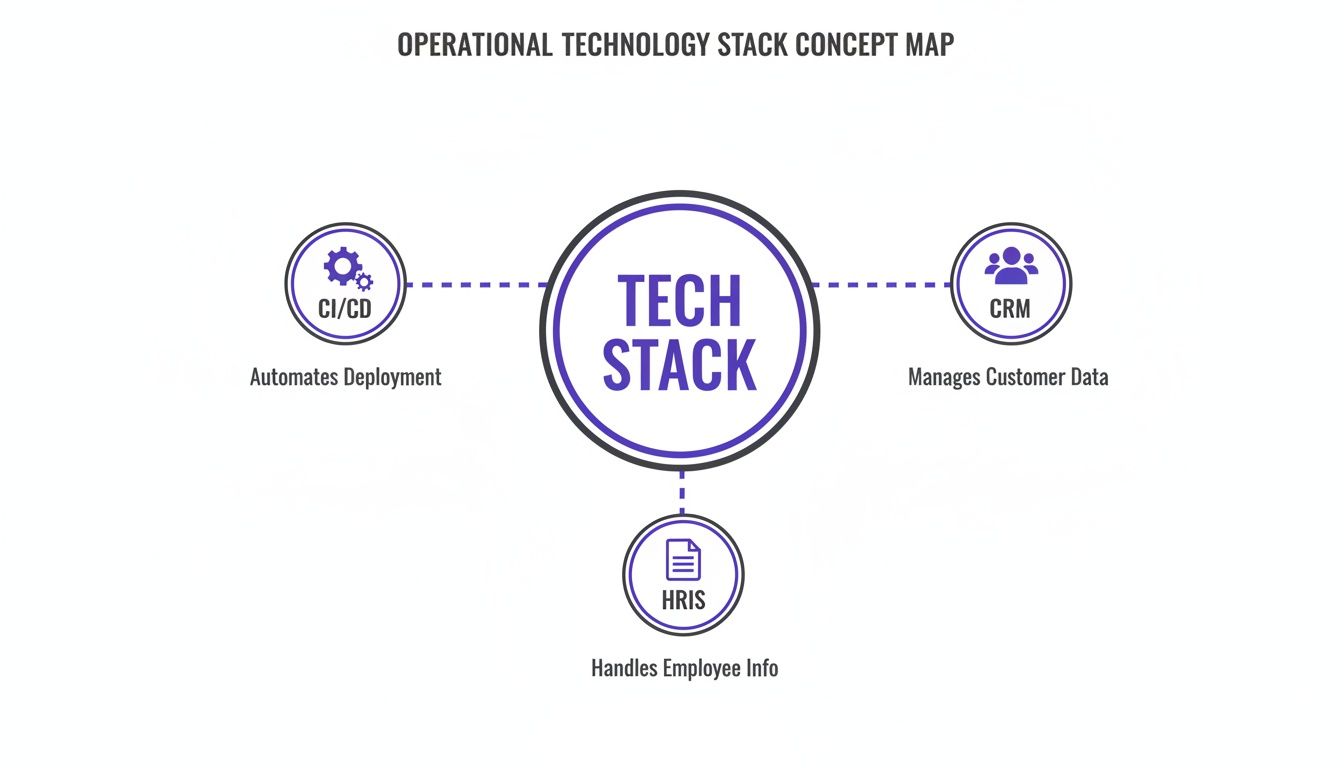
As the map shows, technology is the connective tissue that links product development, customer interactions, and internal processes.
The goal is to draw a straight line from operational activity to a business outcome. When you track the right numbers, you prove that your ops technology isn't just a cost center—it's an engine for growth.
Here are a few of the most critical KPIs they're watching:
- Customer Acquisition Cost (CAC): How much do we spend on sales and marketing, on average, to win a new customer? A core job for RevOps is to drive this number down by improving targeting and process efficiency.
- Sales Cycle Length: What’s the average time from the first conversation with a lead to a signed contract? Ops tech is key to shortening this by automating tasks and arming sales teams with better data. Reducing this by just 10% can significantly boost quarterly revenue.
- Lead Conversion Rate: Of all the leads we generate, what percentage actually become paying customers? This is a direct measure of how efficient your entire revenue funnel is.
A Practical Guide to Implementing Ops Technology
So, you’re ready to build a real operations foundation. The good news is you don’t have to tear everything down and start from scratch. In fact, that’s usually the worst way to go about it.
A phased, practical approach always wins. The best starting point? Find your single biggest, most frustrating operational bottleneck and attack that first.
Is your sales team drowning in manual data entry, spending up to 20% of their time on non-selling activities? A CRM that actually works with your process could be the perfect first project. Are you burning days every month pulling together client reports? Maybe it's time for a business intelligence tool. The key is to solve one real problem and show everyone the immediate value.
Starting Small and Scaling Smart
When you’re picking that first tool, keep two words in mind: scalability and integration. You need software that can grow with you and, just as importantly, play nice with the other systems you'll inevitably add down the road. This simple foresight helps you avoid creating a bunch of disconnected data islands that just make more work for everyone.
Once you have a tool, the mission is automation. You want to get rid of the repetitive, soul-crushing tasks that lead to burnout and human error. Free up your team's brainpower for work that actually requires a human.
Here are a few practical first steps:
- For a startup: Automate lead flow. When a lead fills out a form on your website, make sure it instantly lands in your CRM and gets assigned to the right salesperson with a notification. No more copy-pasting from emails.
- For an agency: Build automated reporting dashboards. Set them up to pull data directly from your various client platforms (like Google Analytics and social media ads), turning a multi-day reporting nightmare into a process that runs itself.
The secret to getting this right is scoring a quick win. Automate one high-friction process, and you'll build the momentum and team buy-in you need for every ops investment that follows.
Integrating Security from Day One
As you start connecting systems and automating workflows, security can't be an afterthought. It has to be part of the plan from the very beginning. This idea of weaving security into every step is often called DevSecOps, and it's essential for building systems people can trust.
This means thinking about who can access what data, how that data is protected, and how you’ll handle potential weak spots at every stage. A practical step is implementing role-based access control (RBAC) in your CRM from day one, ensuring a sales rep can’t accidentally delete marketing campaign data.
This isn’t just a good idea; it’s becoming critical. The market for what’s called Operational Technology security is expected to jump from USD 23.47 billion in 2025 to USD 50.29 billion by 2030, a huge leap driven by a spike in cyberattacks and new regulations. You can explore more about the OT security market to see how fast this space is moving. Locking down your ops tech isn't just about protecting your business—it's about protecting your customers' data as you grow.
Got Questions? We've Got Answers
Let's tackle some of the most common questions people have when they start digging into ops technology.
What's the Real Difference Between IT Ops and DevOps?
Think of it this way: IT Ops is like the crew that keeps a concert venue running perfectly—the lights stay on, the sound system works, and the doors open on time. They focus on keeping the core infrastructure stable, reliable, and secure. Their main job is to prevent things from breaking.
DevOps, on the other hand, is the road crew for the band. They're all about getting new songs (software features) out to the audience (users) as quickly and flawlessly as possible. They build automated systems to set up the stage, test the equipment, and tear it all down, ready for the next show. It's a culture that brings the developers (the band) and the operations team (the venue crew) together to deliver a better show, faster.
Is Ops Technology Overkill for a Small Business?
Not at all. In fact, it's one of the smartest things a small business can do. You don't need a massive "RevOps" department to see the benefits.
Getting a CRM in place early on stops you from managing leads on a spreadsheet, which always ends in chaos. Setting up a simple automated testing pipeline for your app, even with a single developer, catches bugs before your customers do.
The real secret is to start small. Find the most annoying, repetitive task you're currently doing and find a tool to fix it. This proactive approach helps you avoid "operational debt"—those messy, manual workarounds that become a nightmare to untangle once you start growing.
How on Earth Do I Pick the Right Tools?
It’s easy to get distracted by shiny new software. The key is to ignore the hype and focus on your actual problem.
- Find the Bottleneck: First, map out your current process. Where does everything slow down or break? Is it the endless copy-pasting between your sales and finance apps? Or maybe the reporting that takes half a day to compile? Pinpoint that one major headache.
- Look for a Fix, Not a Feature: Search for tools designed to solve that specific problem. The most important feature to look for is how well it plays with the software you already use. Great integrations are non-negotiable.
- Try Before You Buy: Narrow it down to a couple of options and put them to the test. Make sure they have a responsive support team and a pricing plan that won’t break the bank as you grow. Always, always run a free trial with the team that will actually be using it before you sign anything.
Ready to stop guessing and start targeting startups with fresh funding? FundedIQ delivers hand-curated lists of high-intent prospects right to your inbox, complete with verified contacts and critical buying signals. Start connecting with funded startups today.